

Robert Half (RHI) Following Margin Pressure Why Valuation Is Back In Focus
Robert Half Inc. RHI | 0.00 |
Profitability Concerns Put Robert Half Stock in Focus
Fresh commentary on shrinking profit margins at Robert Half (RHI), including falling earnings per share alongside revenue growth, has refocused attention on how these profitability pressures may be influencing current sentiment around the stock.
Despite the pressure on margins, Robert Half’s share price has moved sharply, with a 7 day share price return of 15.46% and a year to date share price return of 50.55%. However, the 5 year total shareholder return is down 47.63%, suggesting recent momentum contrasts with a much weaker longer term experience.
If you are weighing this rebound against other opportunities, it might be a good time to see what else is moving and check out 18 top founder-led companies
For Robert Half, a 50.55% year to date share price gain alongside shrinking profit margins raises a simple tension: are buyers reacting to a stronger underlying business, or has sentiment simply swung too far the other way as valuation resets?
Most Popular Narrative: 38% Overvalued
Compared with the Simply Wall St fair value estimate of $29.89, Robert Half’s last close at $41.16 reflects a clear valuation gap that the most followed narrative tries to explain through detailed growth, margin and risk assumptions.
Persistent declines in revenues (down 7% YoY in Q2 2025; Talent Solutions revenues down 11% YoY; flat to declining Protiviti revenues projected), along with cautious third-quarter guidance (8% lower YoY at midpoint) indicate ongoing difficulty in regaining growth momentum, risking prolonged revenue stagnation or contraction.
Want to understand why this narrative still assigns a higher fair value to Robert Half than many analyst targets? The answer blends modest revenue growth, improving margins and a future earnings multiple that is lower than many peers today. The exact mix of these inputs matters far more than any single headline.
Result: Fair Value of $29.89 (OVERVALUED)
However, that story can quickly change if revenue weakness persists alongside higher SG&A costs, or if Protiviti struggles to win larger, higher margin consulting work.
Another View on Robert Half’s Valuation
The fair value narrative pegs Robert Half at $29.89 and calls the stock overvalued, but our DCF model presents a different picture with an estimate of $62.07 per share. That gap frames a simple question for you: are current worries about margins being overdone, or is the cash flow model too optimistic?
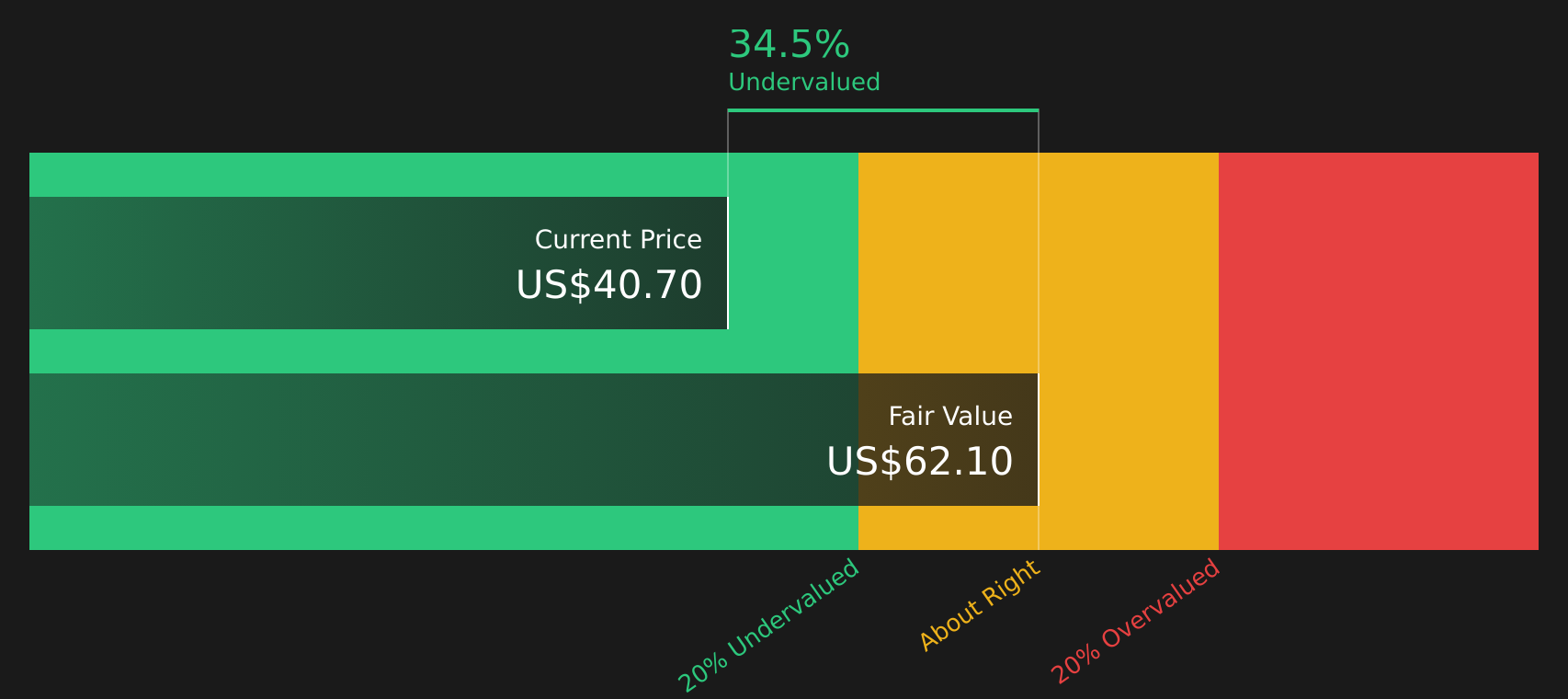
Simply Wall St performs a discounted cash flow (DCF) on every stock in the world every day (check out Robert Half for example). We show the entire calculation in full. You can track the result in your watchlist or portfolio and be alerted when this changes, or use our stock screener to discover 50 high quality undervalued stocks. If you save a screener we even alert you when new companies match - so you never miss a potential opportunity.
Next Steps
If the mixed sentiment around Robert Half feels unresolved, now is a good time to review the underlying data yourself and weigh both sides of the story. You can start with 2 key rewards and 2 important warning signs.
Looking for more investment ideas beyond Robert Half?
Do not stop with Robert Half. Widen your research across sectors and styles so you can compare today’s opportunity with other stocks that may better fit your goals.
- Target potential bargains by scanning companies with solid fundamentals using the 50 high quality undervalued stocks.
- Lock in potential income streams by reviewing stocks highlighted in the 9 dividend fortresses.
- Prioritise capital preservation by focusing on companies surfaced in the 81 resilient stocks with low risk scores.
This article by Simply Wall St is general in nature. We provide commentary based on historical data and analyst forecasts only using an unbiased methodology and our articles are not intended to be financial advice. It does not constitute a recommendation to buy or sell any stock, and does not take account of your objectives, or your financial situation. We aim to bring you long-term focused analysis driven by fundamental data. Note that our analysis may not factor in the latest price-sensitive company announcements or qualitative material. Simply Wall St has no position in any stocks mentioned.