
Should ADP’s Steady Payroll Gains Prompt Investors To Rethink Its Role As A Labor-Market Barometer?
Automatic Data Processing, Inc. ADP | 204.01 | +1.36% |
- In late March 2026, Automatic Data Processing reported its fourth consecutive month of positive private-sector payroll growth, ahead of the government’s March Employment Situation report that was expected to show 45K new jobs added and unemployment rising to 4.5%, the highest since September 2021.
- This consistent payroll expansion underscored ADP’s role as an early barometer of labor-market conditions, drawing attention to how its employment data can shape expectations for broader economic reports and corporate planning.
- With ADP’s fourth straight month of positive private-sector payrolls in focus, we’ll examine how this reinforces and potentially reshapes its investment narrative.
The future of work is here. Discover the 33 top robotics and automation stocks leading the charge in AI-driven automation and industrial transformation.
Automatic Data Processing Investment Narrative Recap
To own ADP, you generally need to believe in the durability of outsourced payroll and HCM services and the company’s ability to keep deepening client relationships through its platforms and data. The fourth straight month of positive private sector payrolls supports near term client activity, but it does not materially change the key catalyst of product adoption or the main risk around slower bookings and moderating pay per control trends.
The recent launch of ADP’s new AI agent Marketplace in March 2026 feels especially relevant here, because it ties ADP’s rich employment data directly into tools that can automate HR workflows and insights. As employers watch payroll and employment reports more closely, these AI driven agents may help reinforce ADP’s role in clients’ planning processes and support the broader catalyst of adoption for Lyric, Workforce Now Next Gen and ADP Assist.
Yet beneath resilient payroll prints, there is a risk investors should be aware of around slowing U.S. payroll growth and potential pressure on ADP’s organic revenue...
Automatic Data Processing’s narrative projects $24.5 billion revenue and $5.1 billion earnings by 2029. This implies 4.9% yearly revenue growth and an earnings increase of about $0.9 billion from $4.2 billion today.
Uncover how Automatic Data Processing's forecasts yield a $271.40 fair value, a 34% upside to its current price.
Exploring Other Perspectives
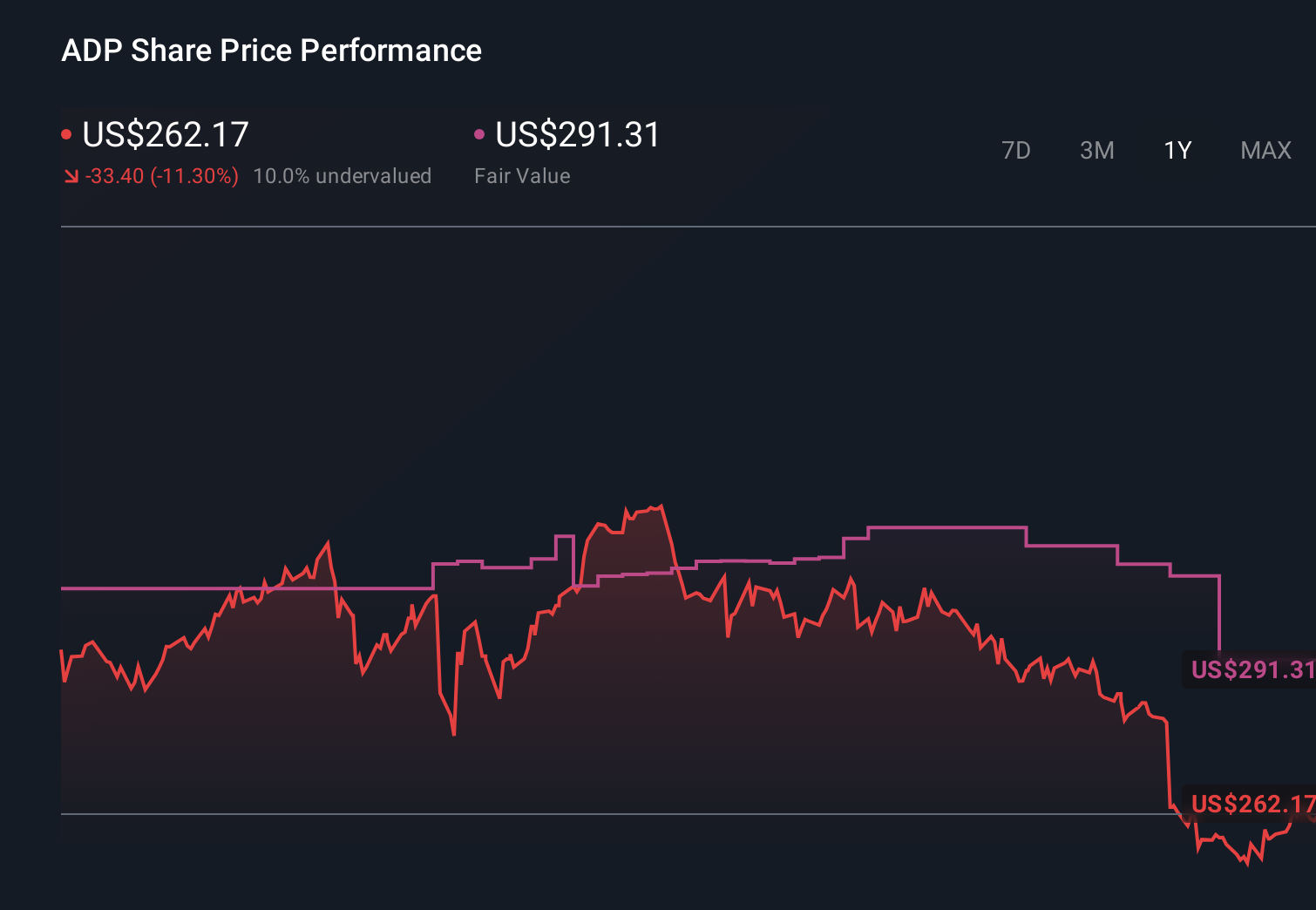
Some of the lowest ranked analysts were already cautious, assuming revenue would grow only about 4.9 percent annually to roughly US$24.5 billion and earnings to about US$5.0 billion by 2029, so this latest labor data could either soften or strengthen their view compared with concerns about slower U.S. payroll growth and pay per control trends.
Explore 5 other fair value estimates on Automatic Data Processing - why the stock might be worth over 2x more than the current price!
Form Your Own Verdict
Don't just follow the ticker - dig into the data and build a conviction that's truly your own.
- A great starting point for your Automatic Data Processing research is our analysis highlighting 5 key rewards that could impact your investment decision.
- Our free Automatic Data Processing research report provides a comprehensive fundamental analysis summarized in a single visual - the Snowflake - making it easy to evaluate Automatic Data Processing's overall financial health at a glance.
Contemplating Other Strategies?
Markets shift fast. These stocks won't stay hidden for long. Get the list while it matters:
- Outshine the giants: these 21 early-stage AI stocks could fund your retirement.
- This technology could replace computers: discover 23 stocks that are working to make quantum computing a reality.
- Find 58 companies with promising cash flow potential yet trading below their fair value.
This article by Simply Wall St is general in nature. We provide commentary based on historical data and analyst forecasts only using an unbiased methodology and our articles are not intended to be financial advice. It does not constitute a recommendation to buy or sell any stock, and does not take account of your objectives, or your financial situation. We aim to bring you long-term focused analysis driven by fundamental data. Note that our analysis may not factor in the latest price-sensitive company announcements or qualitative material. Simply Wall St has no position in any stocks mentioned.