

Should Diebold Nixdorf’s (DBD) Shift Into Defensive Russell Indices Require Action From Investors?
Diebold Nixdorf Inc DBD | 0.00 |
- On 27 June 2026, Diebold Nixdorf, Incorporated was removed from several Russell value-oriented benchmarks but added to the Russell 2000 Defensive and Russell 2000 Growth-Defensive indices, reflecting a reclassification of the stock’s style and risk profile.
- This broad reshuffling across multiple Russell indices can alter how index-tracking funds and style-focused investors engage with Diebold Nixdorf, potentially reshaping its shareholder base and trading characteristics.
- We’ll now examine how Diebold Nixdorf’s shift from value benchmarks into defensive Russell indices may influence its existing investment narrative.
Outshine the giants: these 15 early-stage AI stocks could fund your retirement.
Diebold Nixdorf Investment Narrative Recap
To own Diebold Nixdorf today, you need to believe its shift toward software, services, and branch / retail automation can offset structural pressure on cash and ATM usage. The Russell move from value to defensive indices mostly affects who holds the stock, rather than the underlying business. It may nudge trading patterns in the short term, but it does not materially change the key near term catalyst around execution on higher margin services, or the main risk from long term ATM demand erosion.
The most relevant recent update here is Diebold Nixdorf’s Q1 2026 earnings, where the company reported revenue of US$891.8 million and net income of US$5.0 million. These results underpin the current narrative that operational restructuring and higher value contracts are supporting profitability, which ties directly into why index providers now classify the shares as more “defensive.” How consistently Diebold Nixdorf can extend this earnings profile will matter far more than where it sits inside Russell style buckets.
Yet beneath the defensive label, investors should be aware that the long term shift to cashless payments still raises questions about...
Diebold Nixdorf's narrative projects $4.1 billion revenue and $333.6 million earnings by 2029. This requires 2.9% yearly revenue growth and about a $239 million earnings increase from $94.6 million today.
Uncover how Diebold Nixdorf's forecasts yield a $96.67 fair value, a 16% upside to its current price.
Exploring Other Perspectives
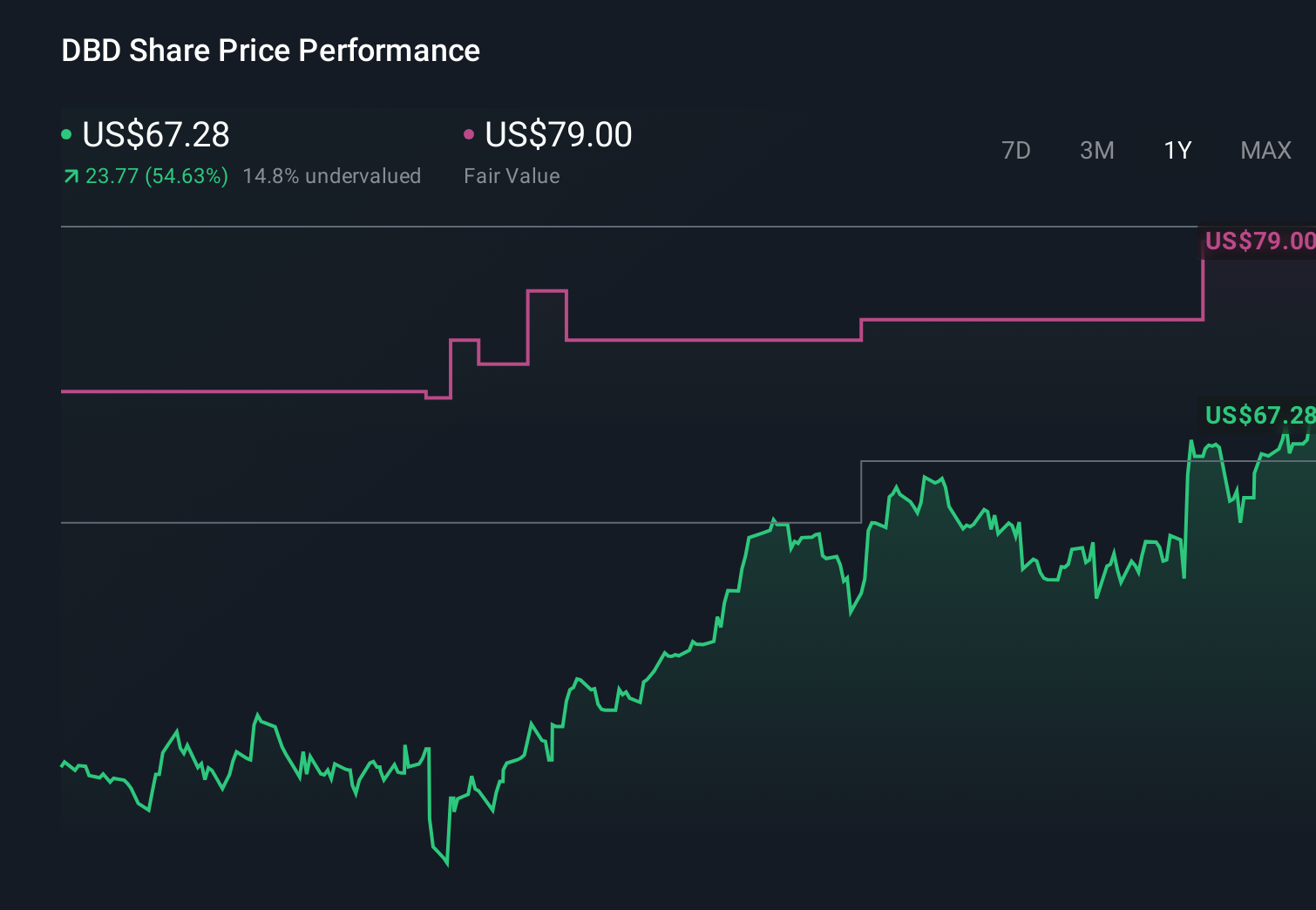
Compared with the baseline view, the most optimistic analysts were baking in a very different story, with revenue reaching about US$4.3 billion and earnings of roughly US$353.9 million by 2029. In light of the Russell style reclassification and the risk that ATM demand could weaken faster than expected, you may find that these bullish expectations and the focus on secure transaction infrastructure highlight just how wide opinion can be and why it is worth weighing several competing narratives before you decide what to believe.
Explore 5 other fair value estimates on Diebold Nixdorf - why the stock might be a potential multi-bagger!
Decide For Yourself
Don't just follow the ticker - dig into the data and build a conviction that's truly your own.
- A great starting point for your Diebold Nixdorf research is our analysis highlighting 3 key rewards and 2 important warning signs that could impact your investment decision.
- Our free Diebold Nixdorf research report provides a comprehensive fundamental analysis summarized in a single visual - the Snowflake - making it easy to evaluate Diebold Nixdorf's overall financial health at a glance.
Looking For Alternative Opportunities?
Opportunities like this don't last. These are today's most promising picks. Check them out now:
- Uncover the next big thing with 21 elite penny stocks that balance risk and reward.
- The future of work is here. Discover the 29 top robotics and automation stocks leading the charge in AI-driven automation and industrial transformation.
- We've uncovered the 8 dividend fortresses yielding 5%+ that don't just survive market storms, but thrive in them.
This article by Simply Wall St is general in nature. We provide commentary based on historical data and analyst forecasts only using an unbiased methodology and our articles are not intended to be financial advice. It does not constitute a recommendation to buy or sell any stock, and does not take account of your objectives, or your financial situation. We aim to bring you long-term focused analysis driven by fundamental data. Note that our analysis may not factor in the latest price-sensitive company announcements or qualitative material. Simply Wall St has no position in any stocks mentioned.