

Should Disney’s (DIS) Parks Momentum and NFL Deal Reframe How Investors View Its Streaming Strategy?
Walt Disney Company DIS | 0.00 |
- In recent weeks, The Walt Disney Company has ended its NFL Network blackout with Comcast, reported improving parks attendance and guest spending, and announced leadership changes including Andy Shu as head of commerce for Disney+ Asia Pacific and Joss Hastings as Senior Vice President of Marketing for Disney Consumer Products, now under Disney Entertainment – Studios.
- Together, stronger parks performance, renewed leverage in sports distribution, and new streaming and consumer products leadership underscore how Disney is reshaping key profit engines across its ecosystem.
- We’ll now examine how stronger parks performance and capacity trends could influence Disney’s existing investment narrative around experiences and streaming.
Invest in the nuclear renaissance through our list of 92 elite nuclear energy infrastructure plays powering the global AI revolution.
Walt Disney Investment Narrative Recap
To own Disney, you typically need to believe its core engines of parks, content, and streaming can work together to grow earnings over time, despite uneven performance in each. Recent signs of improving parks attendance and spending support the near term catalyst around Experiences, while the biggest current risk remains high content and expansion spending that may not be fully offset if consumer demand or engagement softens. The Comcast NFL settlement does not appear to materially change that risk reward balance.
Among the latest announcements, the most relevant is the report that new park and cruise capacity is filling while guests spend more per visit, with domestic park attendance turning from decline to growth in fiscal Q3 2026. For investors focused on catalysts, this ties directly into Disney’s ongoing investments in Villains Land, Avengers Campus expansion, and the growing cruise fleet, which all depend on sustaining healthy demand and per guest monetization to support the broader streaming and IP ecosystem.
Yet even as parks trends look better, investors should be aware that rising sports rights, content, and expansion costs could still pressure margins if...
Walt Disney's narrative projects $112.8 billion revenue and $13.1 billion earnings by 2029. This requires 5.1% yearly revenue growth and about a $1.9 billion earnings increase from $11.2 billion today.
Uncover how Walt Disney's forecasts yield a $126.74 fair value, a 18% upside to its current price.
Exploring Other Perspectives
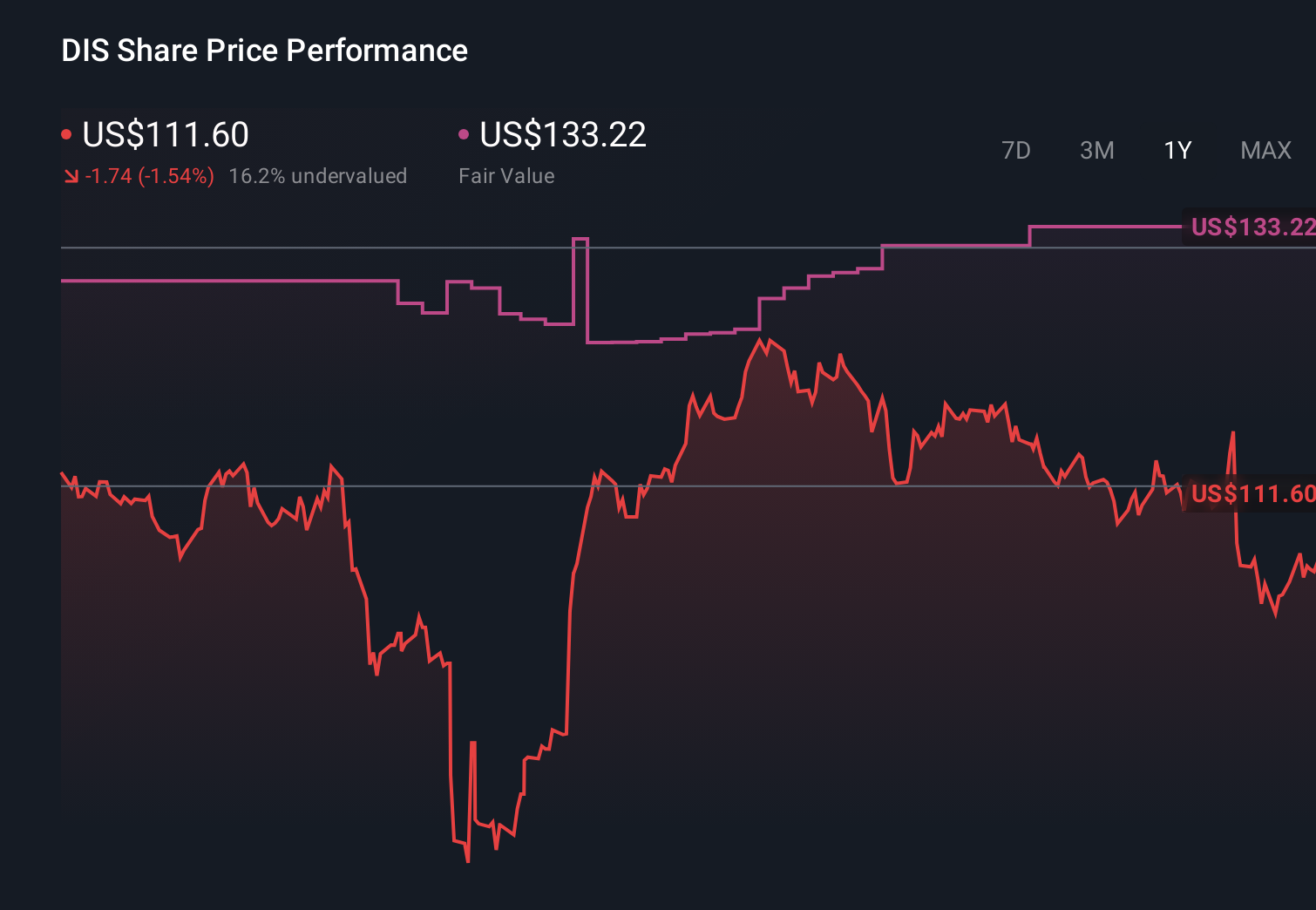
Six Simply Wall St Community fair value estimates cluster between US$109.38 and US$134.63, showing how far opinions can stretch on Disney. Against that backdrop, the risk that heavy sports rights and expansion spending might not be matched by revenue growth is a key issue you should weigh when comparing these different views on the company’s prospects.
Explore 6 other fair value estimates on Walt Disney - why the stock might be worth as much as 25% more than the current price!
Form Your Own Verdict
Don't just follow the ticker - dig into the data and build a conviction that's truly your own.
- A great starting point for your Walt Disney research is our analysis highlighting 2 key rewards and 1 important warning sign that could impact your investment decision.
- Our free Walt Disney research report provides a comprehensive fundamental analysis summarized in a single visual - the Snowflake - making it easy to evaluate Walt Disney's overall financial health at a glance.
Seeking Other Investments?
Don't miss your shot at the next 10-bagger. Our latest stock picks just dropped:
- Uncover the next big thing with 22 elite penny stocks that balance risk and reward.
- We've uncovered the 12 dividend fortresses yielding 5%+ that don't just survive market storms, but thrive in them.
- AI is about to change healthcare. These 41 stocks are working on everything from early diagnostics to drug discovery. The best part - they are all under $10b in market cap - there's still time to get in early.
This article by Simply Wall St is general in nature. We provide commentary based on historical data and analyst forecasts only using an unbiased methodology and our articles are not intended to be financial advice. It does not constitute a recommendation to buy or sell any stock, and does not take account of your objectives, or your financial situation. We aim to bring you long-term focused analysis driven by fundamental data. Note that our analysis may not factor in the latest price-sensitive company announcements or qualitative material. Simply Wall St has no position in any stocks mentioned.