

Should Federal Backing for Rare Earths Shift Peabody Energy’s (BTU) Coal‑Centric Investment Narrative?
Peabody Energy BTU | 0.00 |
- Earlier this month, Peabody Energy announced that the U.S. Department of Energy selected it for funding to advance rare earth element and critical mineral production from its extensive Powder River Basin resource base in Wyoming.
- This support, alongside a Wyoming Energy Authority grant, highlights Peabody’s effort to leverage its coal-mining scale and infrastructure to help build a more secure domestic supply of materials important for U.S. energy, technology and national security goals.
- Next, we’ll examine how this federal backing for rare earth and critical mineral recovery could reshape Peabody’s coal‑focused investment narrative.
Capitalize on the AI infrastructure supercycle with our selection of the 54 best 'picks and shovels' of the AI gold rush converting record-breaking demand into massive cash flow.
Peabody Energy Investment Narrative Recap
To own Peabody today, you have to believe its coal assets can still earn acceptable returns while it gradually builds new profit streams around them. The rare earth and critical minerals funding is a potential early step in that direction, but in the near term the key catalyst remains coal demand and pricing, while the biggest risk is that decarbonization and regulation continue to squeeze coal volumes and margins faster than Peabody can adapt.
Against that backdrop, the recent expansion and extension of Peabody’s revolving credit facility to US$400,000,000 through 2030 matters more immediately than the rare earth headline. It directly affects liquidity and financial flexibility at a time when the company is loss making, carrying sizable environmental and reclamation obligations, and still returning cash via dividends, which together shape how resilient Peabody can be if coal markets weaken further.
Yet even with new mineral opportunities emerging, investors should be aware that Peabody’s large fixed costs and reclamation liabilities could still...
Peabody Energy's narrative projects $5.2 billion revenue and $729.0 million earnings by 2029. This requires 10.1% yearly revenue growth and an earnings increase of about $848.6 million from -$119.6 million today.
Uncover how Peabody Energy's forecasts yield a $32.83 fair value, a 43% upside to its current price.
Exploring Other Perspectives
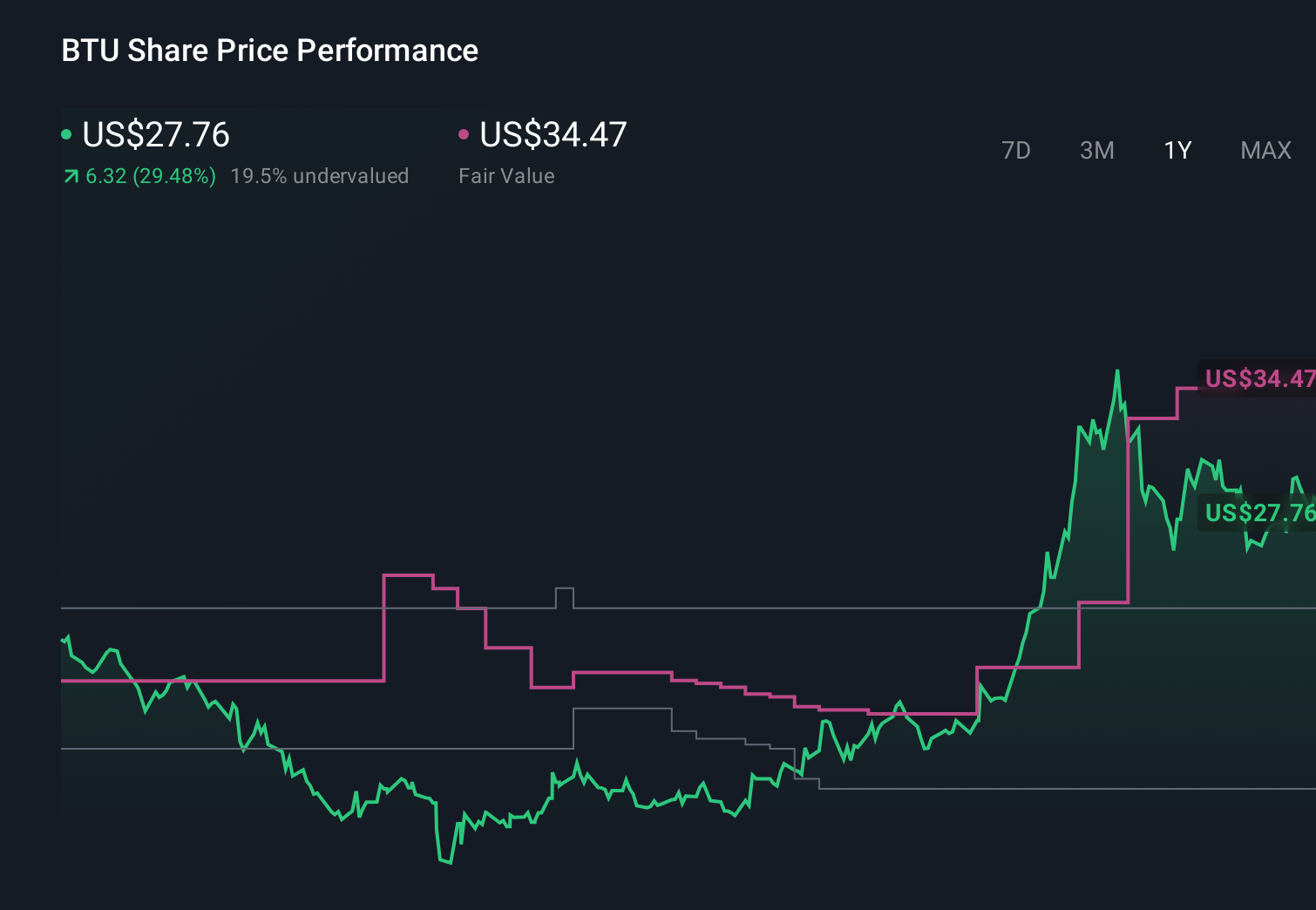
Some analysts are much more cautious, even before this news, assuming revenue of about US$4.5 billion and earnings near US$529 million by 2029, and seeing global decarbonization as a structural headwind that could offset benefits from new projects like rare earth recovery.
Explore 6 other fair value estimates on Peabody Energy - why the stock might be worth just $30.00!
Form Your Own Verdict
Disagree with existing narratives? Extraordinary investment returns rarely come from following the herd, so go with your instincts.
- A great starting point for your Peabody Energy research is our analysis highlighting 3 key rewards that could impact your investment decision.
- Our free Peabody Energy research report provides a comprehensive fundamental analysis summarized in a single visual - the Snowflake - making it easy to evaluate Peabody Energy's overall financial health at a glance.
Ready To Venture Into Other Investment Styles?
Early movers are already taking notice. See the stocks they're targeting before they've flown the coop:
- AI is about to change healthcare. These 39 stocks are working on everything from early diagnostics to drug discovery. The best part - they are all under $10b in market cap - there's still time to get in early.
- Uncover the next big thing with 20 elite penny stocks that balance risk and reward.
- We've uncovered the 9 dividend fortresses yielding 5%+ that don't just survive market storms, but thrive in them.
This article by Simply Wall St is general in nature. We provide commentary based on historical data and analyst forecasts only using an unbiased methodology and our articles are not intended to be financial advice. It does not constitute a recommendation to buy or sell any stock, and does not take account of your objectives, or your financial situation. We aim to bring you long-term focused analysis driven by fundamental data. Note that our analysis may not factor in the latest price-sensitive company announcements or qualitative material. Simply Wall St has no position in any stocks mentioned.