

Should HCA’s Governance Shifts and Shelf Filing Reframe How Investors View Its Long-Term Capital Strategy (HCA)?
HCA Healthcare Inc HCA | 0.00 |
- In April 2026, HCA Healthcare held its annual shareholder meeting, reported voting results that rejected two shareholder proposals, announced a leadership change in marketing and corporate affairs, and filed an omnibus shelf registration for common stock, preferred stock, and debt securities.
- These governance, leadership, and financing developments come alongside HCA’s continued emphasis on nursing excellence and community partnerships, highlighting how corporate decisions intersect with workforce priorities and long-term capital planning.
- Next, we’ll examine how HCA’s reaffirmed full-year guidance and governance decisions, including the failed written-consent proposal, influence its investment narrative.
Capitalize on the AI infrastructure supercycle with our selection of the 40 best 'picks and shovels' of the AI gold rush converting record-breaking demand into massive cash flow.
HCA Healthcare Investment Narrative Recap
To own HCA Healthcare, you need to be comfortable with a large, debt‑heavy hospital operator whose story hinges on sustaining patient volume growth while protecting margins. The latest shareholder votes, leadership change in marketing, and new shelf registration do not materially alter the near term focus on execution against reaffirmed 2026 guidance or the key risk from evolving federal policy and reimbursement pressures.
The omnibus shelf registration for common stock, preferred stock, and debt stands out here, as it shapes HCA’s room to fund future growth projects or refinance obligations. For investors watching volume trends, cost control and capital allocation, this added financing flexibility sits alongside active buybacks and ongoing hospital expansion as part of the same capital planning picture.
Yet even with these positives, investors should be alert to how shifting federal policy could still affect HCA’s revenue stability and...
HCA Healthcare's narrative projects $88.7 billion revenue and $7.6 billion earnings by 2029. This requires 5.1% yearly revenue growth and about a $0.8 billion earnings increase from $6.8 billion today.
Uncover how HCA Healthcare's forecasts yield a $535.00 fair value, a 25% upside to its current price.
Exploring Other Perspectives
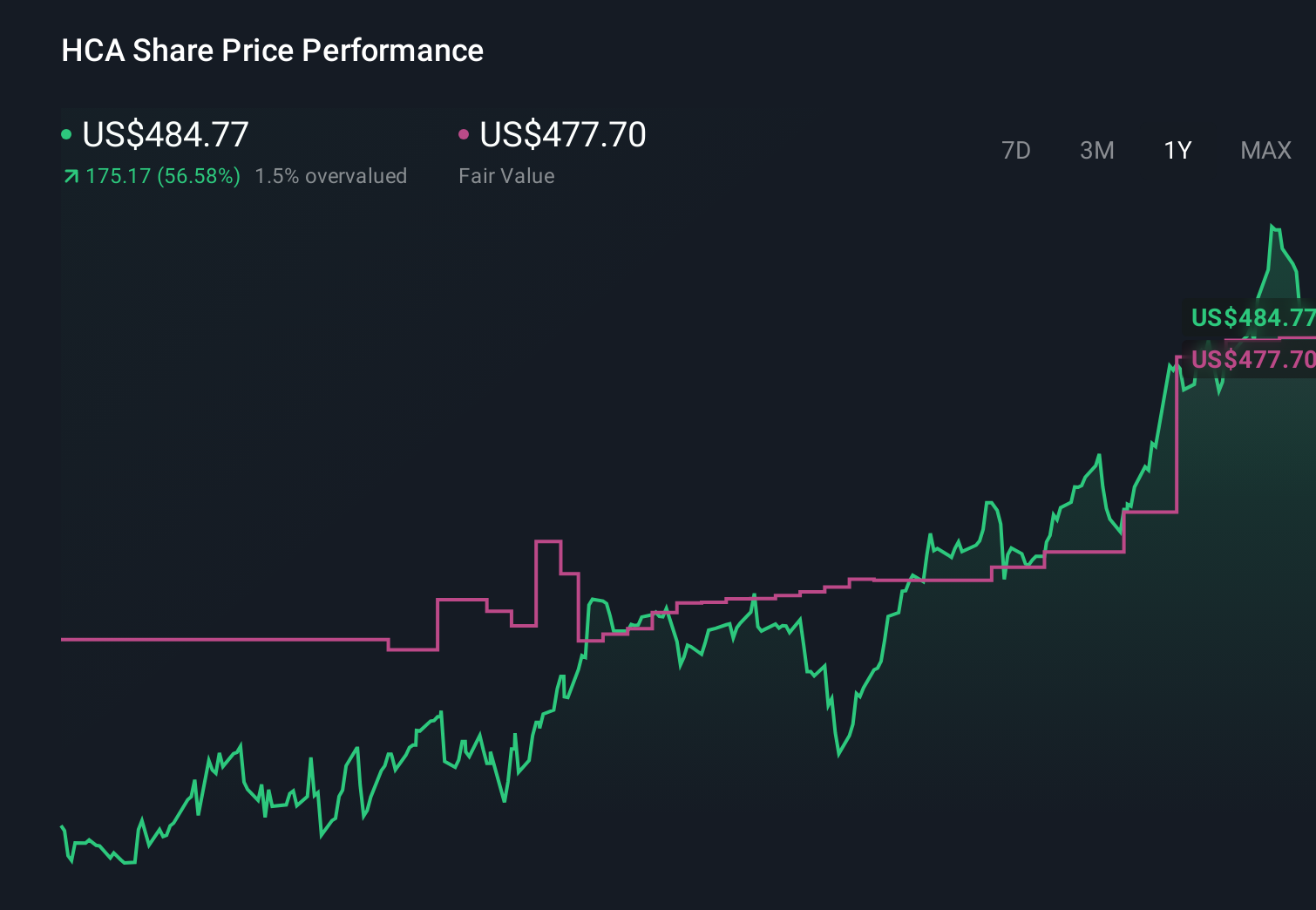
Three members of the Simply Wall St Community currently see HCA’s fair value between US$535 and about US$813 per share, underscoring how far opinions can stretch. You should weigh those against the central risk that changing federal policy and reimbursement terms could alter HCA’s revenue and margin profile, and consider how that might affect the company’s ability to support its long term capital plans.
Explore 3 other fair value estimates on HCA Healthcare - why the stock might be worth as much as 90% more than the current price!
Decide For Yourself
Disagree with existing narratives? Extraordinary investment returns rarely come from following the herd, so go with your instincts.
- A great starting point for your HCA Healthcare research is our analysis highlighting 4 key rewards and 3 important warning signs that could impact your investment decision.
- Our free HCA Healthcare research report provides a comprehensive fundamental analysis summarized in a single visual - the Snowflake - making it easy to evaluate HCA Healthcare's overall financial health at a glance.
Interested In Other Possibilities?
The market won't wait. These fast-moving stocks are hot now. Grab the list before they run:
- Uncover the next big thing with 25 elite penny stocks that balance risk and reward.
- AI is about to change healthcare. These 35 stocks are working on everything from early diagnostics to drug discovery. The best part - they are all under $10b in market cap - there's still time to get in early.
- Find 51 companies with promising cash flow potential yet trading below their fair value.
This article by Simply Wall St is general in nature. We provide commentary based on historical data and analyst forecasts only using an unbiased methodology and our articles are not intended to be financial advice. It does not constitute a recommendation to buy or sell any stock, and does not take account of your objectives, or your financial situation. We aim to bring you long-term focused analysis driven by fundamental data. Note that our analysis may not factor in the latest price-sensitive company announcements or qualitative material. Simply Wall St has no position in any stocks mentioned.