

Should ICE’s Push for Tighter Oversight of On-Chain Energy Derivatives Require Action From Intercontinental Exchange (ICE) Investors?
Intercontinental Exchange, Inc. ICE | 0.00 |
- Recently, Intercontinental Exchange (ICE) and CME asked U.S. regulators to rein in decentralized exchange Hyperliquid’s push into energy-linked on-chain derivatives, citing risks of insider trading, price manipulation, and sanctions evasion in critical oil and gas markets.
- This move underscores how incumbent exchanges are trying to protect the integrity of regulated commodity markets as blockchain-based platforms increasingly overlap with traditional derivatives trading.
- Next, we’ll examine how ICE’s push for tighter oversight of decentralized energy derivatives platforms could influence its long-term investment narrative.
This technology could replace computers: discover 26 stocks that are working to make quantum computing a reality.
Intercontinental Exchange Investment Narrative Recap
To own ICE, you generally need to believe in the long term value of regulated, electronic markets and high quality data and risk tools. The Hyperliquid dispute highlights competitive and regulatory tension around energy derivatives, but it does not materially alter ICE’s near term catalyst, which still centers on growing activity and risk management needs in its core energy and power franchises. The main incremental risk is that new on chain venues could pressure fees or volumes over time.
The recent expansion of ICE’s IRM 2 value at risk margining to U.S. ERCOT power markets sits right next to this story. While ICE pushes regulators to scrutinize decentralized platforms, it is also refining its own risk models across over 1,000 energy contracts, aiming to make its power markets more capital efficient for users. For many shareholders, progress in these power and risk products remains central to the current growth narrative.
Yet investors should also be aware that rising competition from low cost and decentralized trading venues could eventually affect ICE’s core trading economics and...
Intercontinental Exchange's narrative projects $12.3 billion revenue and $4.5 billion earnings by 2029. This requires 5.7% yearly revenue growth and an earnings increase of about $0.6 billion from $3.9 billion today.
Uncover how Intercontinental Exchange's forecasts yield a $200.67 fair value, a 30% upside to its current price.
Exploring Other Perspectives
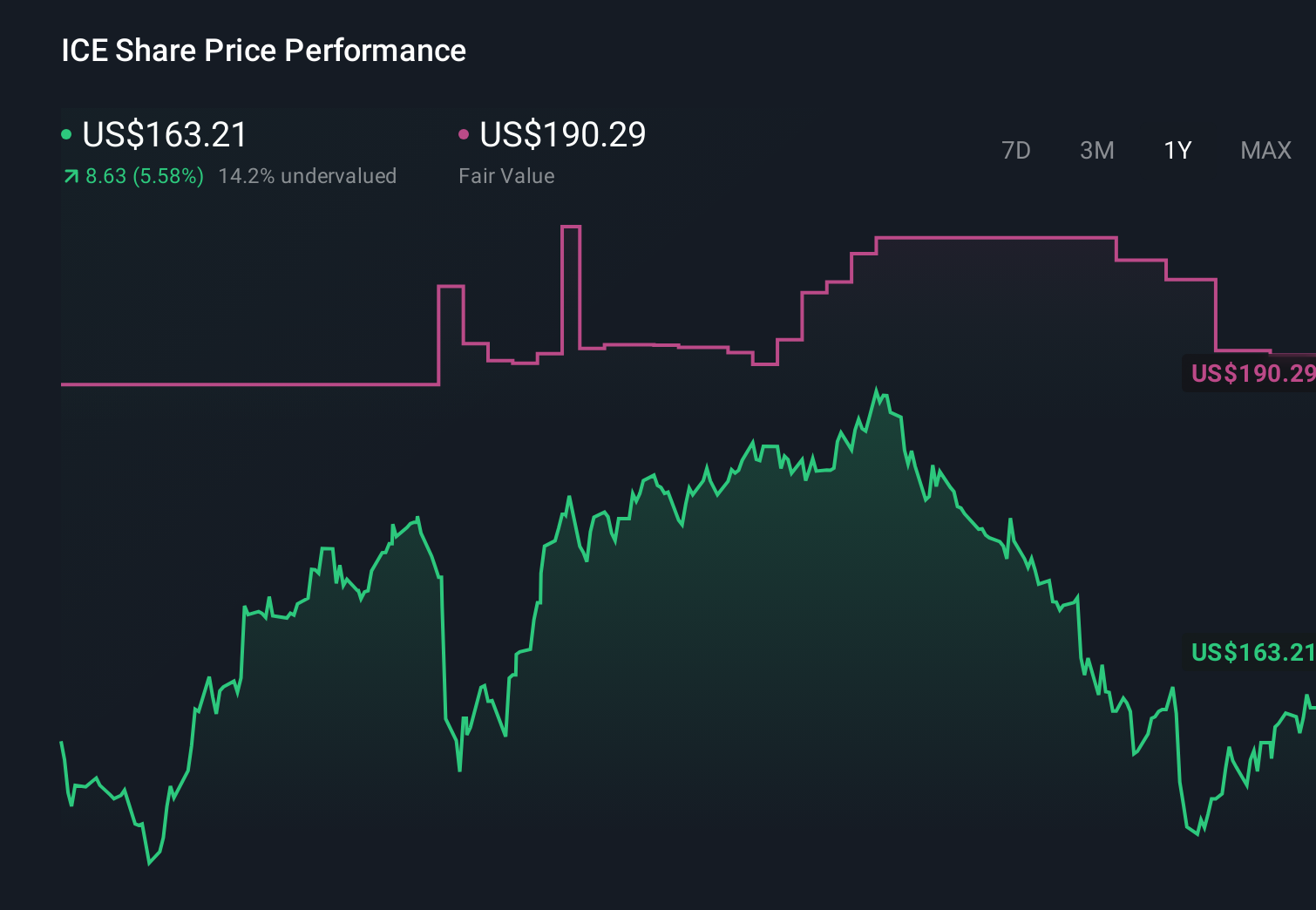
Six fair value estimates from the Simply Wall St Community span roughly US$138 to US$201 per share, showing how far apart individual views on ICE can be. When you set those against ICE’s reliance on sustained growth in energy and commodities markets, it underlines why many readers may want to explore several alternative perspectives on the company’s prospects.
Explore 6 other fair value estimates on Intercontinental Exchange - why the stock might be worth as much as 30% more than the current price!
Form Your Own Verdict
Don't just follow the ticker - dig into the data and build a conviction that's truly your own.
- A great starting point for your Intercontinental Exchange research is our analysis highlighting 4 key rewards and 1 important warning sign that could impact your investment decision.
- Our free Intercontinental Exchange research report provides a comprehensive fundamental analysis summarized in a single visual - the Snowflake - making it easy to evaluate Intercontinental Exchange's overall financial health at a glance.
Contemplating Other Strategies?
Don't miss your shot at the next 10-bagger. Our latest stock picks just dropped:
- Find 50 companies with promising cash flow potential yet trading below their fair value.
- The future of work is here. Discover the 30 top robotics and automation stocks leading the charge in AI-driven automation and industrial transformation.
- Invest in the nuclear renaissance through our list of 87 elite nuclear energy infrastructure plays powering the global AI revolution.
This article by Simply Wall St is general in nature. We provide commentary based on historical data and analyst forecasts only using an unbiased methodology and our articles are not intended to be financial advice. It does not constitute a recommendation to buy or sell any stock, and does not take account of your objectives, or your financial situation. We aim to bring you long-term focused analysis driven by fundamental data. Note that our analysis may not factor in the latest price-sensitive company announcements or qualitative material. Simply Wall St has no position in any stocks mentioned.