

Should Pitney Bowes’ Expanded Strategic Review and Debt Refinancing Require Action From Pitney Bowes (PBI) Investors?
Pitney Bowes Inc. PBI | 0.00 |
- Pitney Bowes recently moved into the second phase of its board-led strategic review while also refinancing its capital structure by redeeming all US$347 million of its 6.875% senior notes due 2027 through an upsized Term Loan A facility.
- Taken together, the broadened review of options, including a potential sale, and the shift in debt profile underscore how actively Pitney Bowes’ board is rethinking the company’s long-term capital allocation and balance sheet structure.
- Next, we’ll examine how the expanded strategic review and recent debt redemption could influence Pitney Bowes’ existing investment narrative.
The future of work is here. Discover the 29 top robotics and automation stocks leading the charge in AI-driven automation and industrial transformation.
Pitney Bowes Investment Narrative Recap
To own Pitney Bowes today, you have to believe that its mix of mailing, Presort, and shipping can still produce solid cash flow even as mail volumes face structural pressure. The second phase of the board’s strategic review, together with the recent refinancing, directly affects the near term catalyst of what path the board ultimately chooses for the company’s portfolio and capital structure. It also ties into the biggest current risk around execution under a relatively new leadership and board.
The move to redeem all US$347,000,000 of 6.875% senior notes due 2027 using an upsized Term Loan A and cash is the most relevant development here. It speaks to Pitney Bowes actively reshaping its debt profile while index changes, such as joining the Russell 2000 Value Defensive Index, may influence which types of shareholders pay attention as the strategic review unfolds and potential capital allocation decisions come into view.
Yet, while the balance sheet looks more flexible, investors still need to be aware of how execution risk around leadership changes and the strategic review could...
Pitney Bowes' narrative projects $1.8 billion revenue and $282.5 million earnings by 2029.
Uncover how Pitney Bowes' forecasts yield a $17.14 fair value, in line with its current price.
Exploring Other Perspectives
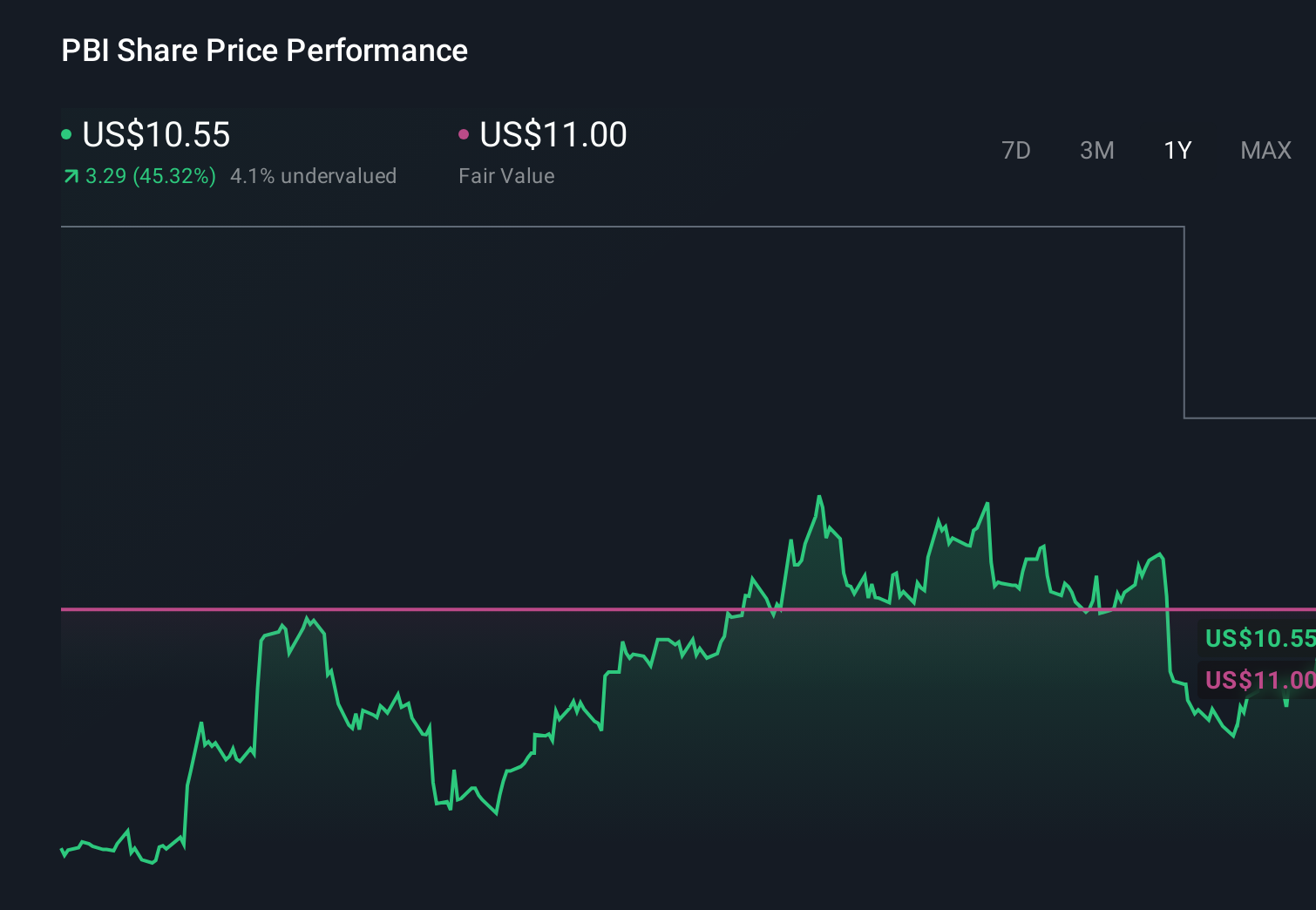
Some of the most optimistic analysts were assuming revenue around US$1.9 billion and earnings above US$300 million by 2029, which is a far more upbeat view than consensus and leans heavily on successful cost savings and better forecasting, so you should expect that these projections, and the risks around them, could shift meaningfully in light of the latest review and refinancing moves.
Explore 5 other fair value estimates on Pitney Bowes - why the stock might be worth 15% less than the current price!
Reach Your Own Conclusion
Disagree with existing narratives? Extraordinary investment returns rarely come from following the herd, so go with your instincts.
- A great starting point for your Pitney Bowes research is our analysis highlighting 4 key rewards and 3 important warning signs that could impact your investment decision.
- Our free Pitney Bowes research report provides a comprehensive fundamental analysis summarized in a single visual - the Snowflake - making it easy to evaluate Pitney Bowes' overall financial health at a glance.
Interested In Other Possibilities?
Don't miss your shot at the next 10-bagger. Our latest stock picks just dropped:
- Uncover the next big thing with 20 elite penny stocks that balance risk and reward.
- Invest in the nuclear renaissance through our list of 89 elite nuclear energy infrastructure plays powering the global AI revolution.
- AI is about to change healthcare. These 40 stocks are working on everything from early diagnostics to drug discovery. The best part - they are all under $10b in market cap - there's still time to get in early.
This article by Simply Wall St is general in nature. We provide commentary based on historical data and analyst forecasts only using an unbiased methodology and our articles are not intended to be financial advice. It does not constitute a recommendation to buy or sell any stock, and does not take account of your objectives, or your financial situation. We aim to bring you long-term focused analysis driven by fundamental data. Note that our analysis may not factor in the latest price-sensitive company announcements or qualitative material. Simply Wall St has no position in any stocks mentioned.