

Should Pitney Bowes’ Shift Into Defensive Value Indices and Debt Refinancing Require Action From PBI Investors?
Pitney Bowes Inc. PBI | 0.00 |
- In late June 2026, Pitney Bowes Inc. (NYSE:PBI) was moved out of several Russell growth benchmarks and added to the Russell 2000 Defensive and Russell 2000 Value-Defensive indices, while also redeeming all US$347 million of its 6.875% Senior Notes due March 2027 using an upsized Term Loan A facility and existing liquidity.
- Together, the index reclassification toward defensive and value segments and the refinancing of higher-coupon debt highlight a shift in how the market and lenders are framing Pitney Bowes’ risk profile and capital structure.
- Next, we’ll examine how Pitney Bowes’ move into defensive value indices and debt refinancing may influence its investment narrative.
AI is about to change healthcare. These 41 stocks are working on everything from early diagnostics to drug discovery. The best part - they are all under $10b in market cap - there's still time to get in early.
Pitney Bowes Investment Narrative Recap
To own Pitney Bowes today, you need to believe that its shift from legacy mailing toward SaaS shipping and logistics can offset structural mail decline, while a new management team delivers on margin and cash flow improvement. The index move into defensive value buckets and the refinancing of 2027 notes both touch the biggest near term swing factors: balance sheet risk and confidence in more stable earnings. At this stage, neither change appears to alter the core near term catalyst or the key structural risk.
The most relevant recent announcement here is the full redemption of US$347 million of 6.875% Senior Notes due 2027, funded by an upsized Term Loan A and existing liquidity. For a business often flagged for high leverage and refinancing risk, extending debt maturities to 2031 sits directly alongside the return of capital story and ongoing cost initiatives, and could influence how investors weigh near term balance sheet risk against the potential earnings lift from operational improvements.
Yet, while the refinancing helps, investors should also be aware that...
Pitney Bowes' narrative projects $1.8 billion revenue and $282.5 million earnings by 2029.
Uncover how Pitney Bowes' forecasts yield a $17.14 fair value, a 4% downside to its current price.
Exploring Other Perspectives
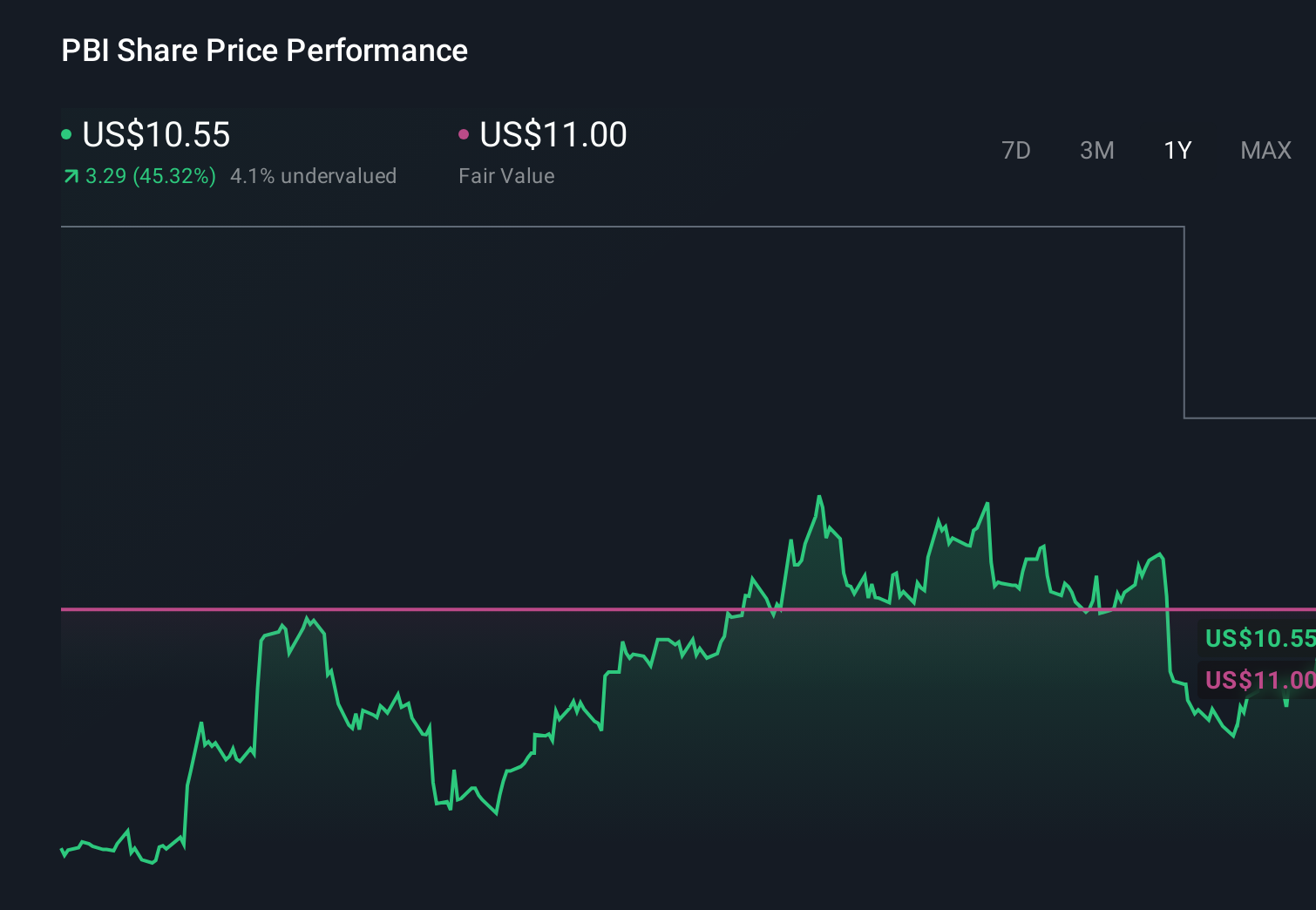
Before this news, the most optimistic analysts were assuming earnings could reach about US$340 million by 2029, which is far more upbeat than consensus and leans heavily on cost savings and Presort consolidation that may or may not play out as expected.
Explore 5 other fair value estimates on Pitney Bowes - why the stock might be worth 19% less than the current price!
Decide For Yourself
Don't just follow the ticker - dig into the data and build a conviction that's truly your own.
- A great starting point for your Pitney Bowes research is our analysis highlighting 4 key rewards and 3 important warning signs that could impact your investment decision.
- Our free Pitney Bowes research report provides a comprehensive fundamental analysis summarized in a single visual - the Snowflake - making it easy to evaluate Pitney Bowes' overall financial health at a glance.
Want Some Alternatives?
These stocks are moving-our analysis flagged them today. Act fast before the price catches up:
- Find 42 companies with promising cash flow potential yet trading below their fair value.
- Capitalize on the AI infrastructure supercycle with our selection of the 52 best 'picks and shovels' of the AI gold rush converting record-breaking demand into massive cash flow.
- This technology could replace computers: discover 26 stocks that are working to make quantum computing a reality.
This article by Simply Wall St is general in nature. We provide commentary based on historical data and analyst forecasts only using an unbiased methodology and our articles are not intended to be financial advice. It does not constitute a recommendation to buy or sell any stock, and does not take account of your objectives, or your financial situation. We aim to bring you long-term focused analysis driven by fundamental data. Note that our analysis may not factor in the latest price-sensitive company announcements or qualitative material. Simply Wall St has no position in any stocks mentioned.