

S&P Global (SPGI) Stock Could Be 2% Overvalued Despite African Ratings Deal
S&P Global, Inc. SPGI | 0.00 |
S&P Global stock has fallen 21.9% over the past year, yet the latest valuation checks suggest the shares are nearer to fair value on intrinsic estimates while looking more expensive on traditional earnings multiples. With the Excess Returns model pointing to a price close to its intrinsic value and the market assigning a richer multiple, investors are being asked to weigh up which signal to lean on.
- The 21.9% one year share price decline raises the question of whether recent weakness has already reset expectations or if the stock is still pricing in a premium.
- Recent moves to expand in credit ratings and data, including acquisitions such as a majority stake in African rating agency Agusto and additional analytics capabilities, may support long term cash flow potential. However, execution and integration risks around these deals can still affect what investors are willing to pay today.
- S&P Global scores 3 out of 6 on Simply Wall St's broader valuation checks, which is a mixed picture rather than a clear bargain or clear overvaluation, and you can see the breakdown on 3.
The stock's next move may depend on whether the current price more closely reflects the intrinsic value suggested by the Excess Returns model or the richer verdict implied by market multiples.
Is S&P Global Fairly Priced on Excess Returns?
The Excess Returns model looks at how much profit S&P Global can earn on its equity above the cost of that equity, then projects how long that can persist. For S&P Global, the inputs point to a company expected to keep generating returns comfortably above its funding costs.
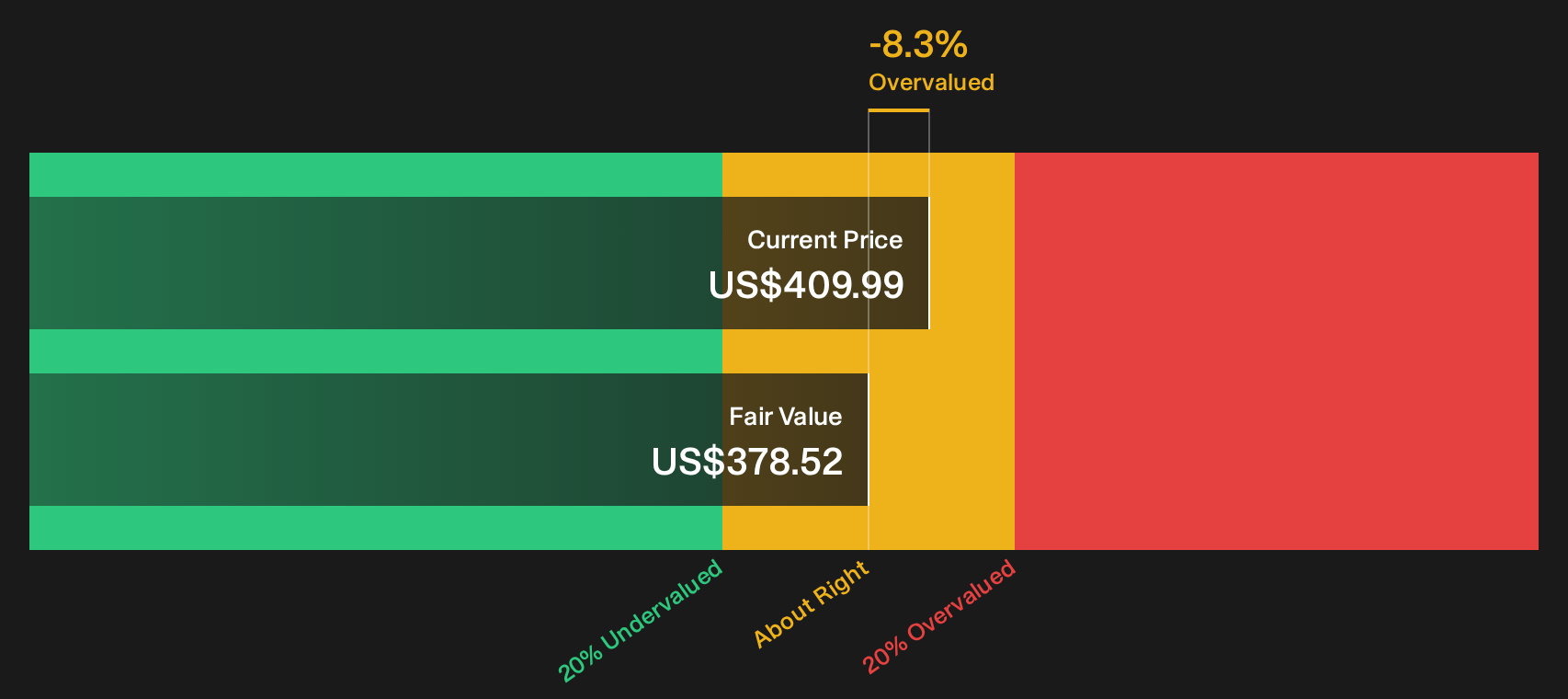
The model uses a Book Value of $106.86 per share and a Stable EPS estimate of $21.36 per share, based on weighted future Return on Equity estimates from 5 analysts. This sits against an estimated Cost of Equity of $8.80 per share and an Excess Return of $12.55 per share, with an average Return on Equity of 19.51% and a Stable Book Value of $109.48 per share, also sourced from analyst forecasts. This combination feeds into an intrinsic value estimate of about $398.57 per share, which is slightly below the current share price. On this basis, the shares screen as about 2.4% overvalued. Because the recent acquisition of Agusto aims to broaden S&P Global's ratings reach, the modest premium suggests the market is already giving some credit for that expansion.
On these Excess Returns assumptions, S&P Global currently appears roughly fairly valued, with only a small tilt toward being overvalued.
S&P Global is fairly valued according to our Excess Returns, but this can change at a moment's notice. Track the value in your watchlist or portfolio and be alerted on when to act.
Is S&P Global Getting Expensive on Earnings?
The P/E ratio is usually a useful way to think about what you are paying for each dollar of earnings at a company like S&P Global. Right now, S&P Global trades on a P/E of about 24.4x, which sits very close to the peer average of 24.9x and below the broader Capital Markets industry average of 37.8x.
The Fair P/E ratio for S&P Global, which adjusts for its size, profitability profile and risk, is estimated at 18.1x. That is meaningfully lower than the current market multiple. This implies investors are paying a premium to this tailored benchmark even though the stock only trades roughly in line with direct peers on P/E.
On the P/E multiple, S&P Global stock currently screens as overvalued compared with what the Fair Ratio suggests would be a more balanced price.

The S&P Global Narrative: What Would Justify Today's Price?
Simply Wall St Narratives pick up where this valuation puzzle for S&P Global leaves off by spelling out which expectations for growth, margins and earnings would need to play out for the stock to be worth materially more or materially less than today’s price on the Community page. Each narrative treats fair value as a thesis about S&P Global's business that you can revisit over time, rather than as a one off snapshot.
Community views on S&P Global sit far apart, with one side seeing meaningful upside and the other arguing the stock now carries a premium.
Bull case: 21% undervalued
"The sustained growth in the Vitality Index, despite product maturation, underpins S&P Global's commitment to innovation, which is expected to increase as a percentage of total revenue, enhancing overall revenue growth."
Bear case: 7% overvalued
"The traditional value proposition faces pressure from the increasing accessibility of information through APIs, automated tools, and large language models."
Do you think there's more to the story for S&P Global? Head over to our Community to see what others are saying!
The Bottom Line
S&P Global sits in a grey zone where the Excess Returns intrinsic value estimate is close to the current price, while the P/E and Fair P/E comparison suggest the stock looks overvalued on earnings. The split reflects two different lenses. The intrinsic view leans on cash flow durability and returns on equity, while the multiple view leans on what investors are currently willing to pay for growth and sector exposure. The crux for you is whether S&P Global can sustain the kind of returns and cash generation implied by the intrinsic model, without integration or execution risks around recent expansions eroding that picture.
This article by Simply Wall St is general in nature. We provide commentary based on historical data and analyst forecasts only using an unbiased methodology and our articles are not intended to be financial advice. It does not constitute a recommendation to buy or sell any stock, and does not take account of your objectives, or your financial situation. We aim to bring you long-term focused analysis driven by fundamental data. Note that our analysis may not factor in the latest price-sensitive company announcements or qualitative material. Simply Wall St has no position in any stocks mentioned.