

State Street (STT) Stock Looks Fully Priced Despite A 14% Value Gap
State Street Corporation STT | 0.00 |
After a 185.0% return over the past three years, State Street now sits at a point where a strong share price run meets a more balanced valuation picture. The intrinsic value estimate from the Excess Returns model indicates some upside, while market multiples look closer to fair.
- State Street's 185.0% gain across three years highlights the question of whether that pace already reflects much of the value the business can justify.
- Recent profit growth and record asset levels can support the current valuation, while ongoing fee pressure in exchange traded funds may constrain how much of that flows through to long term earnings power.
- On Simply Wall St's broader checks, State Street presents a mixed picture rather than a clear bargain or clear overvaluation, with 4 of 6 valuation tests pointing to value.
The issue now is whether State Street's current price around intrinsic value still leaves enough margin for investors who are considering the stock after such a strong three year run.
Is State Street a Bargain on Excess Returns?
The Excess Returns model for State Street looks at how much profit the company is expected to earn on its equity above the required return that shareholders demand. In simple terms, it asks whether future returns on the balance sheet justify a share price above the current accounting book value.
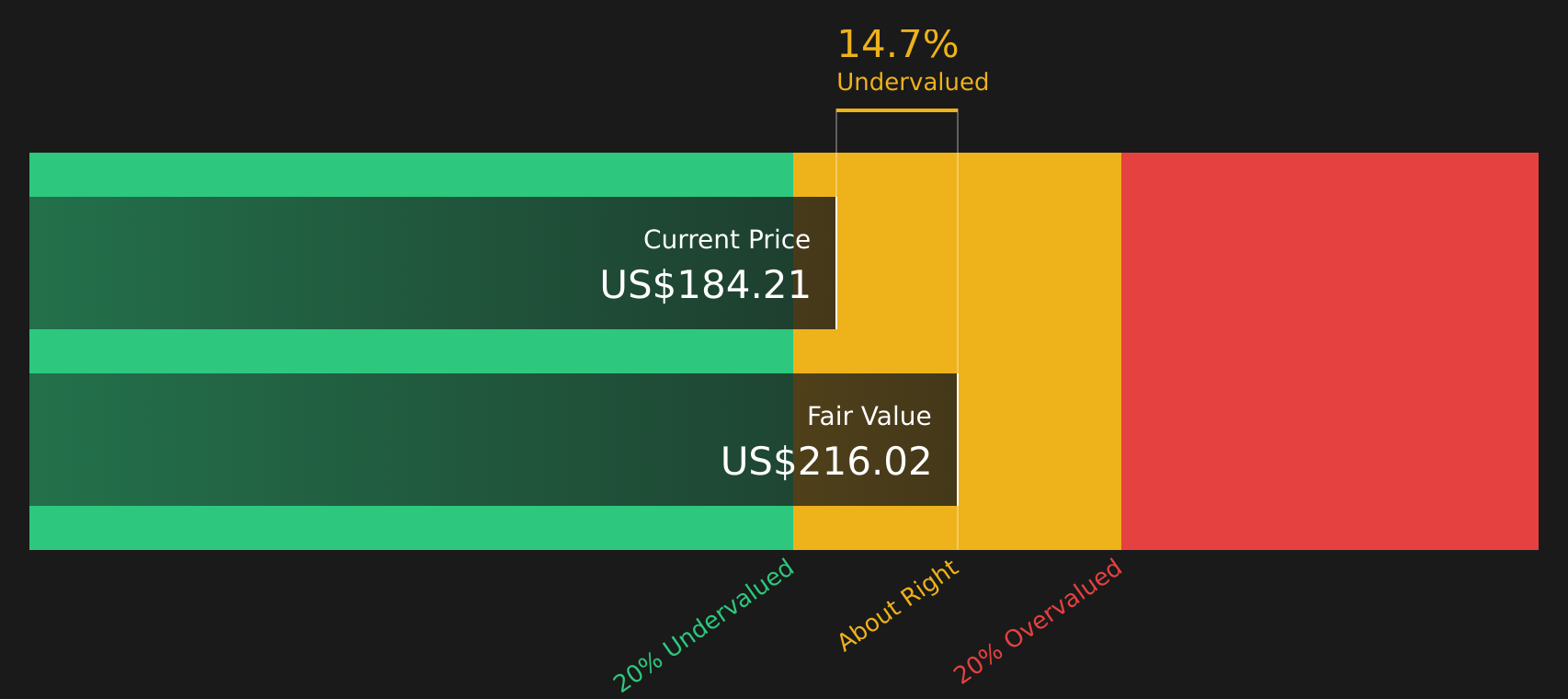
For State Street, the model uses a Book Value of $89.95 per share and a Stable EPS estimate of $15.88 per share, based on weighted future Return on Equity estimates from 8 analysts. Against a Cost of Equity of $9.38 per share, that implies an Excess Return of $6.50 per share and an average Return on Equity of 15.66%, rolling into a Stable Book Value of $101.35 per share from 7 analyst estimates. Putting these pieces together, the Excess Returns valuation points to an intrinsic value of about $215 per share, which is about 13.9% above the current share price.
Because State Street reported a 56% profit surge in Q2 2026 with record assets and higher fee income, the current discount suggests the market is cautious about how durable those excess returns will be.
Overall, State Street screens as undervalued relative to what the Excess Returns model suggests its earnings power and equity base can support.
Our Excess Returns analysis suggests State Street is undervalued by 13.9%. Track this in your watchlist or portfolio, or discover 47 more high quality undervalued stocks.
Where Does State Street Sit on Earnings?
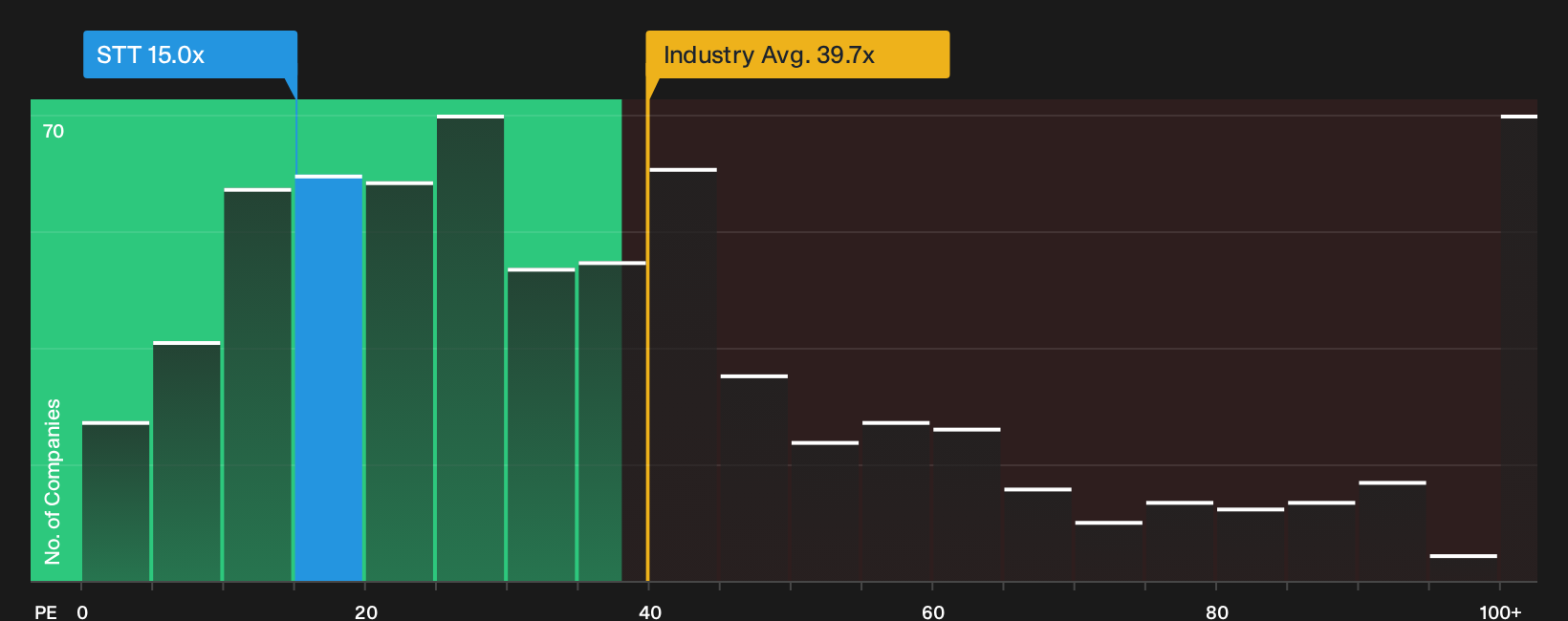
P/E suits State Street because earnings are still the main yardstick investors use for large financial groups. The stock trades on a P/E of about 15.8x, compared with a Capital Markets industry average near 39.0x and a peer average around 21.9x. On raw comparison, that places State Street at a lower multiple than both its sector and closest competitors.
The tailored fair P/E ratio for State Street is 17.3x. This reflects what would typically be expected given its mix of growth expectations, margins, size, and risk profile. Against that benchmark, the current 15.8x multiple sits only modestly below, so the discount is not large enough to suggest a clear mispricing. When set alongside the Excess Returns valuation outcome, the earnings multiple points to a market view that is cautious but not extreme.
On the P/E measure, State Street looks to be priced broadly in line with what its earnings profile would justify.
The State Street Narrative: What Would Justify Today's Price?
For State Street, Simply Wall St Narratives pick up where the valuation tools leave off by spelling out what kind of growth, margins and earnings profile would need to hold for the stock to be worth meaningfully more or less than today's price. Rather than relying on a single multiple or model output, each one lays out the assumptions behind its fair value so you can compare them with State Street's actual results over time on the Community page.
Community views on State Street sit far apart, with one camp seeing meaningful upside and another arguing expectations have already run ahead of fundamentals.
Bull case: 14% undervalued
"State Street anticipates continued long-term growth in its fee business through product innovation and expanding client relationships, which should positively impact revenue as it has shown in prior years…"
Bear case: 42% overvalued
"Goldman Sachs flagged that capital markets stocks, including State Street, are trading at discounts as investors weigh long term disruption risks from AI, tokenization, retail growth sustainability, and private equity monetization…"
Do you think there's more to the story for State Street? Head over to our Community to see what others are saying!
The Bottom Line
For State Street, the Excess Returns intrinsic value estimate points to the stock trading at a modest discount, while the P/E view suggests pricing that is roughly in line with peers once its profile is accounted for. Together, the signals lean toward undervalued rather than overvalued, but with enough mixed flags that it does not screen as a straightforward bargain. The crux for investors from here is whether State Street can sustain the level of returns on equity implied by the intrinsic value model in the face of fee pressure and industry change, or whether the current discount is the market correctly pricing those risks.
This article by Simply Wall St is general in nature. We provide commentary based on historical data and analyst forecasts only using an unbiased methodology and our articles are not intended to be financial advice. It does not constitute a recommendation to buy or sell any stock, and does not take account of your objectives, or your financial situation. We aim to bring you long-term focused analysis driven by fundamental data. Note that our analysis may not factor in the latest price-sensitive company announcements or qualitative material. Simply Wall St has no position in any stocks mentioned.