

The Bull Case For U.S. Bancorp (USB) Could Change Following New Amazon Card Deal And Long-Term Debt Issuance
U.S. Bancorp USB | 0.00 |
- In recent days, U.S. Bancorp has issued a series of senior and subordinated fixed-income securities, including callable fixed and fixed-to-floating notes with maturities stretching into the 2040s, alongside multiple smaller medium-term note offerings.
- At the same time, Amazon announced the launch of new no-annual-fee Prime Business and Amazon Business cards issued by U.S. Bank on the Mastercard network, potentially expanding U.S. Bancorp’s fee-based revenue streams and business customer reach.
- We’ll now explore how this wave of long-dated funding activity and the Amazon business card partnership could influence U.S. Bancorp’s investment narrative.
Invest in the nuclear renaissance through our list of 88 elite nuclear energy infrastructure plays powering the global AI revolution.
U.S. Bancorp Investment Narrative Recap
To own U.S. Bancorp, you need to believe it can turn its payments, cards, and digital capabilities into steady fee income while managing credit and funding risks. The recent wave of long-dated, callable note issuance looks like routine balance sheet management rather than a shift in the near term story, while the Amazon business card launch is more relevant to the key short term catalyst around growing payments and card-related fees. The biggest near term risk remains credit quality in its loan books.
The Amazon Prime Business and Amazon Business cards, issued by U.S. Bank on the Mastercard network, directly connect to the payments and fee-income catalyst many shareholders focus on. This partnership expands U.S. Bancorp’s reach into business spending and card rewards, which ties closely to the thesis that higher, more diversified fee income can help offset pressure on lending margins and funding costs over time.
Yet while these new cards add an attractive growth angle, investors should also be aware of the risk that accelerating digital finance and open banking competition could...
U.S. Bancorp’s narrative projects $35.3 billion revenue and $8.9 billion earnings by 2029.
Uncover how U.S. Bancorp's forecasts yield a $63.48 fair value, a 19% upside to its current price.
Exploring Other Perspectives
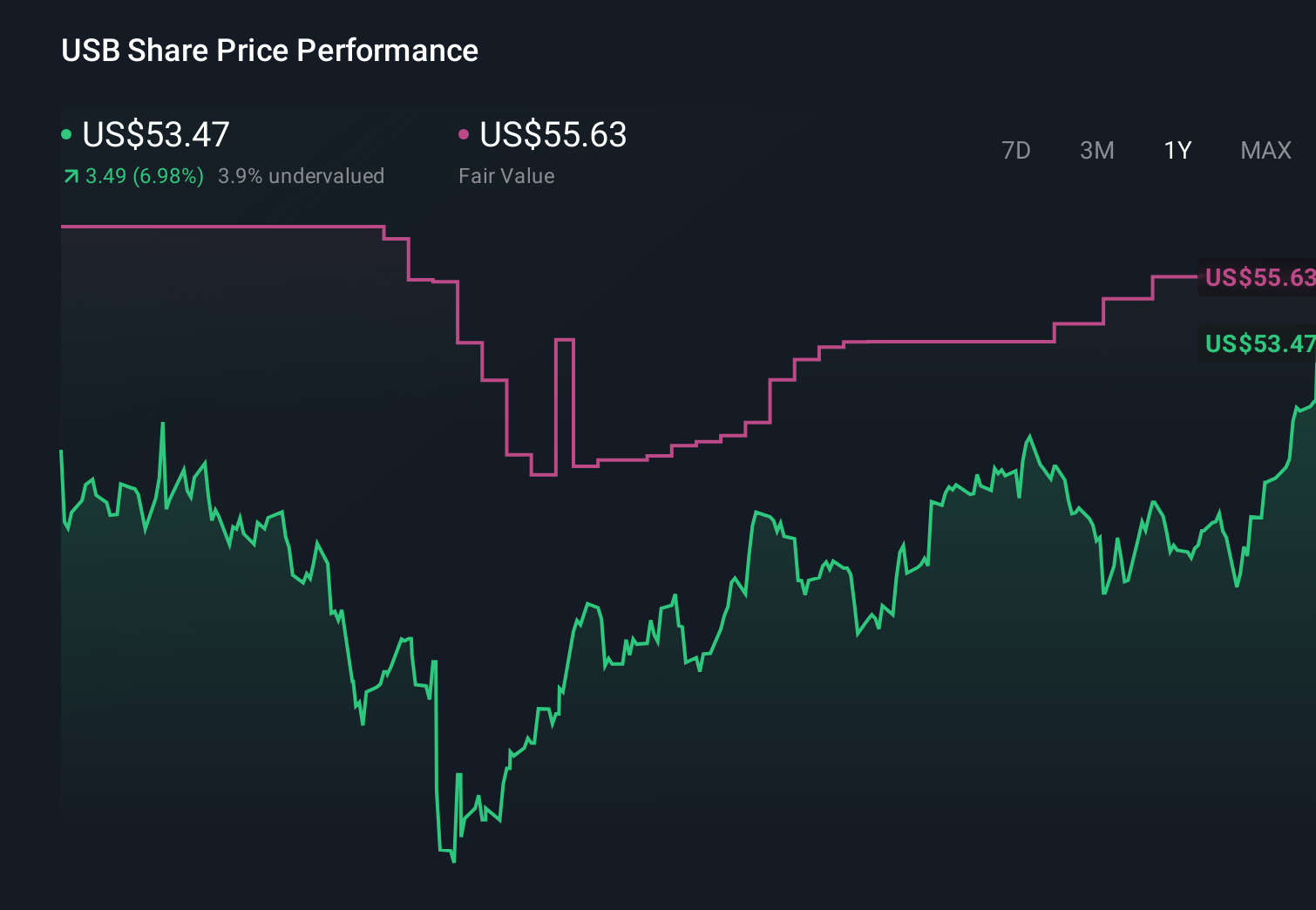
Seven members of the Simply Wall St Community now value U.S. Bancorp anywhere between US$55 and about US$97.92, highlighting very different expectations for the stock. When you set those views against the importance of U.S. Bancorp defending its payments and fee income as new digital competitors emerge, it underlines why comparing several independent assumptions about the bank’s future can be useful before making up your mind.
Explore 7 other fair value estimates on U.S. Bancorp - why the stock might be worth just $55.00!
Form Your Own Verdict
Disagree with existing narratives? Extraordinary investment returns rarely come from following the herd, so go with your instincts.
- A great starting point for your U.S. Bancorp research is our analysis highlighting 4 key rewards and 1 important warning sign that could impact your investment decision.
- Our free U.S. Bancorp research report provides a comprehensive fundamental analysis summarized in a single visual - the Snowflake - making it easy to evaluate U.S. Bancorp's overall financial health at a glance.
Interested In Other Possibilities?
The market won't wait. These fast-moving stocks are hot now. Grab the list before they run:
- Uncover the next big thing with 27 elite penny stocks that balance risk and reward.
- AI is about to change healthcare. These 29 stocks are working on everything from early diagnostics to drug discovery. The best part - they are all under $10b in market cap - there's still time to get in early.
- We've uncovered the 12 dividend fortresses yielding 5%+ that don't just survive market storms, but thrive in them.
This article by Simply Wall St is general in nature. We provide commentary based on historical data and analyst forecasts only using an unbiased methodology and our articles are not intended to be financial advice. It does not constitute a recommendation to buy or sell any stock, and does not take account of your objectives, or your financial situation. We aim to bring you long-term focused analysis driven by fundamental data. Note that our analysis may not factor in the latest price-sensitive company announcements or qualitative material. Simply Wall St has no position in any stocks mentioned.