

Trading Systems And Market News: How To Handle CPI, FOMC, And Unexpected Events
In systematic trading, the release of macroeconomic data and the publication of major market news represent particularly sensitive periods, as they can rapidly alter volatility, liquidity, market direction, and order book depth. Events such as the U.S. Consumer Price Index (CPI), Non-Farm Payrolls, interest rate decisions, or unexpected news can therefore be both a source of risk and, in some cases, an opportunity.
The key question is not whether traders should broadly decide to trade or stay out of the market, but whether a trading system has been specifically designed and validated to operate under those conditions. Different strategies react differently: an intraday system with tight stops may struggle during sudden market swings, while a breakout or trend-following strategy could potentially benefit from them.
For this reason, news events should not be managed through discretionary decisions. Instead, they should be analyzed systematically, just like any other component of a trading system: signals, filters, stops, profit targets, and position sizing. Scheduled events can be studied, categorized, and incorporated into the code through precise rules. Unexpected news, on the other hand, requires robust strategies capable of withstanding shocks, gaps, and sudden shifts in market regimes.
A systematic trader should therefore ask whether a specific category of events is measurable, recurring, and manageable through objective rules, avoiding improvisation and maintaining a consistent, testable approach.
Scheduled News: How to Handle CPI, FOMC, and Macroeconomic Releases
Scheduled news events are, at least in theory, the easiest to manage. We know in advance when they will be released, we know which markets are likely to be affected, and we can build precise rules around them.
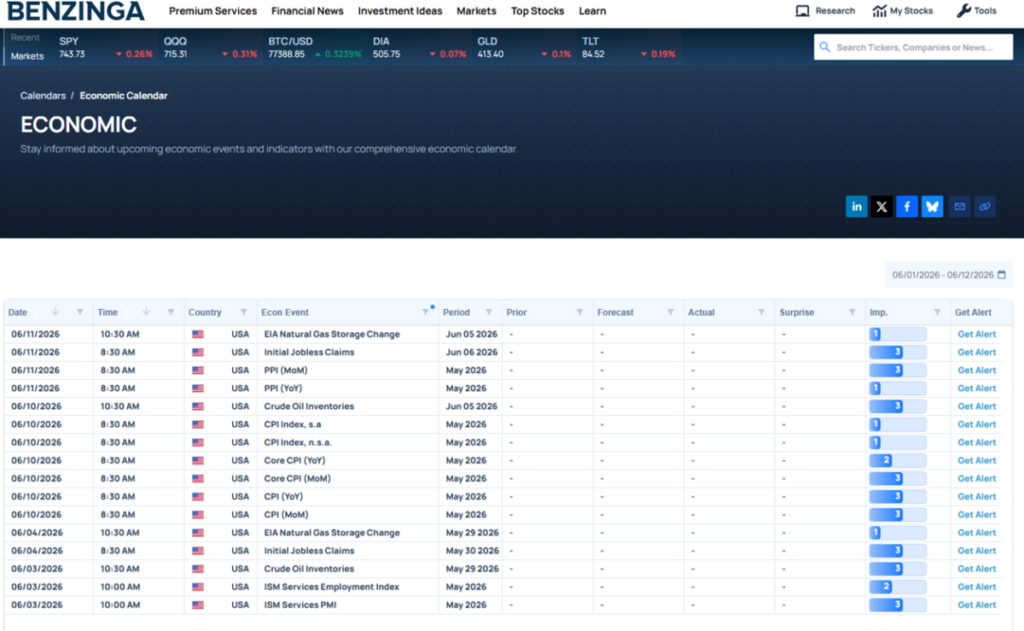
Figure 1 – Example of an economic calendar showing high-impact macroeconomic events for financial markets.
A systematic trader operating intraday on futures such as the S&P 500, Nasdaq, Treasury futures, or currencies cannot treat the release of the U.S. CPI report as just another market event. During those minutes, liquidity conditions may change dramatically, spreads may widen, stop losses may be triggered by violent price movements, and markets may cross key technical levels at speeds rarely seen under normal trading conditions.
The same applies to other high-impact macroeconomic releases, including:
- Non-Farm Payrolls (NFP)
- Federal Reserve interest rate decisions
- FOMC press conferences
- Inflation reports
- Gross Domestic Product (GDP) data
- Initial Jobless Claims
- Crude Oil Inventory reports for energy traders
- European Central Bank (ECB) decisions for traders operating in the euro, Bund futures, or European equity indices
This does not necessarily mean that trading should always be avoided during these events. Rather, it means that a clear procedure should be defined. For example, an intraday trading system might prohibit new entries during the 10 minutes before and after a scheduled release. The important point is that the decision should not be based on intuition or fear, but on testing and statistical evidence.
However, when evaluating strategies during periods characterized by elevated volatility, it is essential to consider a critical factor: not all backtest results are equally reliable. During major economic releases, markets can move extremely quickly, liquidity can temporarily disappear, spreads can widen significantly, and execution quality can deteriorate. Under these conditions, slippage risk increases substantially.
As a result, a backtest may show entries and exits occurring at theoretical prices that would have been difficult, or even impossible, to achieve in live market conditions.
For this reason, traders should apply conservative assumptions regarding slippage and transaction costs, carefully evaluate the quality of the historical data being used, verify the granularity of the bars, and assess worst-case execution scenarios. In some cases, a news filter that appears to slightly reduce theoretical performance may actually improve the overall robustness of the system by preventing it from relying on executions that are unlikely to be achieved during the most turbulent market conditions.
Why News Events Are Not Always Negative for a Trading System
One of the most common mistakes traders make is classifying news events emotionally. “The CPI moves the market too much, so I stay out.” “The FOMC is too risky, so it’s better to shut everything down.” At first glance, this reasoning may seem prudent, but it is not necessarily correct. In systematic trading, the question is not whether a news event feels dangerous. The real question is whether that category of events statistically deteriorates the performance of the strategy.
We know that certain types of systems tend to struggle during periods of explosive volatility. For example, many intraday mean reversion strategies can become vulnerable when the market breaks aggressively in one direction following an unexpected economic release. In these situations, avoiding specific time windows may help reduce drawdowns, false signals, and clusters of losses.
However, there are also systems that benefit precisely from these violent market moves. Breakout, momentum, and trend-following strategies may find news-driven environments particularly favorable because the information release often creates directional movement, range expansion, and acceleration.
As a result, indiscriminately disabling all systems during news events can be a mistake. Doing so may eliminate not only some of the worst trading days, but also some of the best ones. For this reason, news management should be treated like any other trading filter: it must be tested, measured, and compared against the original version of the strategy.
How to Build a News Filter for a Trading System
From an operational perspective, a news filter can be implemented in several ways.
The simplest approach is based on an economic calendar. A database of relevant events is created, including the date and time of each release. Before generating an order, the system checks whether the current time falls within a restricted trading window.
A few hypothetical examples, provided purely for illustrative purposes and not based on actual testing, might include:
- U.S. CPI: no new entries from 15 minutes before to 15 minutes after the release.
- FOMC announcements: trading suspended and all open positions closed from 30 minutes before to 30 minutes after the event.
- Crude Oil Inventories: filter applied only to strategies trading Crude Oil-related markets.
- Earnings announcements: filter applied only to the individual stocks involved.
The key point is to avoid creating a generic, one-size-fits-all filter. Different markets respond to different types of news, and each strategy should be evaluated within the specific context in which it operates.
Managing Open Positions During News Events
Another important consideration involves positions that are already open before a news release. Preventing new entries is one thing; forcibly closing existing positions is another, since the latter decision alters the strategy’s logic much more significantly.
In some cases, it may make sense. If an intraday system operates on small price fluctuations with relatively tight profit targets and stop losses, remaining exposed during a major economic release may effectively turn a normal trade into a bet on the outcome of the announcement. In that situation, closing positions before the release could be a reasonable choice.
In other cases, however, the position is part of a broader trading framework. A daily trend-following system, for example, may have no advantage in exiting before every macroeconomic event because the strategy is specifically designed to remain exposed to major directional market moves. In certain situations, traders might even consider temporarily removing the stop loss around the time of the release to avoid being stopped out by a brief abnormal price spike that is quickly absorbed once the market digests the news.
Once again, the answer should come from the data rather than from assumptions. For example, at least three different scenarios could be tested:
- System without a news filter
- System that blocks only new entries
- System that forcibly closes open positions before the event
Only by comparing these alternatives can traders determine whether the filter truly adds value or simply introduces a false sense of caution.
Unexpected News and Systematic Trading: The Role of Risk Management
Unexpected news events present a completely different challenge because they cannot be coded in advance. Wars, terrorist attacks, bank failures, political crises, geopolitical shocks, unexpected credit rating downgrades, tweets, or sudden statements from influential public figures can move markets without warning.

Figure 2 – News of a potential agreement in the U.S.-Iran conflict triggers a sharp decline in Crude Oil prices.
In these situations, systematic traders should not fool themselves into believing that every event can be predicted. Instead, they must focus on building robust trading systems. Protection against unexpected news does not come from the economic calendar – it comes from risk management.
Several elements become particularly important:
- Proper position sizing
- Stop losses that are consistent with the instrument’s volatility
- Maximum daily loss limits
- Maximum exposure limits by market and asset class
- Diversification across markets and strategies
- Leverage control
- Automatic suspension mechanisms during abnormal volatility or extreme market conditions
When an unexpected event impacts the market, the real problem is rarely a single trade. The real issue is the portfolio’s overall exposure. If multiple strategies are aligned in the same direction across highly correlated instruments, a sudden news event can lead to concentrated losses across the portfolio.
Conclusions: How to Manage News Events in Systematic Trading
Managing news events in systematic trading does not mean ignoring them, nor does it mean being driven by fear.
Scheduled news releases can be transformed into objective trading rules, such as exclusion windows, entry restrictions, position size reductions, preventive position closures, or market-specific news filters. However, every rule should be properly tested and compared against the original version of the strategy before being implemented.
Unexpected news events, on the other hand, cannot be managed through an economic calendar. They must be addressed through robustness, diversification, leverage control, and sound risk management practices.
A systematic trader should therefore think about news events in the following way: if an event is predictable, it can be coded into the trading system; if it is unpredictable, the system must be designed to withstand its impact. This distinction is essential. In trading, we cannot control the news, but we can control how our trading systems respond to it.
See you next time, happy trading!
image credit: Author
Benzinga Disclaimer: This article is from an unpaid external contributor. It does not represent Benzinga’s reporting and has not been edited for content or accuracy.