

Trinity Capital’s New ATM Equity Plan And Softer EPS Might Change The Case For Investing In TRIN
Trinity Capital, Inc. TRIN | 0.00 |
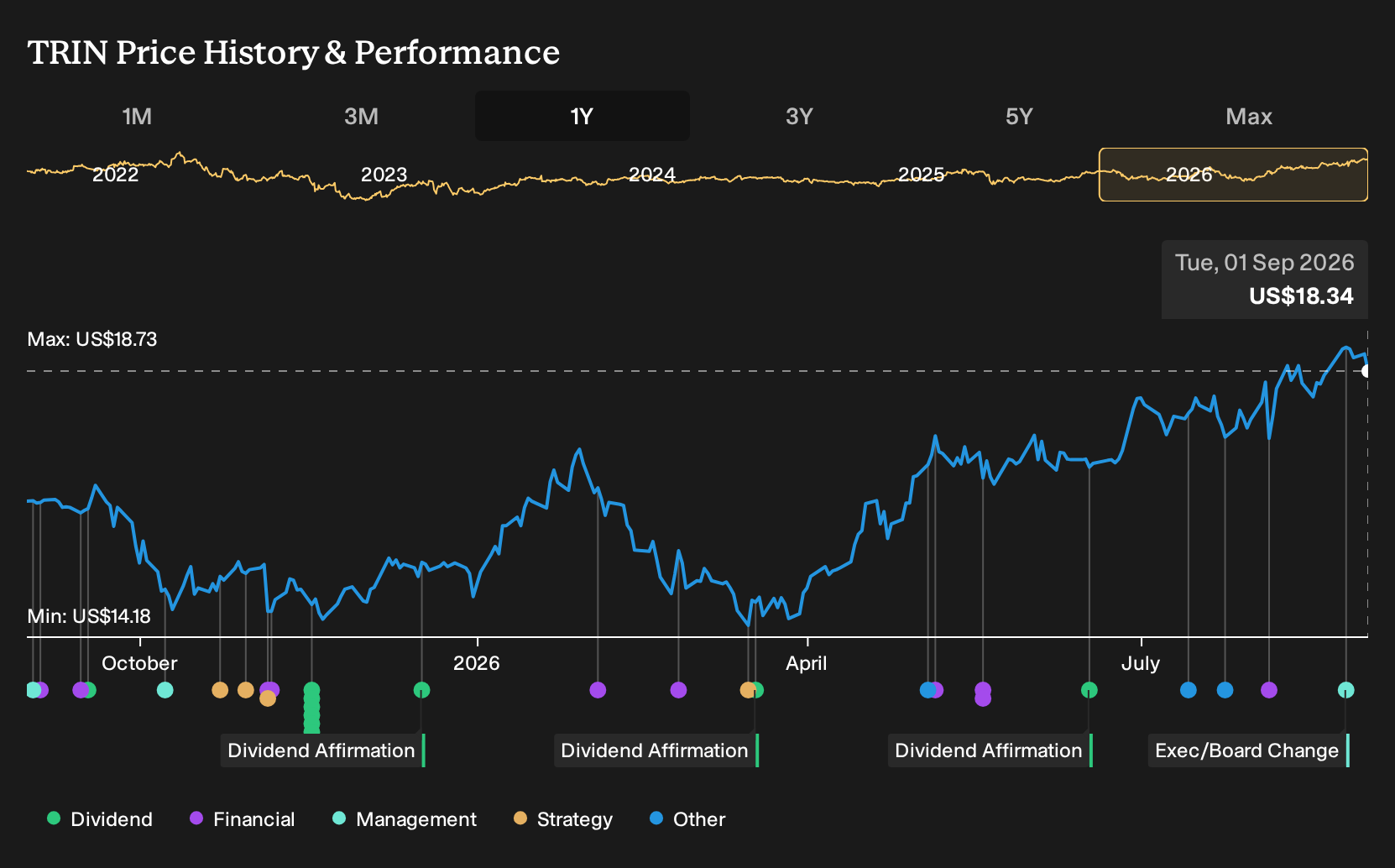
- In early May 2026, Trinity Capital Inc. filed for a US$300 million at-the-market follow-on common equity offering and reported first-quarter 2026 results, with revenue of US$90.13 million and net income of US$29.83 million versus the prior year.
- Although total revenue and net income rose year over year, basic and diluted earnings per share from continuing operations eased to US$0.36 from US$0.43, highlighting the effect of a growing share base and capital-raising activity on per-share metrics.
- Next, we will examine how the new US$300 million at-the-market equity program reshapes Trinity Capital's investment narrative and risk-reward balance.
The future of work is here. Discover the 32 top robotics and automation stocks leading the charge in AI-driven automation and industrial transformation.
Trinity Capital Investment Narrative Recap
To own Trinity Capital, you need to believe in the long term demand for venture lending and equipment finance and in management’s ability to grow while protecting credit quality. The new US$300 million at the market equity program and softer earnings per share in Q1 2026 modestly sharpen the near term focus on dilution risk and dividend coverage, but do not fundamentally change the key catalyst of balance sheet capacity to support future originations.
The most relevant recent development alongside the equity filing is Trinity’s Q1 2026 earnings release, which showed higher total revenue and net income year over year but lower earnings per share. For investors, that mix of growth and per share pressure ties directly into the central catalyst of scaling fee and interest income, while underscoring the risk that frequent equity issuance could weigh on per share returns if portfolio performance or credit quality were to soften.
However, investors should be aware that higher share issuance, combined with a high dividend payout and any future weakening in credit quality, could...
Trinity Capital's narrative projects $430.9 million revenue and $211.2 million earnings by 2029. This requires 12.8% yearly revenue growth and a roughly $72.9 million earnings increase from $138.3 million today.
Uncover how Trinity Capital's forecasts yield a $17.17 fair value, in line with its current price.
Exploring Other Perspectives
Five fair value estimates from the Simply Wall St Community span a wide US$5.49 to US$26.83 range, showing how far apart views on Trinity can be. Against this backdrop, the new US$300 million at the market equity program and its potential impact on dilution, dividend coverage, and per share earnings give you strong reasons to compare several of these perspectives before deciding how Trinity might fit into your portfolio.
Explore 5 other fair value estimates on Trinity Capital - why the stock might be worth less than half the current price!
Form Your Own Verdict
Don't just follow the ticker - dig into the data and build a conviction that's truly your own.
- A great starting point for your Trinity Capital research is our analysis highlighting 3 key rewards and 4 important warning signs that could impact your investment decision.
- Our free Trinity Capital research report provides a comprehensive fundamental analysis summarized in a single visual - the Snowflake - making it easy to evaluate Trinity Capital's overall financial health at a glance.
Seeking Other Investments?
Every day counts. These free picks are already gaining attention. See them before the crowd does:
- The best AI stocks today may lie beyond giants like Nvidia and Microsoft. Find the next big opportunity with these 14 smaller AI-focused companies with strong growth potential through early-stage innovation in machine learning, automation, and data intelligence that could fund your retirement.
- Invest in the nuclear renaissance through our list of 91 elite nuclear energy infrastructure plays powering the global AI revolution.
- Find 49 companies with promising cash flow potential yet trading below their fair value.
This article by Simply Wall St is general in nature. We provide commentary based on historical data and analyst forecasts only using an unbiased methodology and our articles are not intended to be financial advice. It does not constitute a recommendation to buy or sell any stock, and does not take account of your objectives, or your financial situation. We aim to bring you long-term focused analysis driven by fundamental data. Note that our analysis may not factor in the latest price-sensitive company announcements or qualitative material. Simply Wall St has no position in any stocks mentioned.