

UK Inflation Holds At 2.8% As Iran War Disrupts Energy Markets Ahead of BoE Decision
United Kingdom inflation remained unchanged ahead of the country's central bank interest-rate decision and after the economy contracted following nearly four months of global energy supply disruptions caused by the war in the Middle East.
Inflation remained at 2.8% in May, unchanged from April, the Office for National Statistics (ONS) said on Wednesday. Air fares rose by 10.3% between April and May, reversing a 5.0% decline during the same 2025 period, the ONS data showed.
"Inflation held steady in May as various price movements offset each other," ONS Chief Economist Grant Fitzner said. "The main upward movement came from transport with airfares, vehicle taxes, and petrol prices all pushing up inflation. These were offset by lower food prices."
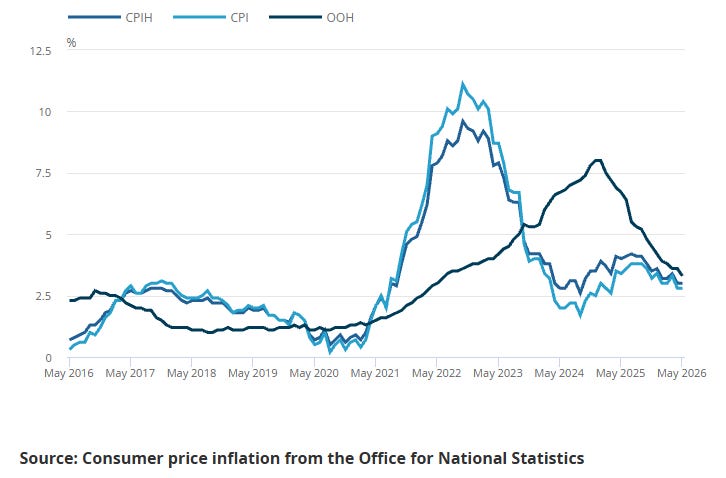
The Bank of England (BoE) in April predicted an increase to 3.3%. The US-Israeli war on Iran kept UK inflation almost a percentage point higher than the central bank had forecast.
The conflict has effectively re-tightened global energy markets at a moment when policymakers expected relief.
"The war in Iran is disrupting energy markets, supply chains, and pushing up costs for businesses across the country," Chancellor of the Exchequer Rachel Reeves said.
US-Iran Deal May Ease Price Strain
The British economy has suffered since the war started in late February. The US-Iranian deal to end the war may not change that immediately.
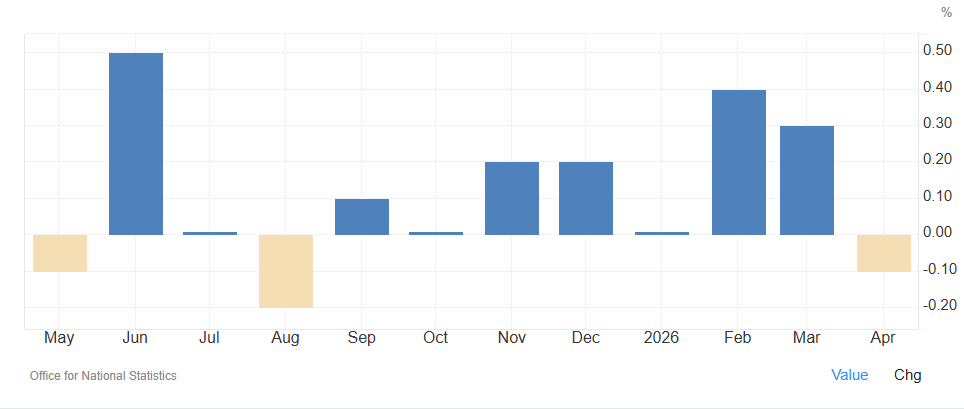
Gross domestic product contracted by 0.1% in April, the first monthly fall since August, the ONS said on Friday. Industrial production stalled in April after contracting by 0.2% year-on-year in March.
UK crude oil input prices rose by 71.8% in the year to May, compared with 76.8% in April. Motor fuel prices jumped 24.6%, the fastest pace since September 2022. The increase reflected both supply‑chain tightness and the UK's exposure to global refined‑product markets.
"Disruptions to shipments through the Strait of Hormuz, together with damage to energy infrastructure, have triggered a sharp rise in energy prices," the OECD said. "Higher costs are feeding into inflation pressures, weakening confidence, and weighing on household demand and business activity."
The OECD forecasts that the British economy will slow from 1.4% in 2025 to 0.9% in 2026. It will recover to 1.1% in 2027, according to the OECD.
UK Eases Russian Fuel Restrictions
In response to higher energy prices, the British government eased restrictions on Russian-derived fuel imports.
The UK's Department for Business and Trade issued a General Trade License on May 20. The move authorized imports of Russian-derived diesel and jet fuel processed in third countries such as India or Turkey.
The prime minister is "choosing to buy dirty Russian oil," Kemi Badenoch, the Leader of the Conservative Party, said. "That money will be used to fund the killing of Ukrainian soldiers."
However, Prime Minister Keir Starmer countered that assertion. He told Parliament that the decision aimed to protect British consumers.
BOE Meets Tomorrow on Rates
The BoE meets on Thursday to determine its next rate move. It will focus on the latest economic data and developments in the Middle East. Under the terms of the new US-Iranian deal, Iran will open the Strait of Hormuz to international maritime traffic.
Markets are pricing in a 95% chance that the Bank of England holds rates steady, LSEG data shows.
Scott Gardner, investment strategist at J.P. Morgan Personal Investing, said that the latest data "will provide some hope that any rebound in UK inflation could be short-lived." Gardner added that while energy dynamics could push prices higher in future readings, attention will turn to how the Ofgem price cap affects inflation and household spending in the coming months
Inflation has remained steady due to the UK's regulated energy price cap. That will rise by 13% later this summer, when energy costs could hit a two-year high, CNBC reported.
Central Bank Set For Prolonged Pause
James Smith, ING Think's Developed Markets Economist, expects the BoE to keep rates steady. At its most recent meeting, the BoE voted to keep its key interest rate at 3.75%.
"Barring the Iran deal falling apart and oil prices spiking back above $100/bbl – and natural gas costs soaring too – we think the BoE is set for a prolonged pause," he said. "We expect a 7-2 vote in favor of ‘no change' tomorrow – and a return to rate cuts in 2027."
Fiona Cincotta, StoneX Senior Market Analyst, said that rate hike expectations are being pushed into the future. That will make the British pound less attractive against the dollar.
"Markets have reduced expectations for further policy tightening, resulting in lower implied support for the pound," Cincotta said. "Currency valuations are often influenced by expected interest rate differentials, and a less hawkish Bank of England outlook could make sterling less attractive relative to peers."
Disclaimer: Any opinions expressed in this article are not to be considered investment advice and are solely those of the authors. European Capital Insights is not responsible for any financial decisions made based on the contents of this article. Readers may use this article for information and educational purposes only.
Benzinga Disclaimer: This article is from an unpaid external contributor. It does not represent Benzinga's reporting and has not been edited for content or accuracy.