

Viasat (VSAT) Is Up 8.8% After Completing ViaSat-3 Constellation With APAC F3 Launch
ViaSat, Inc. VSAT | 0.00 |
- Viasat recently completed the successful launch and initial signal acquisition of its ViaSat-3 F3 satellite on a SpaceX Falcon Heavy, confirming the Asia-Pacific-focused high-throughput spacecraft is healthy in orbit and moving through post-launch deployment toward expected service entry in late summer.
- This launch completes the ViaSat-3 constellation and strengthens Viasat’s global, multi-orbit network, enhancing its ability to concentrate bandwidth where commercial mobility and defense customers need it most.
- We’ll now examine how completing the ViaSat-3 constellation, especially the APAC-focused F3 satellite, reshapes Viasat’s investment narrative and risks.
We've uncovered the 12 dividend fortresses yielding 5%+ that don't just survive market storms, but thrive in them.
Viasat Investment Narrative Recap
To own Viasat, you need to believe that its global, multi-orbit satellite network can turn today’s heavy investment and losses into durable, higher-margin connectivity and defense services. The successful ViaSat-3 F3 launch directly addresses execution risk around its largest capital projects, but it does not eliminate near term pressure from high capex, leverage and competition from LEO constellations and terrestrial broadband, which remain central to the story’s biggest catalyst and risk.
Among the recent announcements, Jetstar’s decision to equip its upgraded 787 fleet with Viasat’s AMARA in-flight connectivity feels most connected to the ViaSat-3 F3 launch. As the APAC focused satellite progresses toward service, it underpins the kind of long haul aviation contracts AMARA targets, offering a clearer line of sight between Viasat’s large capital spend and potential revenue growth in commercial mobility, one of the key areas investors often watch for evidence that new capacity is being effectively commercialized.
But while ViaSat-3 F3 reduces project execution risk, investors should also be aware of...
Viasat's narrative projects $5.1 billion revenue and $557.4 million earnings by 2029.
Uncover how Viasat's forecasts yield a $51.14 fair value, a 20% downside to its current price.
Exploring Other Perspectives
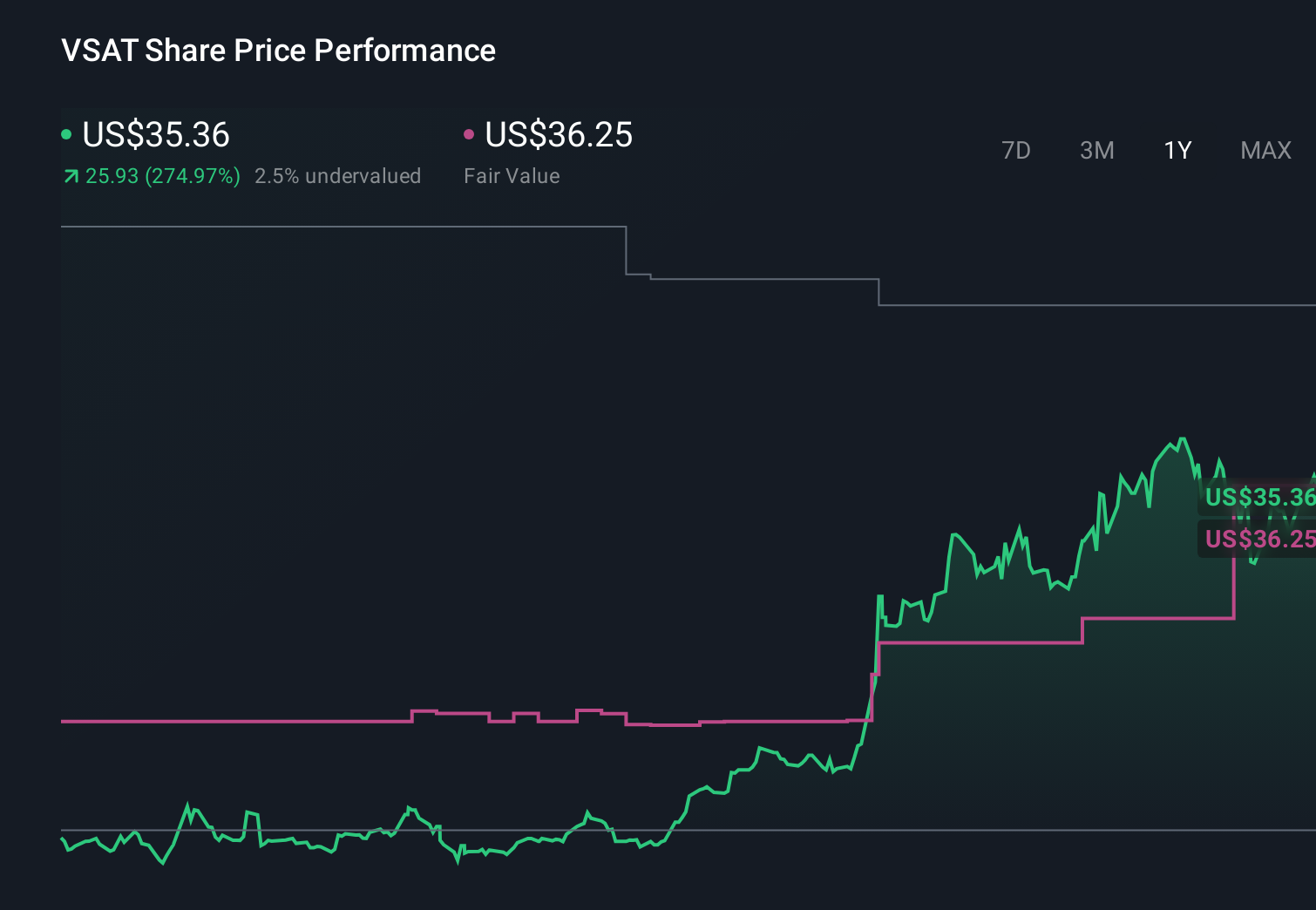
While the ViaSat-3 F3 launch can ease some concerns, the most bearish analysts still saw only about 3.3% annual revenue growth and ongoing losses, showing how sharply opinions can differ and why you may want to compare this cautious view with more optimistic takes before deciding how this new capacity affects your own expectations.
Explore 8 other fair value estimates on Viasat - why the stock might be worth 25% less than the current price!
Reach Your Own Conclusion
Disagree with existing narratives? Extraordinary investment returns rarely come from following the herd, so go with your instincts.
- A great starting point for your Viasat research is our analysis highlighting 2 key rewards and 1 important warning sign that could impact your investment decision.
- Our free Viasat research report provides a comprehensive fundamental analysis summarized in a single visual - the Snowflake - making it easy to evaluate Viasat's overall financial health at a glance.
Ready To Venture Into Other Investment Styles?
Every day counts. These free picks are already gaining attention. See them before the crowd does:
- AI is about to change healthcare. These 33 stocks are working on everything from early diagnostics to drug discovery. The best part - they are all under $10b in market cap - there's still time to get in early.
- Rare earth metals are the new gold rush. Find out which 32 stocks are leading the charge.
- The best AI stocks today may lie beyond giants like Nvidia and Microsoft. Find the next big opportunity with these 18 smaller AI-focused companies with strong growth potential through early-stage innovation in machine learning, automation, and data intelligence that could fund your retirement.
This article by Simply Wall St is general in nature. We provide commentary based on historical data and analyst forecasts only using an unbiased methodology and our articles are not intended to be financial advice. It does not constitute a recommendation to buy or sell any stock, and does not take account of your objectives, or your financial situation. We aim to bring you long-term focused analysis driven by fundamental data. Note that our analysis may not factor in the latest price-sensitive company announcements or qualitative material. Simply Wall St has no position in any stocks mentioned.