

What Hancock Whitney (HWC)'s Weaker Q1 Earnings and Capital Returns Strategy Means For Shareholders
Hancock Whitney Corporation HWC | 0.00 |
- Hancock Whitney Corporation has already reported that first-quarter 2026 net income was US$47.42 million and basic earnings per share from continuing operations was US$0.58, while its board approved a regular second-quarter 2026 common stock cash dividend of US$0.50 per share payable on June 15, 2026.
- Alongside this earnings decline, the company completed a US$94.57 million buyback of 1,400,000 shares and reported lower net charge-offs as a percentage of average total loans compared with the prior quarter, highlighting a mix of weaker profitability and ongoing capital returns.
- We’ll now examine how the sharp year-on-year drop in earnings per share may influence Hancock Whitney’s previously outlined investment narrative.
We've uncovered the 12 dividend fortresses yielding 5%+ that don't just survive market storms, but thrive in them.
Hancock Whitney Investment Narrative Recap
To stay invested in Hancock Whitney, you need to be comfortable with a story centered on disciplined regional banking, stable dividends, and measured loan quality, while accepting that earnings can be volatile. The sharp year-on-year drop in first quarter 2026 EPS to US$0.58 highlights that near term earnings visibility is a key catalyst and risk, but the latest results do not appear to fundamentally change concerns around credit trends, funding costs, or integration of new business lines.
The most relevant update is the board’s decision to maintain the second quarter 2026 dividend at US$0.50 per share, even after weaker quarterly earnings. That choice, alongside the completed US$94.57 million buyback and slightly lower net charge offs at 0.19 percent of average total loans, keeps capital returns in focus while investors watch whether earnings pressure and loan growth uncertainty start to challenge this pace of cash distributions.
Yet this consistency in capital returns sits alongside growing questions about whether softer earnings and loan growth could eventually pressure the dividend that investors should be aware of...
Hancock Whitney's narrative projects $1.9 billion revenue and $589.7 million earnings by 2029. This implies 10.3% yearly revenue growth and about a $177 million earnings increase from $412.3 million today.
Uncover how Hancock Whitney's forecasts yield a $77.67 fair value, a 17% upside to its current price.
Exploring Other Perspectives
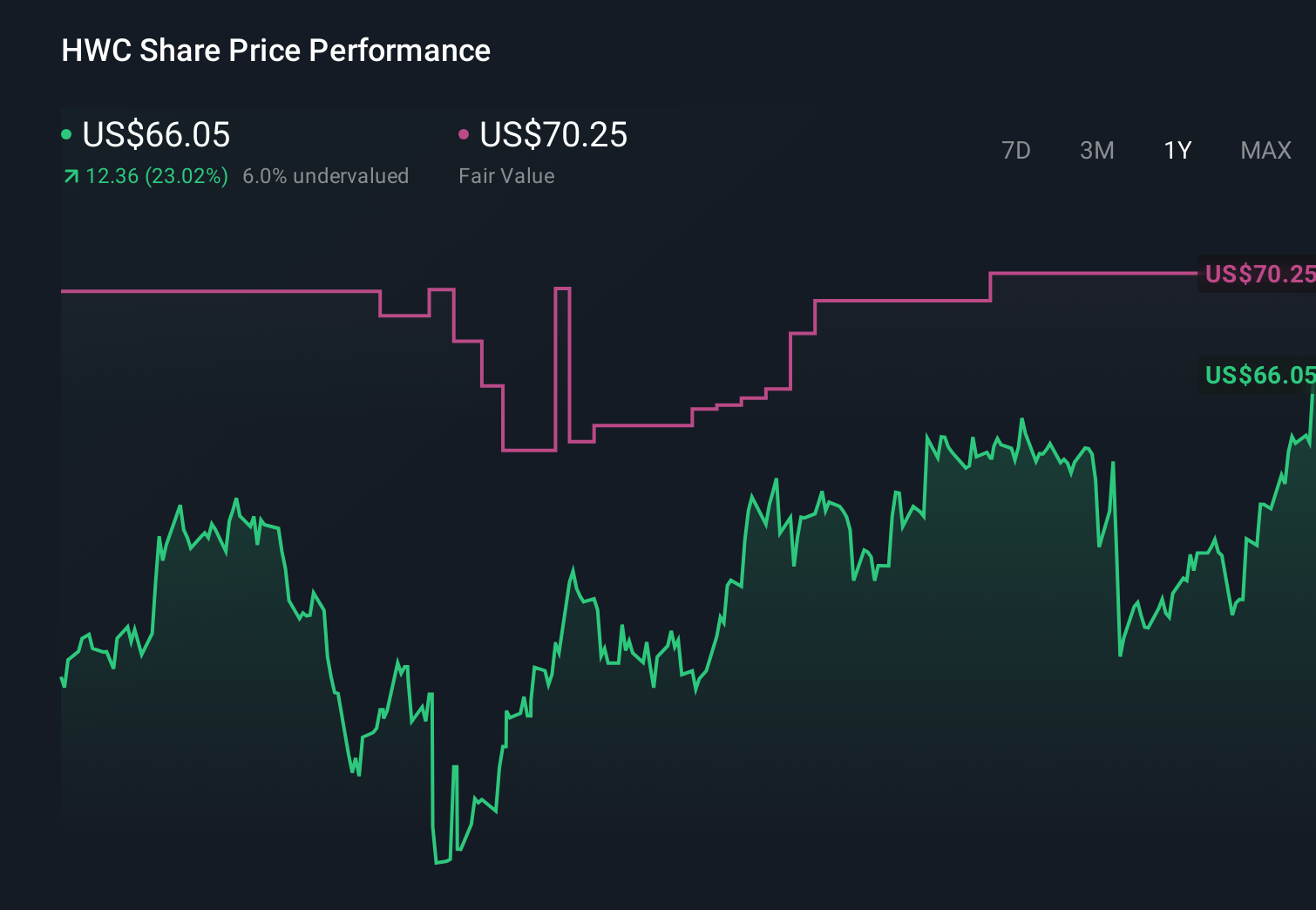
Two fair value estimates from the Simply Wall St Community span roughly US$77.67 to US$131.57, showing how far apart individual views can sit. Readers should weigh those opinions against the recent earnings decline, which keeps forecast profit growth and credit quality firmly in the spotlight for Hancock Whitney’s future performance.
Explore 2 other fair value estimates on Hancock Whitney - why the stock might be worth just $77.67!
Form Your Own Verdict
Disagree with existing narratives? Extraordinary investment returns rarely come from following the herd, so go with your instincts.
- A great starting point for your Hancock Whitney research is our analysis highlighting 3 key rewards and 1 important warning sign that could impact your investment decision.
- Our free Hancock Whitney research report provides a comprehensive fundamental analysis summarized in a single visual - the Snowflake - making it easy to evaluate Hancock Whitney's overall financial health at a glance.
Interested In Other Possibilities?
Our daily scans reveal stocks with breakout potential. Don't miss this chance:
- The future of work is here. Discover the 34 top robotics and automation stocks leading the charge in AI-driven automation and industrial transformation.
- AI is about to change healthcare. These 33 stocks are working on everything from early diagnostics to drug discovery. The best part - they are all under $10b in market cap - there's still time to get in early.
- Find 48 companies with promising cash flow potential yet trading below their fair value.
This article by Simply Wall St is general in nature. We provide commentary based on historical data and analyst forecasts only using an unbiased methodology and our articles are not intended to be financial advice. It does not constitute a recommendation to buy or sell any stock, and does not take account of your objectives, or your financial situation. We aim to bring you long-term focused analysis driven by fundamental data. Note that our analysis may not factor in the latest price-sensitive company announcements or qualitative material. Simply Wall St has no position in any stocks mentioned.