

What Truist Financial (TFC)'s Strong Q1 Earnings and New Debt Issuance Mean For Shareholders
TRUIST FINANCIAL CORPORATION TFC | 50.73 | -1.30% |
- In April 2026, Truist Financial Corporation completed two US$1.00 billion senior unsecured fixed‑to‑floating rate note offerings maturing in 2032 and 2037, while reporting first‑quarter 2026 net income of US$1,481 million, up from US$1,261 million a year earlier.
- Despite the stronger quarterly earnings and ongoing bond issuance, Truist lowered its revenue outlook amid higher market volatility and economic uncertainty, emphasizing flat investment banking and trading revenues for the year.
- We will now examine how Truist’s reduced revenue outlook, despite solid earnings and new debt issuance, reshapes its longer‑term investment narrative.
AI is about to change healthcare. These 34 stocks are working on everything from early diagnostics to drug discovery. The best part - they are all under $10b in market cap - there's still time to get in early.
Truist Financial Investment Narrative Recap
To own Truist, you generally need to believe in its ability to translate ongoing digital and Sunbelt‑focused growth into steady earnings, while managing branch costs and credit risk. The recent US$2,000 million senior note issuance and stronger Q1 2026 earnings do not materially change the near term focus, which still centers on how Truist handles a softer revenue outlook and the risk that higher volatility and flat capital markets fees constrain profit growth.
The completion of two US$1,000 million fixed to floating senior note offerings in April 2026 is especially relevant here, as it highlights Truist’s access to funding while it invests in technology, open banking partnerships and payments capabilities. That funding backdrop sits alongside the company’s ongoing share buybacks and dividend payments, which together form an important part of the current shareholder thesis but also increase the importance of disciplined expense and credit management.
Yet even with these positives, investors should be aware that Truist’s above average commercial real estate exposure could...
Truist Financial's narrative projects $24.2 billion revenue and $6.2 billion earnings by 2029. This requires 9.1% yearly revenue growth and about a $1.0 billion earnings increase from $5.2 billion today.
Uncover how Truist Financial's forecasts yield a $54.82 fair value, a 8% upside to its current price.
Exploring Other Perspectives
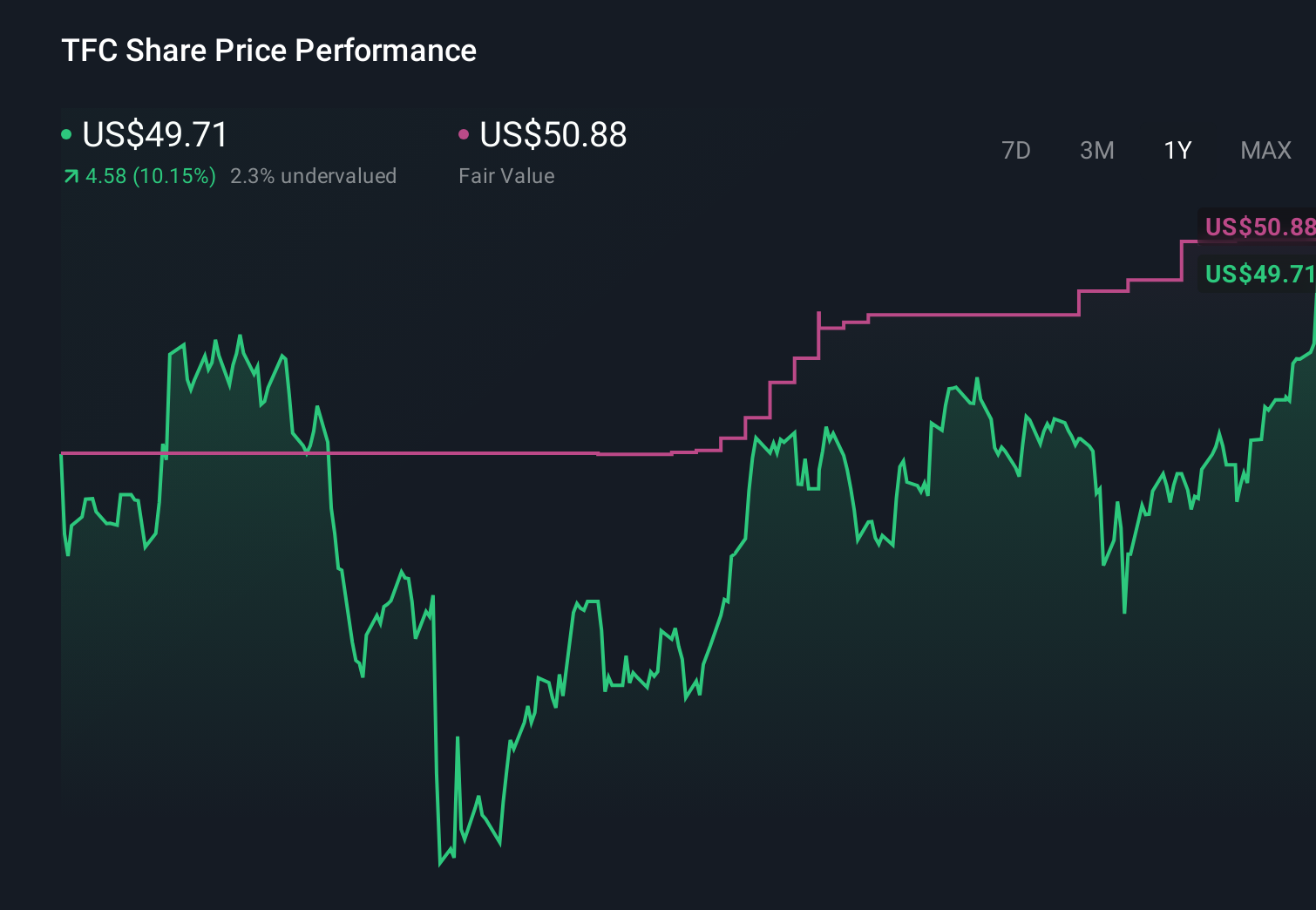
Two Simply Wall St Community fair value estimates, ranging from US$54.82 to US$76.35, show how far opinions can stretch. When you set those views against Truist’s softer revenue outlook and exposure to capital markets volatility, it underlines why many investors compare several perspectives before forming a view on the bank’s longer term performance.
Explore 2 other fair value estimates on Truist Financial - why the stock might be worth just $54.82!
Decide For Yourself
Don't just follow the ticker - dig into the data and build a conviction that's truly your own.
- A great starting point for your Truist Financial research is our analysis highlighting 4 key rewards that could impact your investment decision.
- Our free Truist Financial research report provides a comprehensive fundamental analysis summarized in a single visual - the Snowflake - making it easy to evaluate Truist Financial's overall financial health at a glance.
Seeking Other Investments?
The market won't wait. These fast-moving stocks are hot now. Grab the list before they run:
- The best AI stocks today may lie beyond giants like Nvidia and Microsoft. Find the next big opportunity with these 19 smaller AI-focused companies with strong growth potential through early-stage innovation in machine learning, automation, and data intelligence that could fund your retirement.
- Find 61 companies with promising cash flow potential yet trading below their fair value.
- The future of work is here. Discover the 35 top robotics and automation stocks leading the charge in AI-driven automation and industrial transformation.
This article by Simply Wall St is general in nature. We provide commentary based on historical data and analyst forecasts only using an unbiased methodology and our articles are not intended to be financial advice. It does not constitute a recommendation to buy or sell any stock, and does not take account of your objectives, or your financial situation. We aim to bring you long-term focused analysis driven by fundamental data. Note that our analysis may not factor in the latest price-sensitive company announcements or qualitative material. Simply Wall St has no position in any stocks mentioned.