

Why Maplebear (CART) Is Down 10.3% After Posting Its First $1 Billion Revenue Quarter
Maplebear Inc. CART | 0.00 |
- In early May 2026, Maplebear Inc. (Instacart) reported past first-quarter results showing sales of US$1,019 million and net income of US$144 million, marking its first time surpassing US$10 billion in Gross Transaction Value and US$1 billion in quarterly revenue.
- The company also grew basic earnings per share from continuing operations to US$0.59 and expanded its operating margin to 17.9%, while outlining plans to invest further in AI, international expansion, and in-store technologies.
- We’ll now examine how Instacart’s milestone quarter, particularly its margin expansion, may influence the existing investment narrative for Maplebear.
The future of work is here. Discover the 32 top robotics and automation stocks leading the charge in AI-driven automation and industrial transformation.
Maplebear Investment Narrative Recap
To own Maplebear, you need to believe Instacart can keep turning online grocery demand and its retail-tech platform into durable, high-margin earnings. The latest quarter’s US$1,019 million in sales, US$144 million in net income, and a 17.9% operating margin support that profitability angle, but they do not remove key near term risks around rising labor costs, competitive pressure from retailer-led delivery, and potential pullbacks in high margin advertising spend.
Among recent developments, the ongoing share repurchase program stands out alongside this milestone quarter. Since mid 2024, Maplebear has bought back about 17.8% of its shares for roughly US$1,829 million, while continuing to expand partnerships and invest in AI, international software deployments, and in store technologies. Together with stronger margins in Q1 2026, this mix of capital return and reinvestment sits at the heart of the current catalyst case for the stock.
Yet against this strong margin story, investors should also be aware of how rising labor and fulfillment costs could eventually...
Maplebear's narrative projects $4.9 billion revenue and $800.3 million earnings by 2029. This requires 9.4% yearly revenue growth and a $362.3 million earnings increase from $438.0 million today.
Uncover how Maplebear's forecasts yield a $50.14 fair value, a 32% upside to its current price.
Exploring Other Perspectives
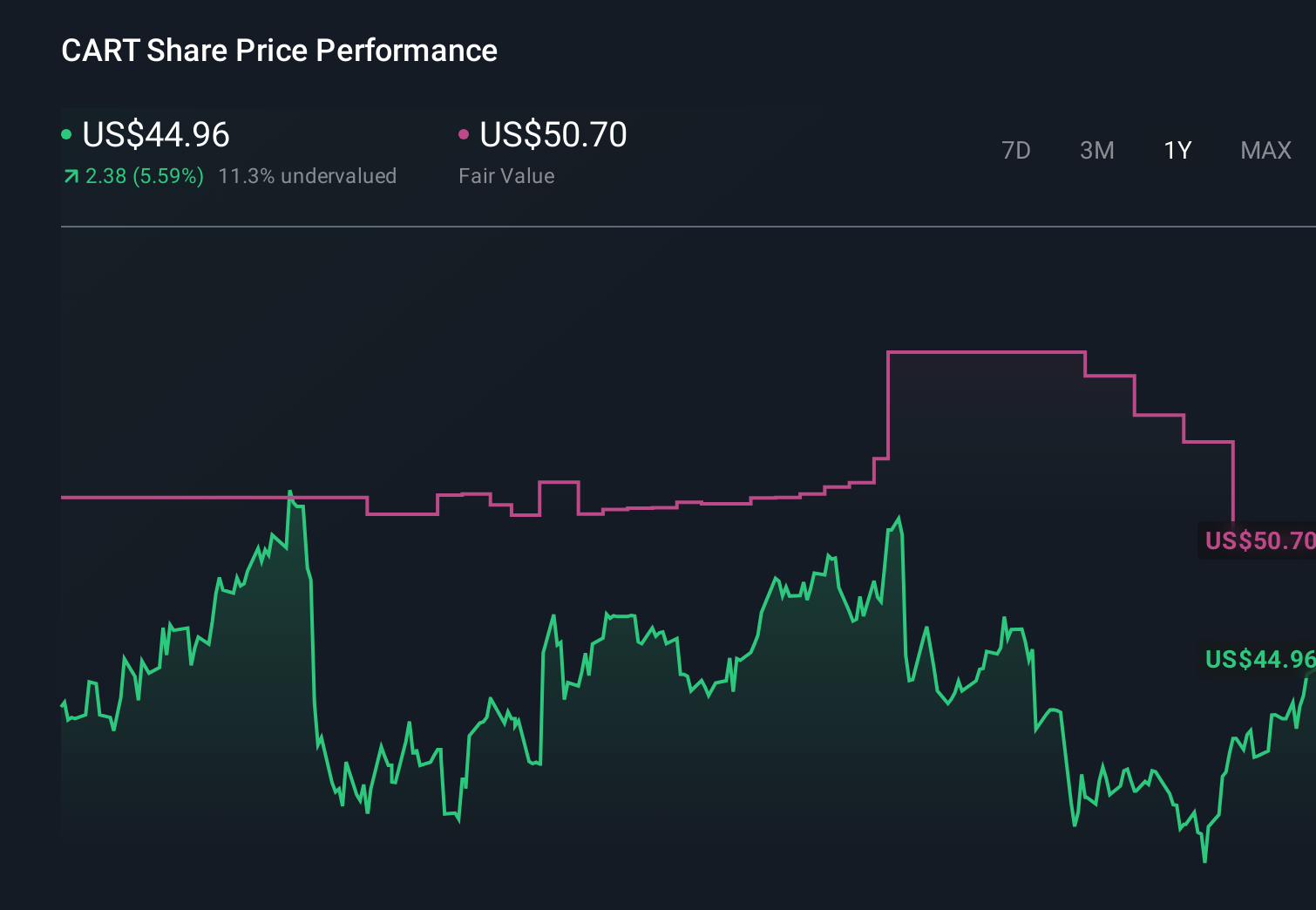
Some of the lowest ranked analysts were assuming revenue would fall about 3.5% a year and earnings slip toward roughly US$451 million, which is far more pessimistic than the baseline view. When you compare that to Instacart’s latest margin expansion and the added risk that higher mandated worker earnings could squeeze unit economics, it highlights how widely your peers can disagree and why it may be worth exploring several alternative viewpoints before deciding what this new quarter really means.
Explore 2 other fair value estimates on Maplebear - why the stock might be worth just $50.14!
The Verdict Is Yours
Don't just follow the ticker - dig into the data and build a conviction that's truly your own.
- A great starting point for your Maplebear research is our analysis highlighting 3 key rewards that could impact your investment decision.
- Our free Maplebear research report provides a comprehensive fundamental analysis summarized in a single visual - the Snowflake - making it easy to evaluate Maplebear's overall financial health at a glance.
No Opportunity In Maplebear?
Our top stock finds are flying under the radar-for now. Get in early:
- Capitalize on the AI infrastructure supercycle with our selection of the 40 best 'picks and shovels' of the AI gold rush converting record-breaking demand into massive cash flow.
- We've uncovered the 12 dividend fortresses yielding 5%+ that don't just survive market storms, but thrive in them.
- Explore 27 top quantum computing companies leading the revolution in next-gen technology and shaping the future with breakthroughs in quantum algorithms, superconducting qubits, and cutting-edge research.
This article by Simply Wall St is general in nature. We provide commentary based on historical data and analyst forecasts only using an unbiased methodology and our articles are not intended to be financial advice. It does not constitute a recommendation to buy or sell any stock, and does not take account of your objectives, or your financial situation. We aim to bring you long-term focused analysis driven by fundamental data. Note that our analysis may not factor in the latest price-sensitive company announcements or qualitative material. Simply Wall St has no position in any stocks mentioned.