

Will UMBF’s Strong Q1, Buyback and ESOP Plan Change UMB Financial’s Capital Allocation Narrative?
UMB Financial Corporation UMBF | 0.00 |
- In late April 2026, UMB Financial reported significantly higher first-quarter results than a year earlier, including net interest income of US$534.37 million and net income of US$261.44 million, while also affirming common and preferred dividends, launching a new buyback authorization of up to 2,000,000 shares, and filing a US$372.66 million ESOP-related common stock shelf registration.
- An interesting angle for investors is that UMB Financial combined materially stronger earnings and lower net charge-offs of US$18.9 million with a mix of capital return and potential ESOP share issuance, highlighting a balanced approach to rewarding shareholders and supporting employee ownership.
- Against this backdrop, we'll examine how the substantial first-quarter earnings jump reshapes UMB Financial's previously outlined investment narrative and assumptions.
This technology could replace computers: discover 27 stocks that are working to make quantum computing a reality.
UMB Financial Investment Narrative Recap
To own UMB Financial, you need to be comfortable with a largely regional, acquisition-heavy bank that is working to convert scale into better efficiency and earnings, while managing credit and integration risks. The sharp first quarter earnings increase and lower net charge-offs support the near term earnings catalyst, but do not eliminate concerns about cost structure and the challenge of fully integrating Heartland’s footprint.
The new US$372.66 million ESOP related shelf registration for up to 3,000,000 common shares sits alongside stronger earnings, lower charge-offs and an expanded buyback program. Together, these moves frame a capital story in which progress on Heartland integration, cost savings and branch efficiency remains central to whether recent earnings strength can be sustained without relying on episodic income sources.
Yet even with strong recent results, investors still need to consider the risk that UMB’s enlarged branch network could become a drag if...
UMB Financial's narrative projects $3.3 billion revenue and $1.2 billion earnings by 2029.
Uncover how UMB Financial's forecasts yield a $142.83 fair value, a 9% upside to its current price.
Exploring Other Perspectives
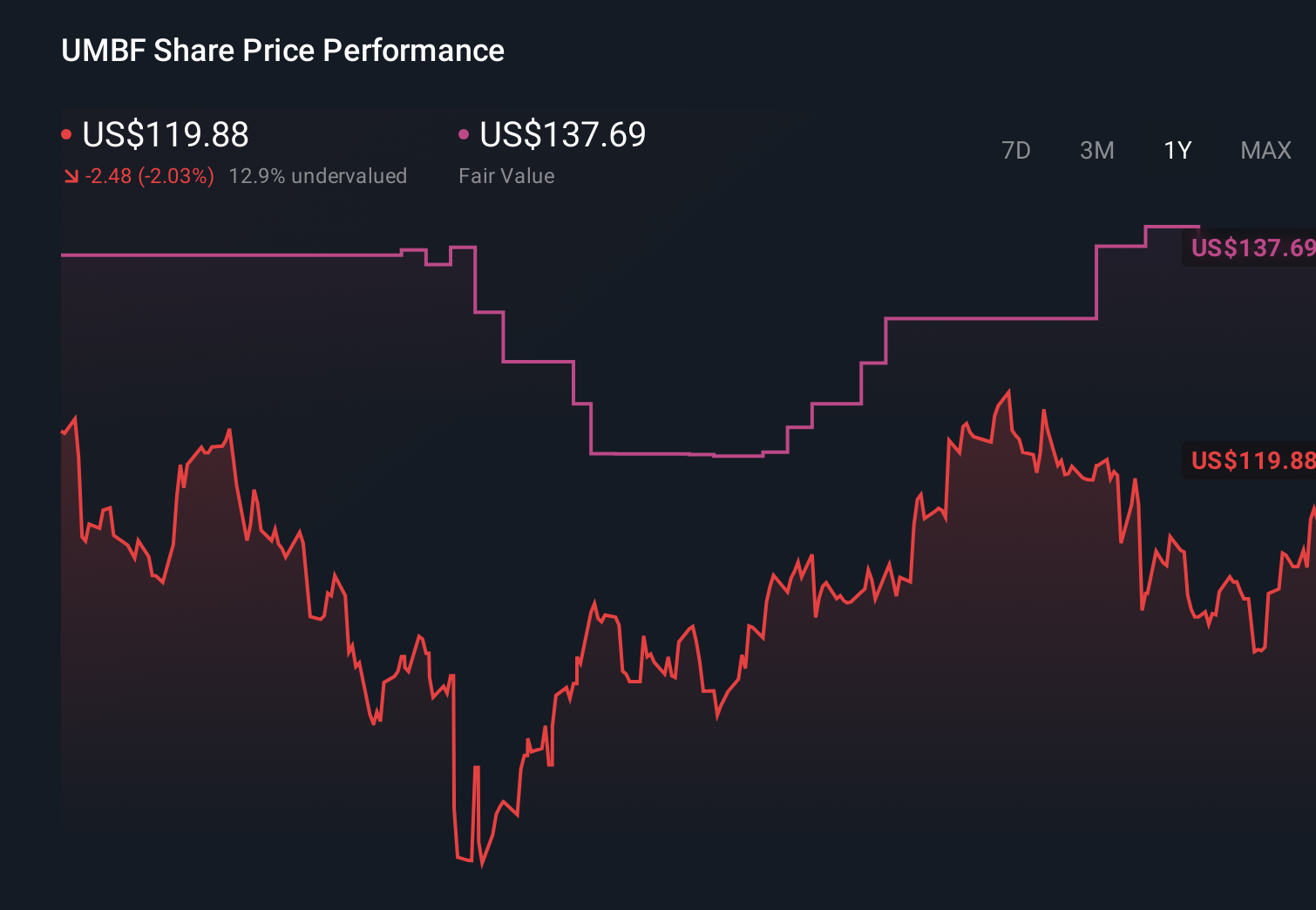
Three Simply Wall St Community fair value estimates for UMB Financial span a wide range, from US$69.60 to US$222.51, underscoring how far apart individual views can be. Against that spread, the recent jump in earnings and lower net charge offs gives you one more angle to weigh alongside concerns about integration execution and regional concentration as you compare different viewpoints on the company’s prospects.
Explore 3 other fair value estimates on UMB Financial - why the stock might be worth as much as 70% more than the current price!
Form Your Own Verdict
Disagree with existing narratives? Extraordinary investment returns rarely come from following the herd, so go with your instincts.
- A great starting point for your UMB Financial research is our analysis highlighting 3 key rewards that could impact your investment decision.
- Our free UMB Financial research report provides a comprehensive fundamental analysis summarized in a single visual - the Snowflake - making it easy to evaluate UMB Financial's overall financial health at a glance.
Looking For Alternative Opportunities?
Early movers are already taking notice. See the stocks they're targeting before they've flown the coop:
- AI is about to change healthcare. These 35 stocks are working on everything from early diagnostics to drug discovery. The best part - they are all under $10b in market cap - there's still time to get in early.
- Uncover the next big thing with 25 elite penny stocks that balance risk and reward.
- Find 51 companies with promising cash flow potential yet trading below their fair value.
This article by Simply Wall St is general in nature. We provide commentary based on historical data and analyst forecasts only using an unbiased methodology and our articles are not intended to be financial advice. It does not constitute a recommendation to buy or sell any stock, and does not take account of your objectives, or your financial situation. We aim to bring you long-term focused analysis driven by fundamental data. Note that our analysis may not factor in the latest price-sensitive company announcements or qualitative material. Simply Wall St has no position in any stocks mentioned.