

Williams Sonoma (WSM) Stock May Be 16% Undervalued Following Kickback Scheme News
Williams-Sonoma, Inc. WSM | 0.00 |
Williams-Sonoma stock has surged over the past three years, yet the current valuation picture is mixed, with an intrinsic value estimate pointing to upside while market multiples suggest the shares are already pricing in a lot of good news. At the same time, the broader value checks lean expensive for Williams-Sonoma, which puts more focus on how sustainable recent performance really is.
- Over the past three years, Williams-Sonoma has delivered a return of about 245.7%, which puts extra attention on whether the current share price still leaves room for further gains.
- The recent guilty plea by a former executive in a US$16.3m warehouse kickback scheme underscores governance and execution risk. Ongoing demand for home goods and related cash flow can support the intrinsic value case if operations remain resilient.
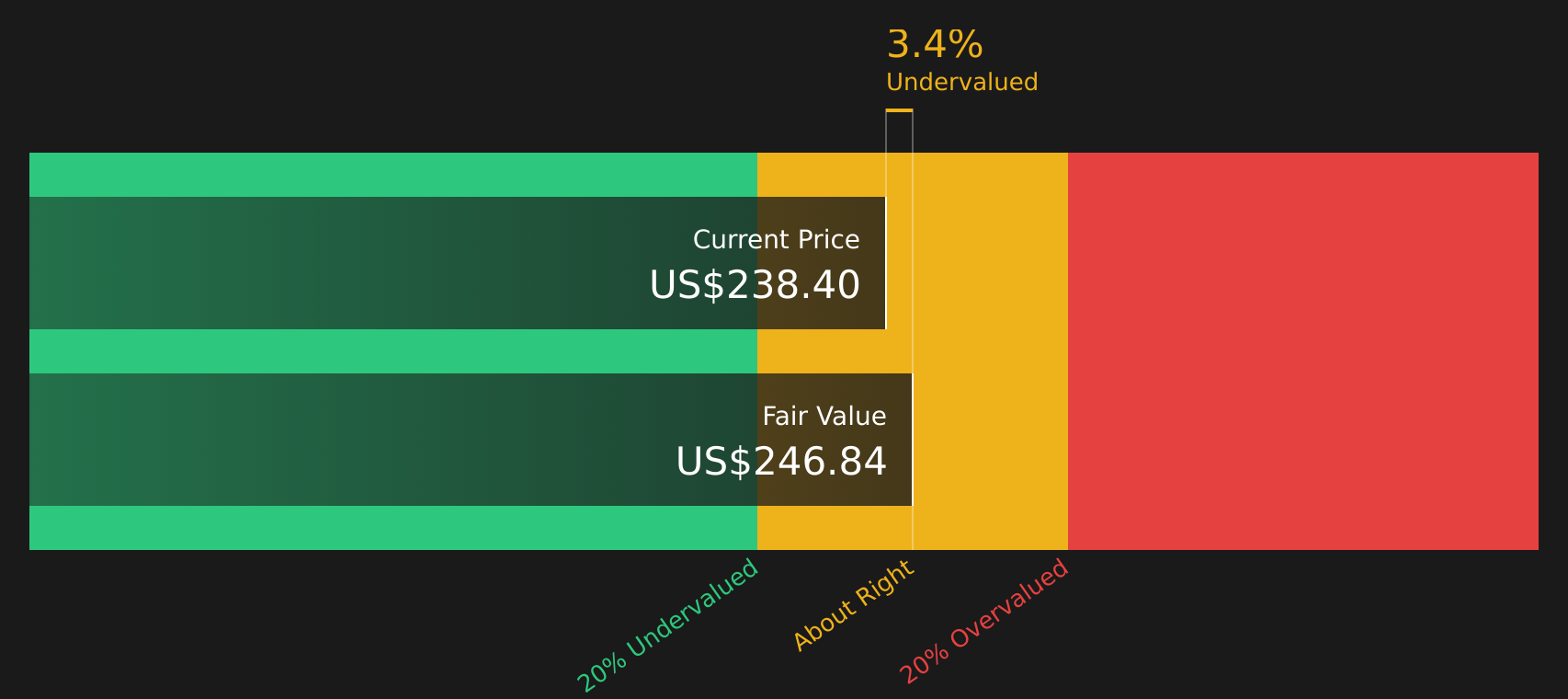
- The stock screens as undervalued on a Discounted Cash Flow (DCF) estimate with a discount of about 15.6%. However, the earnings multiple view leans rich, and the broader checks, with a value score of 1 out of 6, suggest Williams-Sonoma is not a clear bargain.
The issue now is whether Williams-Sonoma's current price better reflects the intrinsic value estimate or the more expensive picture implied by traditional market multiples and the low value score.
Compare Williams-Sonoma's mixed valuation signals with a curated set of 49 high quality undervalued stocks that also pair strong cash generation with balance sheets designed to weather governance and execution shocks.
Is Williams-Sonoma a Bargain on Cash Flow?
The Discounted Cash Flow model looks at the cash Williams-Sonoma is expected to generate for shareholders over time. In this framework, the company is treated as a mature, cash generative retailer, with latest twelve month free cash flow of about $1.1b and projections that assume continued growth rather than a sharp step change.
Those cash flow estimates translate into an intrinsic value of about $278 per share, which implies the stock trades at roughly a 15.6% discount and screens as undervalued on this method. The recent guilty plea linked to the US$16.3m warehouse kickback scheme helps explain why the share price may still sit below the level that the cash flow profile alone would support, as it highlights governance and execution risk that some investors may be factoring in.
On the DCF numbers, Williams-Sonoma stock currently appears undervalued relative to its projected cash flows.
Our Discounted Cash Flow (DCF) analysis suggests Williams-Sonoma is undervalued by 15.6%. Track this in your watchlist or portfolio, or discover 49 more high quality undervalued stocks.
Is Williams-Sonoma Getting Expensive on Earnings?
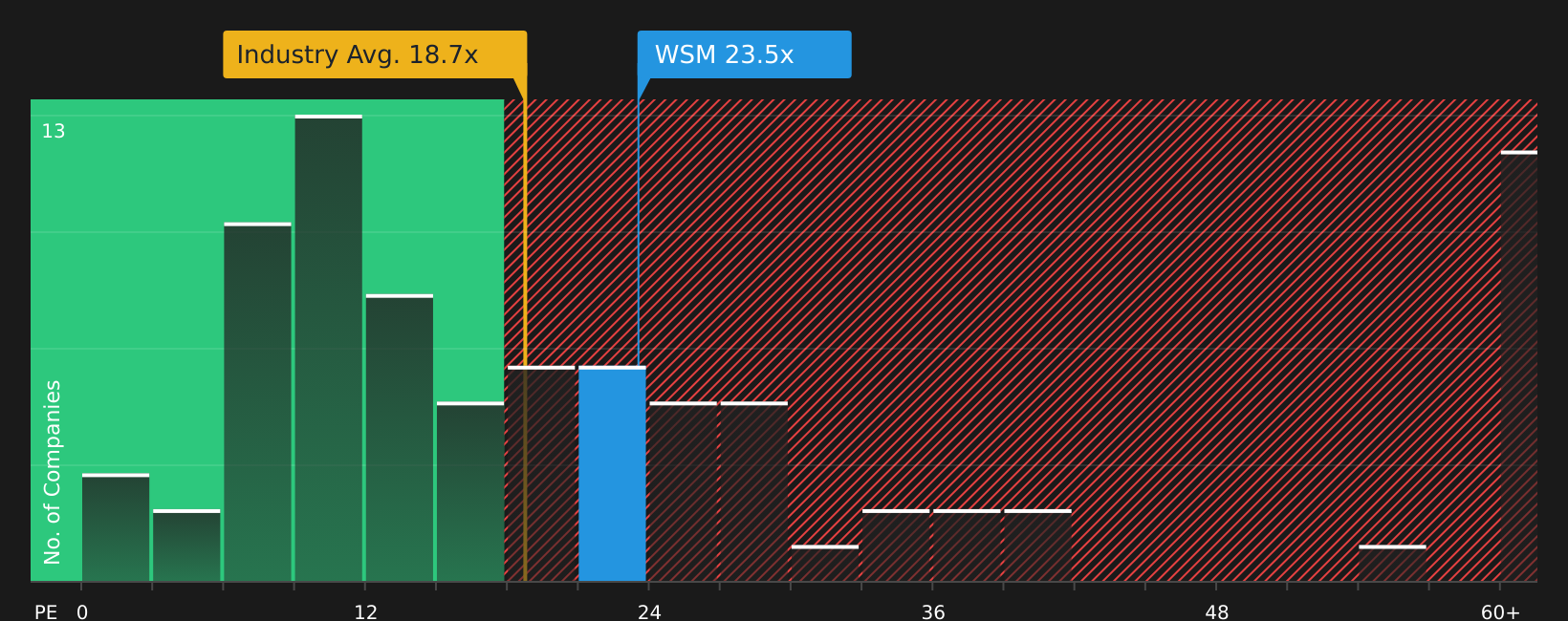
The P/E multiple suits Williams-Sonoma because earnings remain a key anchor for how investors look at established retailers. Williams-Sonoma currently trades on a P/E of about 25.4x, which is above both the Specialty Retail industry average of roughly 18.8x and the peer group average of about 20.1x. That already points to investors paying a clear premium for each dollar of current earnings compared with many comparable retailers.
A more tailored yardstick is the fair P/E ratio estimate of about 17.6x, which incorporates factors such as the company’s growth profile, profitability, scale and risk. Against that benchmark, Williams-Sonoma trades at a higher multiple, which suggests the market is assigning a richer valuation than this framework would support on earnings alone. Taken together, the stock screens as overvalued on the P/E measure, even before considering broader governance concerns that some investors may still be weighing.
On the earnings multiple, Williams-Sonoma stock appears overvalued relative to both sector benchmarks and its own fair P/E estimate.
The Williams-Sonoma Narrative: What Would Justify Today's Price?
Simply Wall St Narratives for Williams-Sonoma pick up where this valuation puzzle leaves off and explain which assumptions about Williams-Sonoma's future growth, margins and earnings would need to hold for the stock to be worth materially more or less than today's price on the Community page. Each Narrative presents fair value as a thesis about the business that you can revisit over time, rather than a single static number.
Community views on Williams-Sonoma pull in very different directions, with one side focused on digital strength and the other on tariff and demand risk.
Bull case: 10% undervalued
"Williams-Sonoma’s leadership in e-commerce and omnichannel retailing, with nearly 66% of revenues from digital channels and ongoing investments in AI-driven personalization and integrated channel experiences, positions the company to capture share as consumer spending increasingly shifts online..."
Bear case: 44% overvalued
"The current macroeconomic uncertainties, including tariffs on imports from China, Mexico, Canada, and additional tariffs on metals and aluminum, are expected to negatively impact Williams-Sonoma's gross margins, potentially challenging earnings growth..."
Do you think there's more to the story for Williams-Sonoma? Head over to our Community to see what others are saying!
The Bottom Line
For Williams-Sonoma, the Discounted Cash Flow (DCF) view points to some intrinsic value upside, while the earnings multiple suggests the stock already trades on a premium to peers. That gap reflects a market that is willing to pay up for current earnings and sentiment, even as the cash flow profile paints a more supportive picture. With broader checks still weak, the key question is whether Williams-Sonoma can sustain its cash generation and address governance and execution risks. The answer to that question is likely to decide whether the current discount to intrinsic value is an opportunity or a value trap.
This article by Simply Wall St is general in nature. We provide commentary based on historical data and analyst forecasts only using an unbiased methodology and our articles are not intended to be financial advice. It does not constitute a recommendation to buy or sell any stock, and does not take account of your objectives, or your financial situation. We aim to bring you long-term focused analysis driven by fundamental data. Note that our analysis may not factor in the latest price-sensitive company announcements or qualitative material. Simply Wall St has no position in any stocks mentioned.