

Ziff Davis to Join UBS Global Technology and AI Conference
Reuters 03/12 11:00
Does Bandwidth (NASDAQ:BAND) Have A Healthy Balance Sheet?
Bandwidth BAND | 0.00 |
The external fund manager backed by Berkshire Hathaway's Charlie Munger, Li Lu, makes no bones about it when he says 'The biggest investment risk is not the volatility of prices, but whether you will suffer a permanent loss of capital.' So it might be obvious that you need to consider debt, when you think about how risky any given stock is, because too much debt can sink a company. We note that Bandwidth Inc. (NASDAQ:BAND) does have debt on its balance sheet. But the real question is whether this debt is making the company risky.
Debt is a tool to help businesses grow, but if a business is incapable of paying off its lenders, then it exists at their mercy. Part and parcel of capitalism is the process of 'creative destruction' where failed businesses are mercilessly liquidated by their bankers. However, a more common (but still painful) scenario is that it has to raise new equity capital at a low price, thus permanently diluting shareholders. Of course, plenty of companies use debt to fund growth, without any negative consequences. When we think about a company's use of debt, we first look at cash and debt together.
You can click the graphic below for the historical numbers, but it shows that Bandwidth had US$254.4m of debt in March 2025, down from US$419.0m, one year before. However, because it has a cash reserve of US$41.7m, its net debt is less, at about US$212.7m.
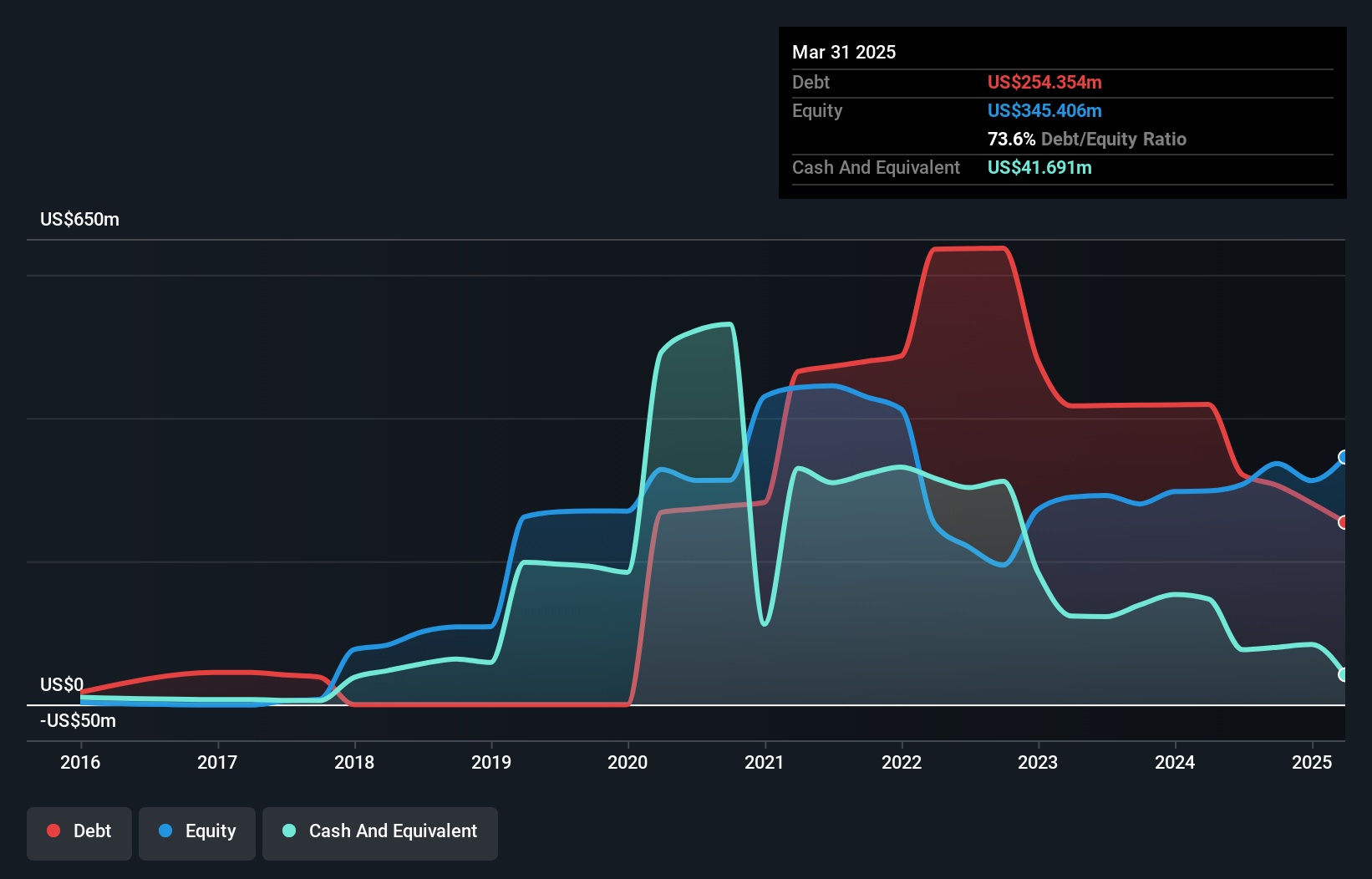
According to the last reported balance sheet, Bandwidth had liabilities of US$115.7m due within 12 months, and liabilities of US$503.2m due beyond 12 months. On the other hand, it had cash of US$41.7m and US$87.0m worth of receivables due within a year. So its liabilities outweigh the sum of its cash and (near-term) receivables by US$490.3m.
When you consider that this deficiency exceeds the company's US$453.9m market capitalization, you might well be inclined to review the balance sheet intently. Hypothetically, extremely heavy dilution would be required if the company were forced to pay down its liabilities by raising capital at the current share price. When analysing debt levels, the balance sheet is the obvious place to start. But ultimately the future profitability of the business will decide if Bandwidth can strengthen its balance sheet over time. So if you want to see what the professionals think, you might find this free report on analyst profit forecasts to be interesting.
Over 12 months, Bandwidth reported revenue of US$752m, which is a gain of 19%, although it did not report any earnings before interest and tax. We usually like to see faster growth from unprofitable companies, but each to their own.
Importantly, Bandwidth had an earnings before interest and tax (EBIT) loss over the last year. To be specific the EBIT loss came in at US$14m. When we look at that alongside the significant liabilities, we're not particularly confident about the company. We'd want to see some strong near-term improvements before getting too interested in the stock. It's fair to say the loss of US$1.0m didn't encourage us either; we'd like to see a profit. And until that time we think this is a risky stock. When analysing debt levels, the balance sheet is the obvious place to start. But ultimately, every company can contain risks that exist outside of the balance sheet.
Of course, if you're the type of investor who prefers buying stocks without the burden of debt, then don't hesitate to discover our exclusive list of net cash growth stocks, today.
This article by Simply Wall St is general in nature. We provide commentary based on historical data and analyst forecasts only using an unbiased methodology and our articles are not intended to be financial advice. It does not constitute a recommendation to buy or sell any stock, and does not take account of your objectives, or your financial situation. We aim to bring you long-term focused analysis driven by fundamental data. Note that our analysis may not factor in the latest price-sensitive company announcements or qualitative material. Simply Wall St has no position in any stocks mentioned.