


Please use a PC Browser to access Register-Tadawul
Get It
How Eli Lilly’s US$3.5 Billion Obesity Plant Investment At Eli Lilly (LLY) Has Changed Its Investment Story
Eli Lilly and Company LLY | 985.08 | +0.80% |
These 14 companies survived and thrived after COVID and have the right ingredients to survive Trump's tariffs. Discover why before your portfolio feels the trade war pinch.
To own Eli Lilly today, you have to believe its GLP‑1 franchise can keep driving earnings while the company steadily reduces its dependence on a few blockbuster injectables. The new US$3.50 billion Lehigh Valley plant fits that story as a long‑dated, capital‑intensive bet on sustained obesity demand rather than a near‑term catalyst; with operations not expected until 2031, it does little to change the next couple of years, which still hinge on tirzepatide execution, the orforglipron pill decision delay and competitive pressure from Novo Nordisk’s oral Wegovy. Where it does move the needle is on the risk side: Lilly is leaning harder into obesity, adding fixed costs and balance sheet demands to a business that already carries a high valuation, high debt levels and meaningful single‑therapy concentration.
However, investors should also recognize how much of Lilly’s value now rests on a narrow set of obesity assumptions. Despite retreating, Eli Lilly's shares might still be trading 21% above their fair value. Discover the potential downside here.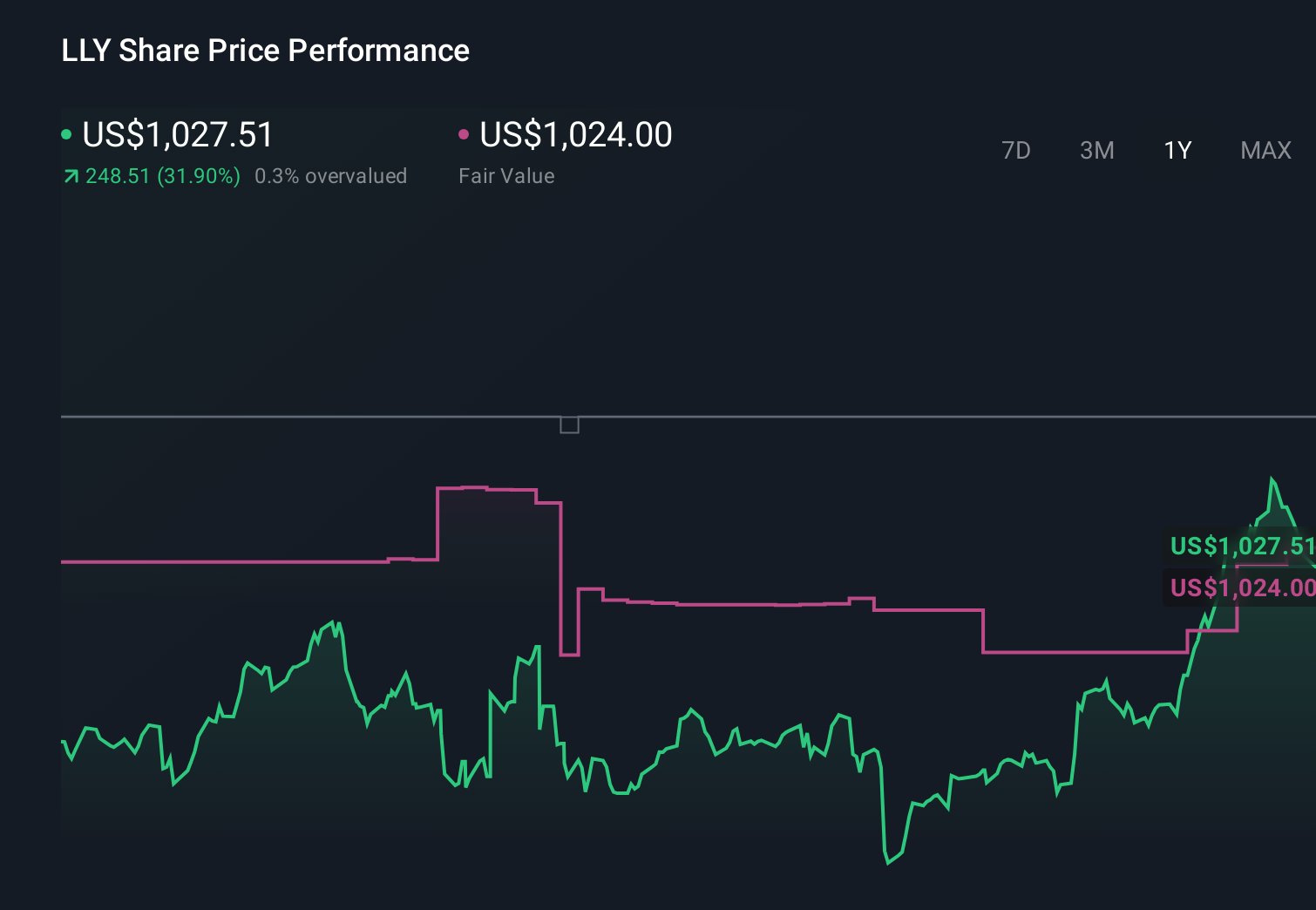
Thirty seven members of the Simply Wall St Community currently place Lilly’s fair value between about US$770 and just under US$1,430, with several clustering above US$1,200. That spread sits against a business where short term share performance is still closely tied to GLP‑1 outcomes and regulatory milestones, even as long term commitments like the new Pennsylvania facility raise the stakes on execution. You can use these very different viewpoints to stress test your own expectations for how Lilly handles those risks and opportunities.
Explore 37 other fair value estimates on Eli Lilly - why the stock might be worth as much as 38% more than the current price!
Disagree with this assessment? Create your own narrative in under 3 minutes - extraordinary investment returns rarely come from following the herd.
Early movers are already taking notice. See the stocks they're targeting before they've flown the coop:
This article by Simply Wall St is general in nature. We provide commentary based on historical data and analyst forecasts only using an unbiased methodology and our articles are not intended to be financial advice. It does not constitute a recommendation to buy or sell any stock, and does not take account of your objectives, or your financial situation. We aim to bring you long-term focused analysis driven by fundamental data. Note that our analysis may not factor in the latest price-sensitive company announcements or qualitative material. Simply Wall St has no position in any stocks mentioned.