


Please use a PC Browser to access Register-Tadawul
Get It
Oklo Inc.'s (NYSE:OKLO) biggest owners are individual investors who got richer after stock soared 31% last week
Oklo Inc OKLO | 87.42 | -15.13% |
If you want to know who really controls Oklo Inc. (NYSE:OKLO), then you'll have to look at the makeup of its share registry. We can see that individual investors own the lion's share in the company with 57% ownership. Put another way, the group faces the maximum upside potential (or downside risk).
As a result, individual investors collectively scored the highest last week as the company hit US$1.2b market cap following a 31% gain in the stock.
Let's delve deeper into each type of owner of Oklo, beginning with the chart below.
View our latest analysis for Oklo
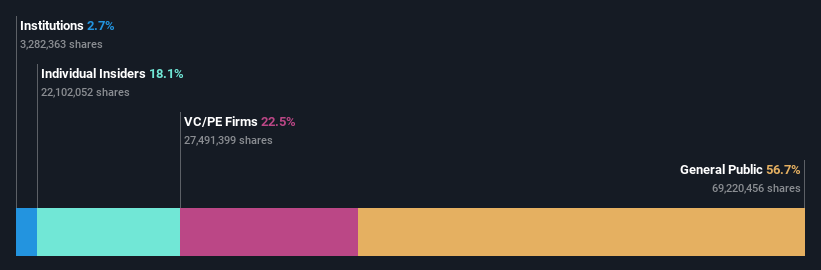
Institutions typically measure themselves against a benchmark when reporting to their own investors, so they often become more enthusiastic about a stock once it's included in a major index. We would expect most companies to have some institutions on the register, especially if they are growing.
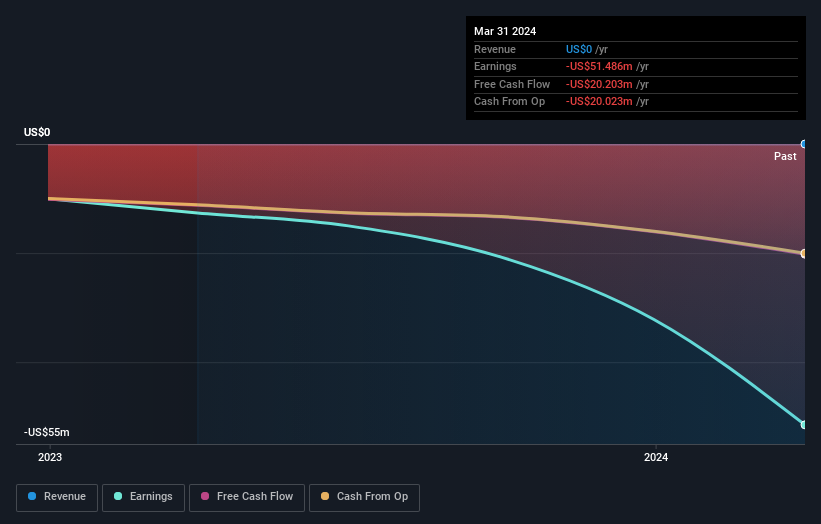
Since institutions own only a small portion of Oklo, many may not have spent much time considering the stock. But it's clear that some have; and they liked it enough to buy in. If the business gets stronger from here, we could see a situation where more institutions are keen to buy. When multiple institutional investors want to buy shares, we often see a rising share price. The past revenue trajectory (shown below) can be an indication of future growth, but there are no guarantees.
Oklo is not owned by hedge funds. Our data shows that SuRo Capital Corp. is the largest shareholder with 11% of shares outstanding. In comparison, the second and third largest shareholders hold about 9.2% and 8.9% of the stock. Note that the second and third-largest shareholders are also Chief Executive Officer and Member of the Board of Directors, respectively, meaning that the company's top shareholders are insiders.
On studying our ownership data, we found that 10 of the top shareholders collectively own less than 50% of the share register, implying that no single individual has a majority interest.
While it makes sense to study institutional ownership data for a company, it also makes sense to study analyst sentiments to know which way the wind is blowing. As far as we can tell there isn't analyst coverage of the company, so it is probably flying under the radar.
The definition of company insiders can be subjective and does vary between jurisdictions. Our data reflects individual insiders, capturing board members at the very least. Management ultimately answers to the board. However, it is not uncommon for managers to be executive board members, especially if they are a founder or the CEO.
Insider ownership is positive when it signals leadership are thinking like the true owners of the company. However, high insider ownership can also give immense power to a small group within the company. This can be negative in some circumstances.
It seems insiders own a significant proportion of Oklo Inc.. It has a market capitalization of just US$1.2b, and insiders have US$224m worth of shares in their own names. That's quite significant. Most would be pleased to see the board is investing alongside them. You may wish to access this free chart showing recent trading by insiders.
The general public, mostly comprising of individual investors, collectively holds 57% of Oklo shares. With this amount of ownership, retail investors can collectively play a role in decisions that affect shareholder returns, such as dividend policies and the appointment of directors. They can also exercise the power to vote on acquisitions or mergers that may not improve profitability.
With an ownership of 23%, private equity firms are in a position to play a role in shaping corporate strategy with a focus on value creation. Some investors might be encouraged by this, since private equity are sometimes able to encourage strategies that help the market see the value in the company. Alternatively, those holders might be exiting the investment after taking it public.
While it is well worth considering the different groups that own a company, there are other factors that are even more important. Consider for instance, the ever-present spectre of investment risk. We've identified 3 warning signs with Oklo , and understanding them should be part of your investment process.
Of course, you might find a fantastic investment by looking elsewhere. So take a peek at this free list of interesting companies.
NB: Figures in this article are calculated using data from the last twelve months, which refer to the 12-month period ending on the last date of the month the financial statement is dated. This may not be consistent with full year annual report figures.
This article by Simply Wall St is general in nature. We provide commentary based on historical data and analyst forecasts only using an unbiased methodology and our articles are not intended to be financial advice. It does not constitute a recommendation to buy or sell any stock, and does not take account of your objectives, or your financial situation. We aim to bring you long-term focused analysis driven by fundamental data. Note that our analysis may not factor in the latest price-sensitive company announcements or qualitative material. Simply Wall St has no position in any stocks mentioned.