


Please use a PC Browser to access Register-Tadawul
Get It
Tuniu's (NASDAQ:TOUR) Returns On Capital Are Heading Higher
Tuniu Corp. Sponsored ADR Class A TOUR | 0.71 | +1.33% |
What trends should we look for it we want to identify stocks that can multiply in value over the long term? Ideally, a business will show two trends; firstly a growing return on capital employed (ROCE) and secondly, an increasing amount of capital employed. If you see this, it typically means it's a company with a great business model and plenty of profitable reinvestment opportunities. So when we looked at Tuniu (NASDAQ:TOUR) and its trend of ROCE, we really liked what we saw.
For those who don't know, ROCE is a measure of a company's yearly pre-tax profit (its return), relative to the capital employed in the business. The formula for this calculation on Tuniu is:
Return on Capital Employed = Earnings Before Interest and Tax (EBIT) ÷ (Total Assets - Current Liabilities)
0.047 = CN¥46m ÷ (CN¥1.9b - CN¥878m) (Based on the trailing twelve months to June 2025).
So, Tuniu has an ROCE of 4.7%. Ultimately, that's a low return and it under-performs the Hospitality industry average of 10%.
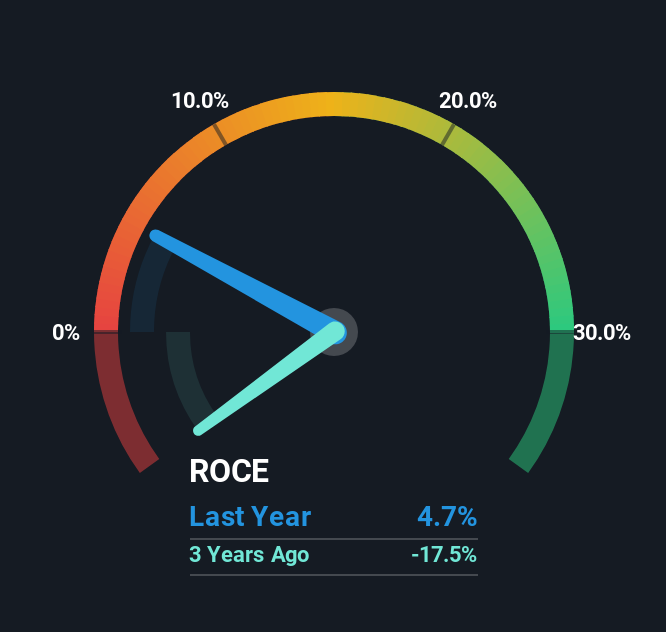
In the above chart we have measured Tuniu's prior ROCE against its prior performance, but the future is arguably more important. If you'd like, you can check out the forecasts from the analysts covering Tuniu for free.
It's great to see that Tuniu has started to generate some pre-tax earnings from prior investments. The company was generating losses five years ago, but now it's turned around, earning 4.7% which is no doubt a relief for some early shareholders. Additionally, the business is utilizing 61% less capital than it was five years ago, and taken at face value, that can mean the company needs less funds at work to get a return. This could potentially mean that the company is selling some of its assets.
On a separate but related note, it's important to know that Tuniu has a current liabilities to total assets ratio of 47%, which we'd consider pretty high. This can bring about some risks because the company is basically operating with a rather large reliance on its suppliers or other sorts of short-term creditors. Ideally we'd like to see this reduce as that would mean fewer obligations bearing risks.
In a nutshell, we're pleased to see that Tuniu has been able to generate higher returns from less capital. Given the stock has declined 21% in the last five years, this could be a good investment if the valuation and other metrics are also appealing. So researching this company further and determining whether or not these trends will continue seems justified.
If you'd like to know about the risks facing Tuniu, we've discovered 1 warning sign that you should be aware of.
This article by Simply Wall St is general in nature. We provide commentary based on historical data and analyst forecasts only using an unbiased methodology and our articles are not intended to be financial advice. It does not constitute a recommendation to buy or sell any stock, and does not take account of your objectives, or your financial situation. We aim to bring you long-term focused analysis driven by fundamental data. Note that our analysis may not factor in the latest price-sensitive company announcements or qualitative material. Simply Wall St has no position in any stocks mentioned.