


Please use a PC Browser to access Register-Tadawul
Get It
US Stocks Open Lower, Market Reacts to Trump's Auto Tariff Announcement
General Motors Company GM | 81.15 | +0.32% |
Ford Motor Company F | 13.62 | -1.02% |
STELLANTIS STLA | 11.83 | +0.42% |
Tesla Motors, Inc. TSLA | 476.09 | +3.73% |
NVIDIA Corporation NVDA | 177.67 | +1.52% |
US stocks opened lower on Thursday, with the auto sector taking a hit after President Trump announced a 25% tariff on all imported cars and threatened broader trade tariffs. The US Q4 GDP annualized growth rate was revised upwards to 2.4%, exceeding expectations.
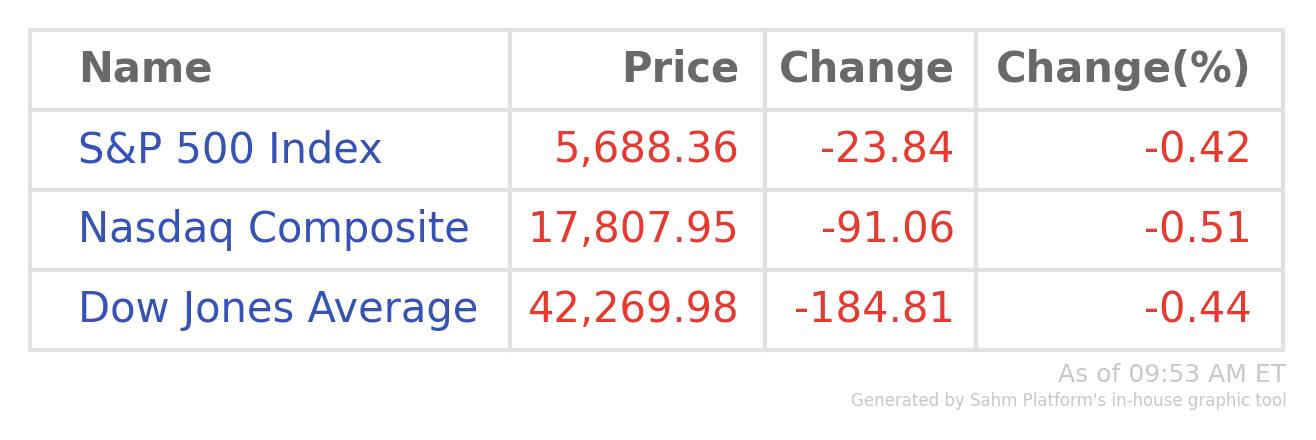
As of 09:53 AM, ET (or 04:53 PM in Riyadh), the broad-based S&P 500 INDEX(SPX.US) fades 24 points or 0.42% to 5,688, the tech-heavy NASDAQ(IXIC.US) recedes by 91 points or 0.51% to 17,808, and the blue-chip Dow Jones Industrial Average(DJI.US) deteriorates by 185 points or 0.44% to 42,270.
US President Trump, who has long discussed imposing reciprocal tariffs on trade partners, stated on Wednesday that his retaliatory tariffs would remain in effect throughout his second term. He announced a 25% tariff on all non-US-made cars, effective April 2.
In response to Trump's announcement, shares of automakers fell, with General Motors Company(GM.US), Ford Motor Company(F.US), and STELLANTIS (STLA.US) declining. However, Trump's comments about the tariffs being "more lenient than reciprocal" provided some relief to investors. He indicated a willingness to reduce tariffs on China to facilitate a deal with ByteDance's TikTok.
Trump continued to use tariffs as a negotiation tool, threatening higher tariffs on the EU and Canada if they coordinated against US trade policies. He warned on social media that any economic harm from the EU and Canada would be met with significant tariffs.
Investors are concerned about the broader economic impact of Trump's retaliatory tariffs, especially as the US economy shows signs of weakness. The Conference Board reported that US consumer confidence in March reached its lowest point in 12 years, reflecting widespread economic pessimism.
Former Federal Reserve Vice Chairman Donald Kohn warned on Thursday that Trump's trade war could reverse factors that have curbed inflation for decades. Economists from Commerzbank, Vincent Stamer and Bernd Weidensteiner, cautioned that the US is on the brink of a destructive trade war following the auto tariff announcement, which would impact major exporters like the EU and Germany.
The German Automobile Industry Association described the tariffs as a "deadly signal" threatening global trade. Market strategist Jun Rong Yeap from IG Asia noted that trade restrictions could trigger risk aversion in the market, linking tariffs to recession risks.
On Wednesday, US stocks closed lower after the White House announced the impending auto tariffs.
Daniel Skelly, head of market research and strategy at Morgan Stanley Wealth Management, stated that despite recent market rebounds, volatility will persist due to uncertainty surrounding Trump's tariff and trade policies.
Investors are awaiting new unemployment claims data on Thursday and the March personal consumption expenditures price index (PCE) on Friday, the Fed's preferred inflation gauge.
In economic data, the US Department of Labor reported initial jobless claims of 224,000 for the week ending January 11, slightly below the expected 225,000. February wholesale inventories rose 0.3%, below the 0.7% forecast. The Q4 final reading for real personal consumption expenditures was 4%, matching expectations. The Q4 core PCE price index annualized rate was 2.6%, slightly below the 2.7% forecast. The Q4 real GDP annualized rate was revised to 2.4%, above the 2.3% estimate. The February goods trade deficit was $147.9 billion, narrower than the expected $140 billion.
- Tesla Motors, Inc.(TSLA.US) was recently excluded from Canada's federal electric vehicle subsidy program (iZEV) and had pending subsidies frozen, seen as a retaliatory measure following the US's 10% tariff on Canadian aluminum.
- Automaker stocks General Motors Company(GM.US), STELLANTIS (STLA.US), Ford Motor Company(F.US) fell due to Trump's tariff announcement.
- NVIDIA Corporation(NVDA.US) is reportedly in advanced talks to acquire cloud AI startup Lepton AI in a deal valued at several hundred million dollars.
- Copper-related stocks declined as Citigroup projected a 25% US import tariff on copper.
- Toyota Motor Corp. Sponsored ADR(TM.US) delayed the construction of an electric vehicle battery plant in Fukuoka, Japan.
- Tencent Music Entertainment Group(TME.US) received an upgrade to "buy" from Deutsche Bank.