


Please use a PC Browser to access Register-Tadawul
Get It
Why Capricor Therapeutics (CAPR) Is Down 15.8% After Phase 3 Win And $1.5 Billion Deal
Capricor Therapeutics, Inc. CAPR | 28.51 | -2.20% |
We've found 12 US stocks that are forecast to pay a dividend yield of over 6% next year. See the full list for free.
To own Capricor today, you have to believe deramiocel can progress from positive Phase 3 data through regulatory review into real-world use for Duchenne patients, while the company manages its cash burn and dependence on a single lead asset. The HOPE-3 success and Nippon Shinyaku deal directly strengthen the near term approval and launch catalyst, but the biggest current risk remains regulatory unpredictability and any delay or setback in turning that data into an approved, marketable therapy.
Among recent announcements, the completion of the rolling BLA submission for deramiocel and the FDA’s Priority Review acceptance stand out as especially relevant. Together with the positive Phase 3 results and Nippon Shinyaku commercialization agreement, they concentrate the investment thesis around a relatively near term regulatory decision that could either validate Capricor’s long clinical journey or extend the period of losses and financing pressure.
Yet despite these advances, investors should still be aware of how regulatory uncertainty around deramiocel could...
Capricor Therapeutics' narrative projects $134.4 million revenue and $14.4 million earnings by 2028. This requires 115.7% yearly revenue growth and an $84.4 million earnings increase from $-70.0 million today.
Uncover how Capricor Therapeutics' forecasts yield a $44.56 fair value, a 87% upside to its current price.
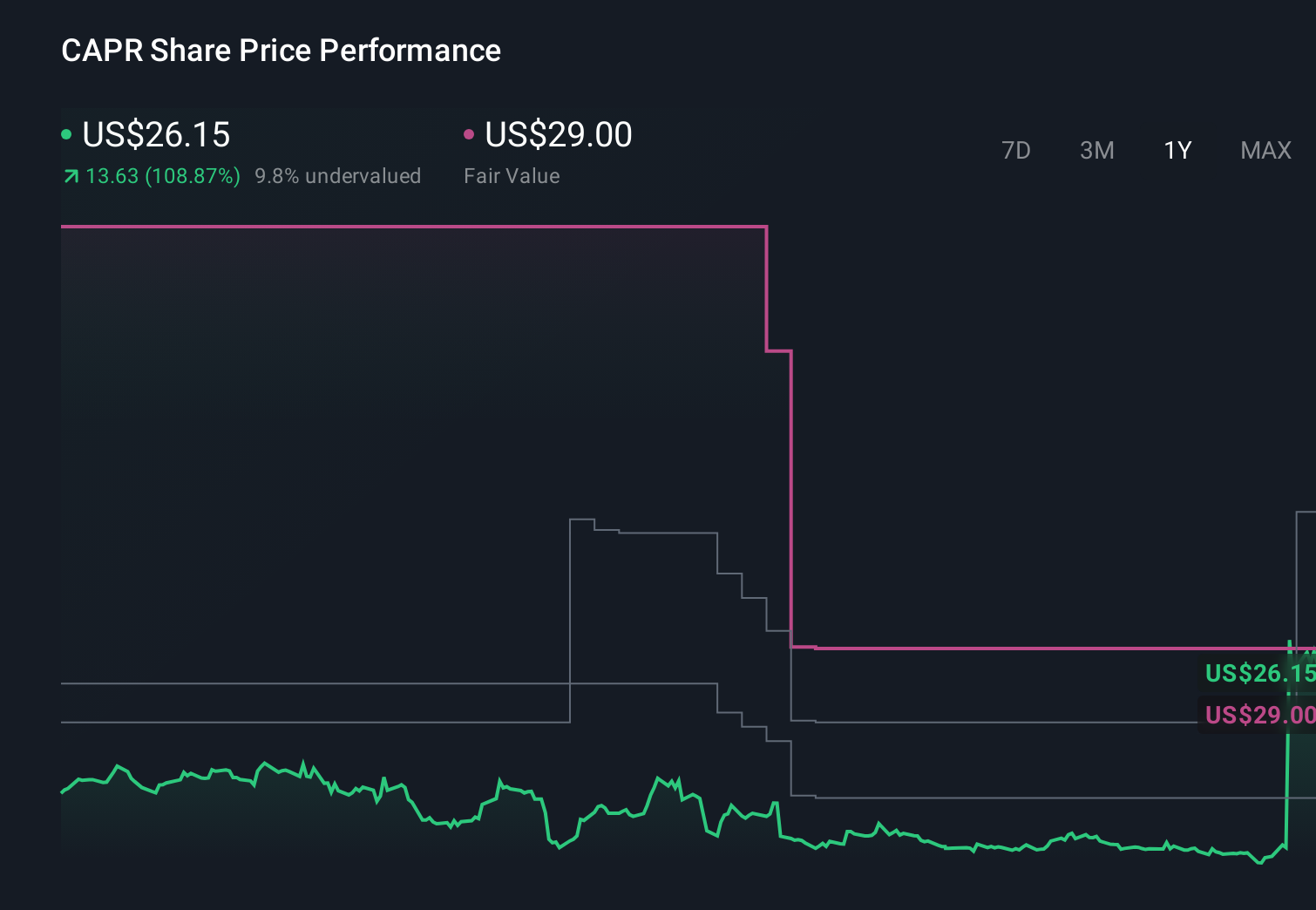
Nine fair value estimates from the Simply Wall St Community span roughly US$8 to US$294 per share, with views spread across the entire range. Against that backdrop, the recent Phase 3 success and global Nippon Shinyaku partnership focus attention squarely on whether regulators ultimately turn deramiocel into an approved commercial product, a decision that could heavily influence which of these perspectives ends up closer to reality.
Explore 9 other fair value estimates on Capricor Therapeutics - why the stock might be a potential multi-bagger!
Disagree with existing narratives? Create your own in under 3 minutes - extraordinary investment returns rarely come from following the herd.
Our top stock finds are flying under the radar-for now. Get in early:
This article by Simply Wall St is general in nature. We provide commentary based on historical data and analyst forecasts only using an unbiased methodology and our articles are not intended to be financial advice. It does not constitute a recommendation to buy or sell any stock, and does not take account of your objectives, or your financial situation. We aim to bring you long-term focused analysis driven by fundamental data. Note that our analysis may not factor in the latest price-sensitive company announcements or qualitative material. Simply Wall St has no position in any stocks mentioned.