

$8 Million in 2 Years with Just 4 Indicators – How This 24-Year-Old Beat 90% of Traders
S&P 500 index SPX | 0.00 | |
Tadawul All Shares Index TASI.SA | 0.00 |
Important Risk Warning and Disclaimer: The success story described herein is highly exceptional and does not represent the typical outcome for retail traders. Trading in financial markets, particularly day trading, involves substantial risk and can result in the loss of your entire invested capital. This content is for informational and educational purposes only and should not be considered financial advice or a recommendation to trade.
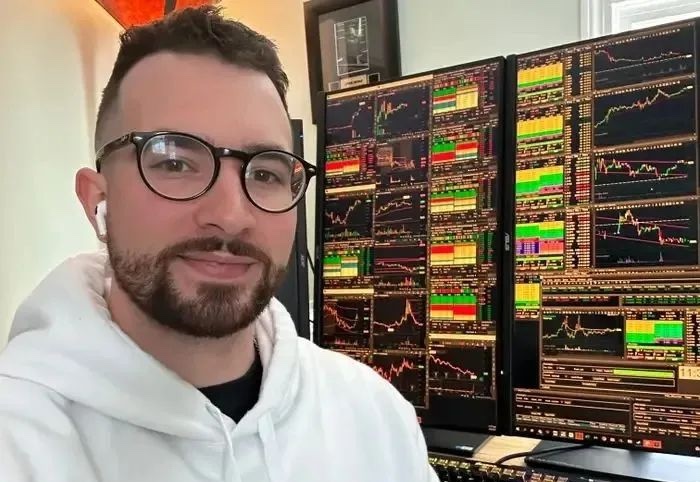
Making money in the stock market sounds like a dream for most traders – and for most, it remains exactly that. Unless your name is Jack Kellogg, the 24-year-old who earned $8 million through day trading in 2020 and 2021.
Kellogg started his trading journey in 2017 with just $7,500. He weathered the 2020 pandemic crash, rode the 2021 bull market, and survived the 2022 bear market. Through it all, he learned one crucial lesson: trading must stay simple and flexible.
The Power of Simplicity
"There's a saying called the KISS principle: 'Keep It Simple, Stupid,'" Kellogg explains. "I don't think you need fancy technical indicators to make money. I use basic trend lines, support, resistance, and volume – that's all my indicators."
This philosophy helped him become a trader who can go long or short based on market conditions, allowing him to keep trading even during the 2022 bear market. According to tax records reviewed by Insider, he made over $8 million from day trading in 2020 and 2021 combined – $1.6 million in 2020 and $6.5 million in 2021.
From $7,500 to Millions
Kellogg's journey wasn't smooth sailing. He initially lost several hundred dollars, which made him realize he didn't know how to trade. He turned to paper trading for practice and enrolled in an online course taught by Timothy Sykes, a former penny stock trader famous for turning his bar mitzvah money into over a million dollars.
Through the course, he developed his skills, patience, and trading style. While he wasn't successful early on, he had the advantage of gaining experience across different market types.
Reading Market Patterns
Today, Kellogg can "relive" 2017 through real trading because he sees many similarities to that year. He notes that market volatility hasn't been too extreme in either direction, unless you're trading hot theme stocks like AI-related names.
"Bitcoin's move from $1,000 to $20,000 back then is very similar to what I'm seeing with AI stocks now. AI is a hot theme in the media and among traders," Kellogg says.
This hype creates opportunities for both long and short trades, as AI stocks often become overbought. You can ride the uptrend long, then short when they get ahead of themselves.
The Four Key Indicators
Kellogg's strategy revolves around four essential indicators:
◔ VWAP (Volume Weighted Average Price) VWAP shows the average buying price adjusted for volume, helping him avoid entering at unfavorable levels. His rule: if the price is above VWAP, he won't buy because it means buying above average – violating the "buy low, sell high" principle.
He also uses VWAP to decide when to take profits or cut losses. For example, if he shorts a stock at $9 and VWAP is at $7.50, he might close around $7.50 to lock in profits.
◔ Linear Regression This indicator helps him judge trend direction and potential reversal points. It consists of three lines overlaid on the chart, showing price movement range, volatility, and average values, boosting his confidence in trend predictions.
When price breaks above the upper band, it suggests the stock might be overvalued; when it falls below the lower band, it might be undervalued.
◔ Volume Volume measures the number of shares traded in a given period and is a key clue for potential reversals. It helps Kellogg determine if many traders are "on the wrong side," potentially triggering a directional change.
"If there's a big volume spike near the daily high, it usually means many people are chasing, which might signal a reversal is coming."
◔ Support and Resistance Support levels are areas where prices tend to stop falling and bounce back; resistance levels are where prices tend to fall. Kellogg confirms their strength by watching volume changes and how long prices spend near these levels.
If prices oscillate in a range for 30 minutes to an hour, it usually indicates strong support or resistance.
A Necessary Clarification: Rare Exceptions vs. General Rules
It is vital to understand that Jack Kellogg's achievements represent a "rare exception, not the general rule." His extraordinary profits were realized during the unique and highly volatile market conditions of 2020 and 2021. This is a classic case of "survivorship bias"—we focus on the one remarkable winner while overlooking the thousands who attempted similar strategies and failed.
Simply copying his four indicators does not guarantee success. His edge comes from years of experience, psychological discipline, and a market environment that may not be repeated. Aspiring traders should not view this strategy as a simple blueprint for wealth, but as an example of one professional's approach in a specific context. Attempting to replicate such results without commensurate skill and risk management is extremely hazardous.
From Hype to Technicals
Initially, Kellogg would follow market sentiment, but at some point, he shifts away from crowd discussion toward his familiar technical indicators and chart patterns.
For theme-driven trades, he gives stocks more room to move rather than strictly cutting losses like in technical day trading. "I aim for bigger percentage gains because I've seen these patterns repeatedly over seven years – they always end up going higher than expected because everyone's buying these concepts hyped as 'the next big thing.'"
The Ultimate Rule
Ultimately, Kellogg emphasizes: "Price action is king. Even if you have great logic but price moves against you, you should cut losses."
Despite relying on these technical indicators, Kellogg never makes decisions based solely on indicators. If price action contradicts his trading logic, he cuts losses decisively.
He never fully depends on any indicator and never blames losses on technical tools. He starts with small positions (10-15% of planned size), watches the move, and gradually adds once he confirms his entry point.
The Psychology Factor
Kellogg believes everyone has access to the same data – the real difference lies in how you use that information. Most traders' problems stem from psychology. Even with great strategies and indicators, without discipline, you'll still make poor trading decisions.
"Most people don't invest enough effort in training their emotional control," he concludes.
Key Takeaways
Kellogg's success exemplifies the "Simple + Flexible + Disciplined" approach to trading. His journey from novice to millionaire offers important lessons for aspiring traders, emphasizing the importance of mastering key indicators, adapting to changing markets, and controlling psychological emotions.
A Final Note: Day trading isn't for everyone. Volatile price swings can be nerve-wracking, especially for those unfamiliar with fundamentals. For many people, long-term investing might be a simpler, more relaxed path.
Remember: Success in trading comes not from complexity, but from consistency and discipline.
This article is for informational purposes only and does not constitute an offer or solicitation to buy or sell any security. The strategies and experiences discussed are not an endorsement and may not be suitable for all investors. Past performance is not indicative of future results. All readers should conduct their own independent research, understand the risks involved, and consult with a qualified financial advisor before making any investment decisions. Trading is a high-risk activity, and you should never invest money that you cannot afford to lose.