


Please use a PC Browser to access Register-Tadawul
Get It
Big Companies, Market Fallout, Investor Settlements: Lessons from Apple, Opendoor, Rivian and Others
Apple Inc. AAPL | 278.12 | +0.80% |
OpenDoor Technologies OPEN | 4.88 | +3.83% |
Rivian Automotive, Inc. Class A RIVN | 14.80 | +7.79% |
UWM Holdings Corp. Class A UWMC | 4.75 | -7.77% |
Arrival ARVLF | 0.00 | 0.00% |
Securities litigation has become a normal cost of doing business for fast-growing companies, especially when markets are volatile and expectations are high. When leaders talk up their capabilities or hide key risks from investors, the fallout rarely stops at paying a settlement. It shows up in wiped-out market value, damaged reputations, and strategy U-turns that can take years to fix.
The pattern is consistent across industries. At big turning points like IPOs, SPAC deals, or aggressive expansion phases, some companies cross the line in how they guide investors. The stocks pay the price with steep drawdowns and nine-figure payouts. The gap between what’s promised and what’s real almost always shows up later as shareholder losses.
The settlements that follow in this article tell us something important about how markets punish companies that fail the transparency test, regardless of whether the damage was intentional or just the result of wishful thinking during high-growth phases. Let's dive in.
Opendoor Technologies (NASDAQ:OPEN) ran into serious trouble in 2025 after agreeing to a $39 million settlement to resolve a federal investor class action that claimed it overstated how smart its home‑pricing algorithms were and oversold its tech edge. The lawsuit landed after Opendoor's stock had already collapsed by about 94% from its 2020 IPO peak to its 2022 low, which showed how risky weak disclosure can be when an entire business model leans on "proprietary" technology. The payout was manageable given Opendoor's cash, but the core business was still under pressure, with Q1 2025 revenue of $1.2 billion, a net loss of $85 million, and thin gross margins of 8.6%.
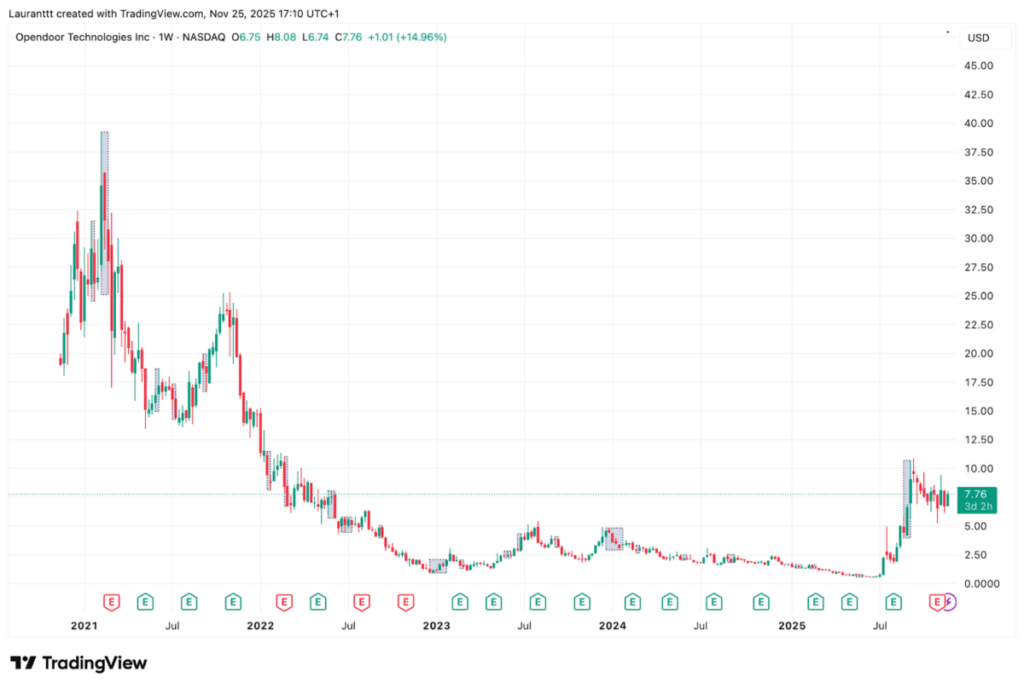
The settlement kept questions alive about whether Opendoor's model can really scale profitably, so sentiment around the stock stayed fragile. After the company rolled out governance changes and new leadership in September 2025, the share price started swinging more sharply: it traded as low as $0.51 in June, then climbed above $10.87 within a few months as the market reacted to the overhaul and restructuring push. The legal risk is now largely behind the company, but the real proof will be whether its shift toward working more with agents, alongside aggressive cost cuts, can finally move the business toward durable profits and rebuild investor confidence.
Apple (NASDAQ:AAPL) faced one of its biggest securities cases in March 2024, agreeing to pay $490 million to settle claims that CEO Tim Cook misled investors about weakening iPhone demand in China. The dispute focused on a November 2018 earnings call where Cook told analysts that China was not under economic pressure and described the business there as "very strong," then cut revenue guidance by up to $9 billion just two months later because of soft Greater China sales. That update led to a 10% one‑day drop in the share price, wiping out about $74 billion in market value.

For Apple, the cash hit was small. The settlement worked out to roughly two days of profit on $97 billion of net income in fiscal 2023 and less than 1% of the $93.74 billion it earned in 2024, so the core earnings power stayed intact. The case still mattered, though, because it highlighted how much damage a few confident comments about a key market can do if the outlook turns quickly. After five years of litigation, the deal won final court approval in September 2024 and became the third‑largest securities recovery ever in the Northern District of California. Apple did not admit wrongdoing, but the episode has made investors even more sensitive to how the company talks about future demand, especially around China and new AI‑driven growth plans heading into 2026.
Gores Holdings IV (NYSE:UWMC) is a clear example of how SPAC incentives can work against regular shareholders. In January 2021, the blank‑check company closed a $16 billion merger with United Wholesale Mortgage, the biggest wholesale mortgage lender in the U.S., creating UWM Holdings Corp. The lawsuit claimed that SPAC sponsor Alec Gores and the board pushed the deal through using "patently unattainable" forecasts that ignored an expected slowdown in refinancing and higher interest rates, information that likely would have led many shareholders to redeem their $10.10 shares instead of staying invested.
The stock's performance after the merger backed up those worries. The shares opened at $11.54 on January 22, 2021, dropped to $7.23 by April 2021, and then slid further to $5.29 by January 2022.

At the same time, SPAC insiders walked away with more than $112 million on the closing date. In July 2025, the Delaware Chancery Court signed off on a $17.5 million cash settlement funded by UWM Holdings, and Vice Chancellor Lori Will called the payout "meaningful" and "fair and reasonable on balance." For shareholders who saw 30–50% of their investment disappear in a year, the settlement only partly closes the gap, but it sends a strong signal that sponsors and boards will be held to account when SPAC deals’ economics favor insiders over public investors.
Rivian (NASDAQ:RIVN) delivered one of the biggest and most hyped IPOs of 2021, raising $11.9 billion at $78 per share and briefly hitting a market value of around $150 billion, above both Ford and General Motors. Within a few months, though, a major problem in its numbers became obvious. The R1T and R1S were priced too low to cover what it actually cost to build them. In March 2022, Rivian announced price hikes of almost 20%, lifting the R1S from $70,000 to $84,500 and the R1T from $67,500 to $79,500 for both new buyers and many existing reservation holders. Customers reacted badly, cancellations jumped, and the stock dropped about 39% over ten days. CEO RJ Scaringe later called that move his "most painful" mistake in more than 12 years of building the company.
Investors then took Rivian to court in 2022, arguing that its IPO filings hid known cost overruns that made those price hikes all but certain. In October 2025, Rivian agreed to a $250 million settlement, with $67 million paid by directors' and officers' insurance and $183 million coming directly from the company's cash. The shares now trade around $15, far below the $179 high reached shortly after the IPO.

Rivian continues to deny any wrongdoing, but settling clears a major legal overhang and lets management concentrate on executing the R2 launch planned for 2026. That rollout will be critical if Rivian is going to turn its brand strength and order book into real scale, positive margins, and a more stable place in a crowded EV market.
Arrival SA (OTC:ARVLF) is one of the clearest examples of how a SPAC‑era EV story can unravel in public markets. The Luxembourg‑based startup went public in March 2021 through a merger with CIIG Merger Corp., opening at $22 and briefly valuing the business at about $13 billion on promises of "microfactories" that would build electric vans and buses at healthy double‑digit margins. Those expectations proved far too optimistic. By November 2021, Arrival had cut its 2022 revenue guidance and admitted its costs were far higher than planned, and the stock finished that month down 43.2%. The slide did not stop there, as the share price fell more than 80% by late 2023, dropped below $1, triggered Nasdaq compliance warnings, and the company was eventually delisted in January 2024 after it failed to file its financials.

Arrival then filed for bankruptcy in Luxembourg in May 2024, having never delivered a production vehicle at a meaningful scale. For investors who held during the class period from November 2020 to November 2021, a $11.3 million settlement now awaits final approval. That recovery is small compared with the collapse from a $13 billion valuation to almost nothing, but it still matters in a bankruptcy context. More importantly, the case stands as a clear warning about SPAC‑era EV deals built on aggressive production promises that were not backed by realistic funding, timelines, or execution.
In the end, these high-profile settlements show what's at stake when public companies fail the transparency test. Verdicts like these force companies to rethink how they communicate and operate. From tech giants to EV disruptors, the lesson is clear: investors don't just price growth, they also price trust. For companies at key inflection points, honest disclosures are the foundation for credibility and long-term value, no matter how tempting it is to sell the big vision.
Benzinga Disclaimer: This article is from an unpaid external contributor. It does not represent Benzinga’s reporting and has not been edited for content or accuracy.