


Please use a PC Browser to access Register-Tadawul
Get It
Harley-Davidson (NYSE:HOG) Takes On Some Risk With Its Use Of Debt
Harley-Davidson, Inc. HOG | 21.25 | -0.56% |
Howard Marks put it nicely when he said that, rather than worrying about share price volatility, 'The possibility of permanent loss is the risk I worry about... and every practical investor I know worries about.' It's only natural to consider a company's balance sheet when you examine how risky it is, since debt is often involved when a business collapses. Importantly, Harley-Davidson, Inc. (NYSE:HOG) does carry debt. But the more important question is: how much risk is that debt creating?
Debt is a tool to help businesses grow, but if a business is incapable of paying off its lenders, then it exists at their mercy. Ultimately, if the company can't fulfill its legal obligations to repay debt, shareholders could walk away with nothing. However, a more common (but still painful) scenario is that it has to raise new equity capital at a low price, thus permanently diluting shareholders. Of course, debt can be an important tool in businesses, particularly capital heavy businesses. The first thing to do when considering how much debt a business uses is to look at its cash and debt together.
As you can see below, Harley-Davidson had US$7.30b of debt, at March 2025, which is about the same as the year before. You can click the chart for greater detail. However, it does have US$947.4m in cash offsetting this, leading to net debt of about US$6.35b.
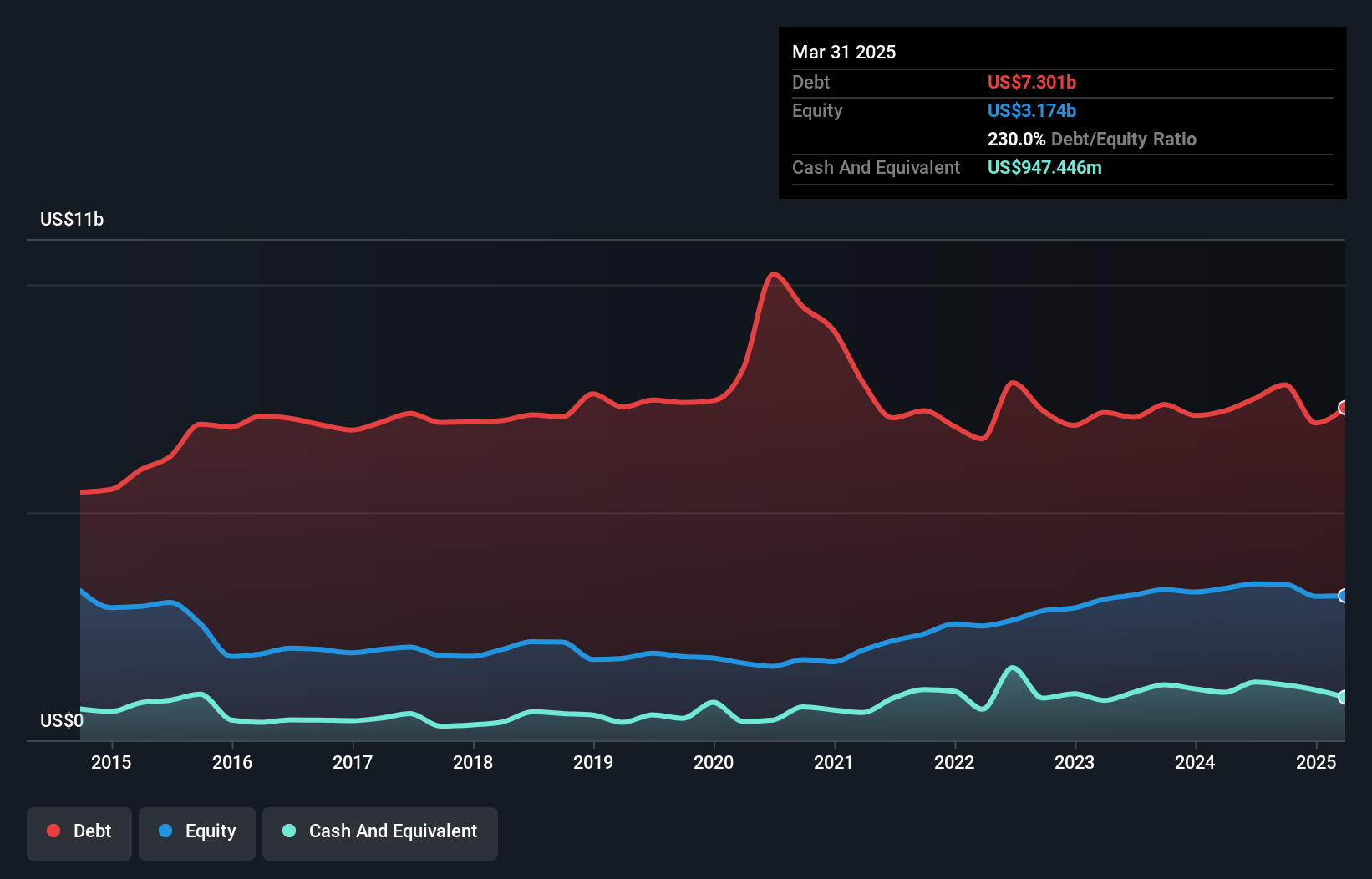
According to the last reported balance sheet, Harley-Davidson had liabilities of US$3.62b due within 12 months, and liabilities of US$5.59b due beyond 12 months. On the other hand, it had cash of US$947.4m and US$313.3m worth of receivables due within a year. So its liabilities total US$7.95b more than the combination of its cash and short-term receivables.
The deficiency here weighs heavily on the US$2.90b company itself, as if a child were struggling under the weight of an enormous back-pack full of books, his sports gear, and a trumpet. So we definitely think shareholders need to watch this one closely. After all, Harley-Davidson would likely require a major re-capitalisation if it had to pay its creditors today.
We measure a company's debt load relative to its earnings power by looking at its net debt divided by its earnings before interest, tax, depreciation, and amortization (EBITDA) and by calculating how easily its earnings before interest and tax (EBIT) cover its interest expense (interest cover). Thus we consider debt relative to earnings both with and without depreciation and amortization expenses.
Strangely Harley-Davidson has a sky high EBITDA ratio of 11.9, implying high debt, but a strong interest coverage of 1k. So either it has access to very cheap long term debt or that interest expense is going to grow! Importantly, Harley-Davidson's EBIT fell a jaw-dropping 50% in the last twelve months. If that decline continues then paying off debt will be harder than selling foie gras at a vegan convention. The balance sheet is clearly the area to focus on when you are analysing debt. But it is future earnings, more than anything, that will determine Harley-Davidson's ability to maintain a healthy balance sheet going forward.
Finally, a business needs free cash flow to pay off debt; accounting profits just don't cut it. So it's worth checking how much of that EBIT is backed by free cash flow. Over the last three years, Harley-Davidson recorded free cash flow worth a fulsome 84% of its EBIT, which is stronger than we'd usually expect. That positions it well to pay down debt if desirable to do so.
On the face of it, Harley-Davidson's EBIT growth rate left us tentative about the stock, and its level of total liabilities was no more enticing than the one empty restaurant on the busiest night of the year. But at least it's pretty decent at covering its interest expense with its EBIT; that's encouraging. Overall, it seems to us that Harley-Davidson's balance sheet is really quite a risk to the business. For this reason we're pretty cautious about the stock, and we think shareholders should keep a close eye on its liquidity. When analysing debt levels, the balance sheet is the obvious place to start. But ultimately, every company can contain risks that exist outside of the balance sheet. These risks can be hard to spot.
This article by Simply Wall St is general in nature. We provide commentary based on historical data and analyst forecasts only using an unbiased methodology and our articles are not intended to be financial advice. It does not constitute a recommendation to buy or sell any stock, and does not take account of your objectives, or your financial situation. We aim to bring you long-term focused analysis driven by fundamental data. Note that our analysis may not factor in the latest price-sensitive company announcements or qualitative material. Simply Wall St has no position in any stocks mentioned.