


Please use a PC Browser to access Register-Tadawul
Get It
Here's What's Concerning About Robert Half's (NYSE:RHI) Returns On Capital
Robert Half Inc. RHI | 28.34 28.34 | -2.38% 0.00% Post |
When we're researching a company, it's sometimes hard to find the warning signs, but there are some financial metrics that can help spot trouble early. More often than not, we'll see a declining return on capital employed (ROCE) and a declining amount of capital employed. This indicates to us that the business is not only shrinking the size of its net assets, but its returns are falling as well. So after we looked into Robert Half (NYSE:RHI), the trends above didn't look too great.
Just to clarify if you're unsure, ROCE is a metric for evaluating how much pre-tax income (in percentage terms) a company earns on the capital invested in its business. Analysts use this formula to calculate it for Robert Half:
Return on Capital Employed = Earnings Before Interest and Tax (EBIT) ÷ (Total Assets - Current Liabilities)
0.08 = US$118m ÷ (US$2.8b - US$1.4b) (Based on the trailing twelve months to September 2025).
So, Robert Half has an ROCE of 8.0%. In absolute terms, that's a low return and it also under-performs the Professional Services industry average of 16%.
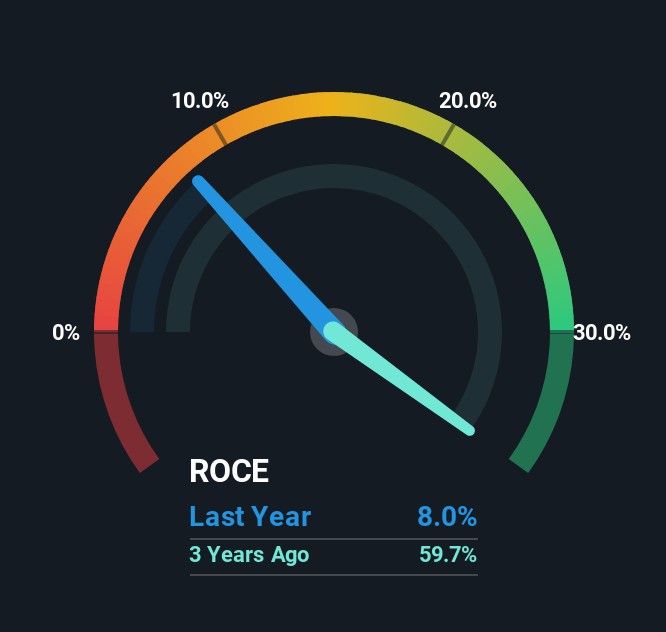
Above you can see how the current ROCE for Robert Half compares to its prior returns on capital, but there's only so much you can tell from the past. If you'd like to see what analysts are forecasting going forward, you should check out our free analyst report for Robert Half .
There is reason to be cautious about Robert Half, given the returns are trending downwards. Unfortunately the returns on capital have diminished from the 26% that they were earning five years ago. On top of that, it's worth noting that the amount of capital employed within the business has remained relatively steady. Companies that exhibit these attributes tend to not be shrinking, but they can be mature and facing pressure on their margins from competition. So because these trends aren't typically conducive to creating a multi-bagger, we wouldn't hold our breath on Robert Half becoming one if things continue as they have.
On a separate but related note, it's important to know that Robert Half has a current liabilities to total assets ratio of 48%, which we'd consider pretty high. This can bring about some risks because the company is basically operating with a rather large reliance on its suppliers or other sorts of short-term creditors. Ideally we'd like to see this reduce as that would mean fewer obligations bearing risks.
In the end, the trend of lower returns on the same amount of capital isn't typically an indication that we're looking at a growth stock. Long term shareholders who've owned the stock over the last five years have experienced a 49% depreciation in their investment, so it appears the market might not like these trends either. That being the case, unless the underlying trends revert to a more positive trajectory, we'd consider looking elsewhere.
Robert Half does have some risks, we noticed 2 warning signs (and 1 which shouldn't be ignored) we think you should know about.
This article by Simply Wall St is general in nature. We provide commentary based on historical data and analyst forecasts only using an unbiased methodology and our articles are not intended to be financial advice. It does not constitute a recommendation to buy or sell any stock, and does not take account of your objectives, or your financial situation. We aim to bring you long-term focused analysis driven by fundamental data. Note that our analysis may not factor in the latest price-sensitive company announcements or qualitative material. Simply Wall St has no position in any stocks mentioned.