

In One Chart | Broadcom (AVGO): Building the AI Backbone—Positioned at an Inflection Point and Facing Market Revaluation
Broadcom Limited AVGO | 0.00 | |
S&P 500 index SPX | 0.00 | |
NASDAQ IXIC | 0.00 | |
PowerShares QQQ Trust,Series 1 QQQ | 0.00 |
The content and analysis in this article are sourced from the educational team at Sahm Capital. The information presented is for informational purposes only.
Since April, Broadcom Limited(AVGO.US) 's stock price has been on an upward trend. As of November 3, Broadcom's cumulative increase for the year reached 58%. In recent days, the company's stock price has experienced some pullback. So, what is the subsequent investment value of the company? What are the investment highlights?
Broadcom is a global technology company that designs, develops, and provides semiconductor and infrastructure software solutions. It operates through its semiconductor solutions and infrastructure software segments.
This report released by the Sahm team provides an in-depth analysis of Broadcom's strategic transformation and value re-rating in the era of artificial intelligence. The report argue that Broadcom has transcended its traditional identity as a semiconductor giant, successfully evolving into an indispensable core supplier of AI infrastructure. The primary driver of its investment value is shifting from its historical strengths in M&A integration and business diversification to a new narrative defined by the explosive growth of its AI business and the strategic elevation of its software division.
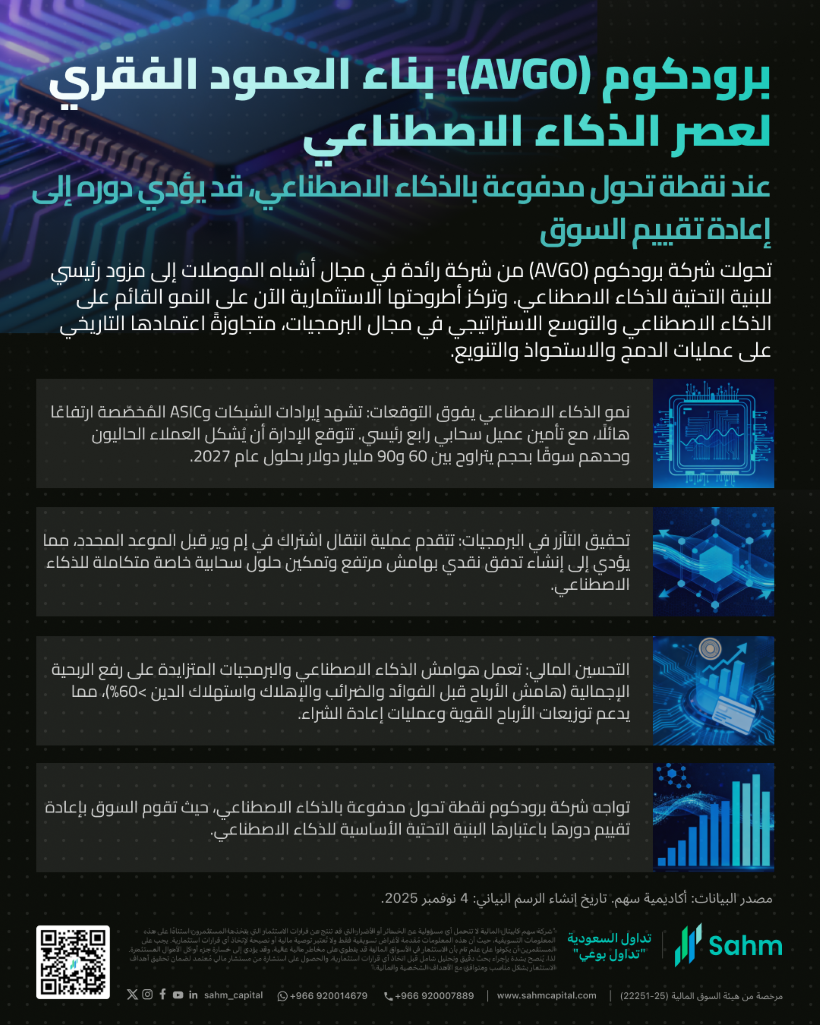
1/3 Core Conclusion
Broadcom's investment thesis is built upon a powerful and synergistic foundation of three pillars. First, its "dual AI hardware engines"—comprising its leadership in both AI networking (Ethernet switching chips) and AI compute customization (ASICs)—position it as a definitive beneficiary of the exponential growth in AI compute demand.
Second, the successful integration of VMware not only provides the company with a high-margin, high-stability software "cash cow" but, more importantly, carves out a unique strategic lane in "enterprise private cloud AI," building a deep competitive moat. Finally, the company's excellent operational efficiency and consistently generous shareholder return policy provide a solid safety cushion for its long-term value.
2/3 Key Highlights
AI Business Growth Exceeds Expectations, Opening New Upside Potential: Broadcom's AI-related revenue is experiencing explosive growth. Its networking chip business is benefiting from the inexorable trend of AI cluster scaling, while its custom ASIC business has achieved a major breakthrough in its customer landscape. On top of its three major cloud giant clients, Broadcom has secured a fourth major XPU customer with a multi-billion dollar order book. The long-term market size guidance from management (potential demand of $60-90 billion by 2027 from existing customers alone) signals that the AI business is set to become the most powerful engine driving the company's future growth.
Strategic Elevation of Software Business, with Synergies Beginning to Materialize: The integration of VMware is progressing far ahead of market expectations. The rapid transition to a subscription model (with customer conversion rates exceeding forecasts) is reshaping the software business into a stable growth engine with high margins and strong cash flow. Of greater long-term significance, through hardware-software synergy, Broadcom is creating a one-stop "private cloud AI" solution for large enterprises, addressing their core needs for data sovereignty and security and establishing a differentiated competitive advantage.
Optimized Financial Structure, Propelling Profitability to New Heights: The rapid growth of the two high-margin segments, AI and software, is profoundly optimizing Broadcom's revenue mix and driving a continuous rise in the company's overall gross margin and EBITDA margin (with EBITDA margin already exceeding 60%). The powerful free cash flow generation, combined with a long-standing policy of high dividends and substantial share buybacks, constitutes Broadcom's strong resilience across economic cycles and its enduring appeal to investors.
In summary, Broadcom is at a critical inflection point, driven by a structural re-rating in the age of AI. The market is re-appraising its strategic value as a core enabler of AI infrastructure, and its stock performance is expected to continue reflecting this profound shift in its fundamentals.
3/3 Risk Analysis
Although Broadcom demonstrates strong competitive advantages and a clear growth trajectory, investors should remain mindful of the following potential risks:
Risk of Integration and Synergies Falling Short of Expectations
The integration of VMware is the largest and most complex in the company's history. Challenges such as resistance from customers migrating to the new subscription model, the loss of key technical talent, or a slowerthan-expected realization of software-hardware synergies could pose a challenge to the company's financial performance and long-term strategy.
Risk of High Customer Concentration
A significant portion of the company's revenue depends on a small number of large customers (such as Apple Inc. and major hyperscale cloud service providers). Any change in the relationship with these key customers—for instance, if a customer decides to switch to in-house chip development, change suppliers, or significantly reduce orders—would have a material adverse impact on the company's revenue and profitability.
Risk of Intensified Competition and Technological Disruption
Broadcom operates in highly competitive fields, including networking chips, RF front-end modules, and infrastructure software. Technological breakthroughs by competitors, more attractive business models, or price wars could erode Broadcom's market share and profitability. The company must sustain high levels of R&D investment and technological leadership to cope with rapid technological iteration.
Macroeconomic and Geopolitical Risk
As a global company, Broadcom's business performance is closely tied to the health of the global economy. A worldwide economic recession could lead to weakness in enterprise IT spending and consumer electronics demand. Furthermore, ongoing geopolitical uncertainties, such as U.S.-China trade friction and chip export controls, could pose risks to its supply chain stability, cost control, and market access.