


Please use a PC Browser to access Register-Tadawul
Get It
Kroger (NYSE:KR) Has A Pretty Healthy Balance Sheet
Kroger Co. KR | 62.10 62.10 | -0.89% 0.00% Pre |
David Iben put it well when he said, 'Volatility is not a risk we care about. What we care about is avoiding the permanent loss of capital.' So it might be obvious that you need to consider debt, when you think about how risky any given stock is, because too much debt can sink a company. Importantly, The Kroger Co. (NYSE:KR) does carry debt. But is this debt a concern to shareholders?
Generally speaking, debt only becomes a real problem when a company can't easily pay it off, either by raising capital or with its own cash flow. In the worst case scenario, a company can go bankrupt if it cannot pay its creditors. However, a more usual (but still expensive) situation is where a company must dilute shareholders at a cheap share price simply to get debt under control. By replacing dilution, though, debt can be an extremely good tool for businesses that need capital to invest in growth at high rates of return. The first thing to do when considering how much debt a business uses is to look at its cash and debt together.
As you can see below, at the end of November 2024, Kroger had US$20.6b of debt, up from US$10.8b a year ago. Click the image for more detail. However, it also had US$13.4b in cash, and so its net debt is US$7.22b.
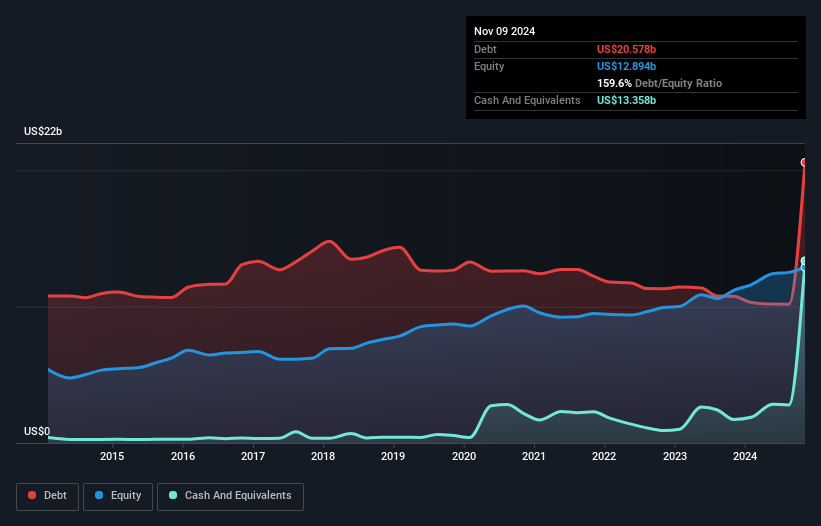
The latest balance sheet data shows that Kroger had liabilities of US$16.3b due within a year, and liabilities of US$33.3b falling due after that. Offsetting this, it had US$13.4b in cash and US$2.19b in receivables that were due within 12 months. So its liabilities outweigh the sum of its cash and (near-term) receivables by US$34.0b.
This is a mountain of leverage even relative to its gargantuan market capitalization of US$44.7b. Should its lenders demand that it shore up the balance sheet, shareholders would likely face severe dilution.
We use two main ratios to inform us about debt levels relative to earnings. The first is net debt divided by earnings before interest, tax, depreciation, and amortization (EBITDA), while the second is how many times its earnings before interest and tax (EBIT) covers its interest expense (or its interest cover, for short). Thus we consider debt relative to earnings both with and without depreciation and amortization expenses.
Kroger's net debt is only 0.89 times its EBITDA. And its EBIT covers its interest expense a whopping 12.3 times over. So you could argue it is no more threatened by its debt than an elephant is by a mouse. The good news is that Kroger has increased its EBIT by 3.8% over twelve months, which should ease any concerns about debt repayment. When analysing debt levels, the balance sheet is the obvious place to start. But ultimately the future profitability of the business will decide if Kroger can strengthen its balance sheet over time.
Finally, while the tax-man may adore accounting profits, lenders only accept cold hard cash. So it's worth checking how much of that EBIT is backed by free cash flow. Looking at the most recent three years, Kroger recorded free cash flow of 45% of its EBIT, which is weaker than we'd expect. That weak cash conversion makes it more difficult to handle indebtedness.
When it comes to the balance sheet, the standout positive for Kroger was the fact that it seems able to cover its interest expense with its EBIT confidently. But the other factors we noted above weren't so encouraging. For instance it seems like it has to struggle a bit to handle its total liabilities. When we consider all the factors mentioned above, we do feel a bit cautious about Kroger's use of debt. While we appreciate debt can enhance returns on equity, we'd suggest that shareholders keep close watch on its debt levels, lest they increase. When analysing debt levels, the balance sheet is the obvious place to start. But ultimately, every company can contain risks that exist outside of the balance sheet.
This article by Simply Wall St is general in nature. We provide commentary based on historical data and analyst forecasts only using an unbiased methodology and our articles are not intended to be financial advice. It does not constitute a recommendation to buy or sell any stock, and does not take account of your objectives, or your financial situation. We aim to bring you long-term focused analysis driven by fundamental data. Note that our analysis may not factor in the latest price-sensitive company announcements or qualitative material. Simply Wall St has no position in any stocks mentioned.