


Please use a PC Browser to access Register-Tadawul
Get It
Stock Market: 5 Rules to Avoid The Worst
S&P 500 index SPX | 6738.46 | +0.58% |
Tadawul All Shares Index TASI.SA | 10946.26 | +0.55% |
"Everyone has the ability to follow the stock market. If you managed to do mathematical in year 6 you can do it".
-Peter Lynch
"But leave the saleswoman alone! Peter, Stop it!"
"Yes, I'm coming, honey, one minute… so how much is your margin on this article? Hmm… And this one? What is your bestseller? What do you think of the CEO?"
In the early 1970s, everything was going on like a normal shopping trip with the Lynch couple.
Except that this time, Peter had foreseen a vein with enormous potential for his Magellan fund.
Hanes, a then little-known clothing company, had just released its range of L'EGGS tights.
His wife had praised it to him last week, and after being impressed by their packaging and their product, Peter had to investigate.
And after hours of research and staff interviews, he finally decides to invest. And he had seen just because, a few years later, Hanes became the largest position in his fund. Contributing greatly to its impressive yield of 29.2% per year.
(Which makes him one of the best managers on Wall Street).
But the real reason for his success and his obsession to always look for THE nugget comes from a realization.
Nothing beats owning shares in a company (equity).
Whether by investing in an index or directly in stocks, no return has been higher since 1800 :
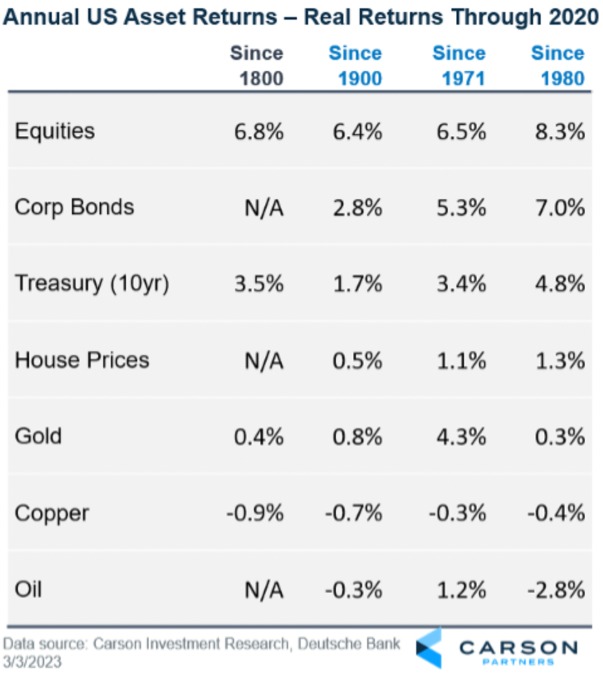
Not gold, oil, real estate, corporate or government bonds…
In the long term, equity has remained the most profitable investment since 1800.
That is why, just by focusing on this type of investment and abandoning all others, Lynch's Magellan Fund has made +608% in 13 years.
But, as you know, it is also the most dangerous and volatile investment.
And to be sure to get the most out of it without burning your wings, Peter Lynch, just like the other masters of this investment, follows these 5 principles :
1. The stock market is designed to recover.
It has experienced wars, recessions, depressions, pandemics, terrorist attacks, and speculative bubbles. Some of these events caused sharp declines that lasted for years.
Yet not only has the stock market recovered from the worst declines in its history, it has done so spectacularly :
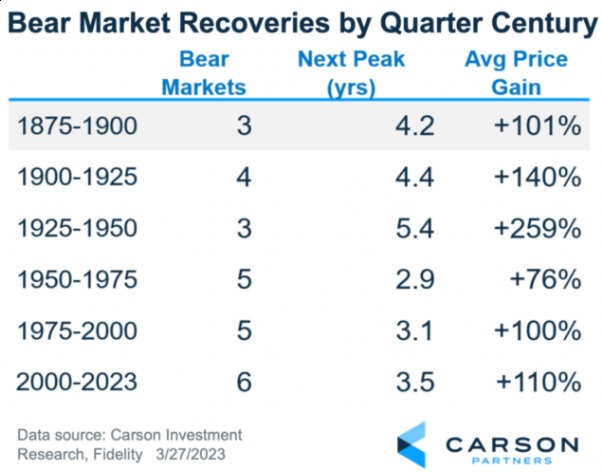
Because even after dozens of bear markets with average losses of up to -59% that eradicated portfolios in a few weeks,
The rebounds were even more spectacular, reaching average gains of +259%. This has largely bailed out and enriched investors who knew the market dynamics and remained positioned.
2. The reward comes through the risk.
Who says better performance necessarily means greater risk? The volatility of stocks is the price to pay. And even if you invest in indices, which is much less risky, there were several years when the S&P 500 collapsed by -30% and more.
But beyond volatility, there is a greater risk.
That of not having a long-term strategy.
Volatility is not a real problem for investors who see far, as I proved in the previous point.
Not having a plan or an objective will limit the performance of your portfolio according to your needs, which can make you lose a lot of money in the long term. This brings us to the third principle :
3. We must respect the complexity of the market.
Yes, investing is easy, and even a baboon can make his capital grow if he invests in the right indices.
Yes, with ETFs, you can, without breaking your head too much, and, in a few clicks, build a high-performance portfolio that holds up.
But don't get complacent about buying anything and everything just because "it's cheap" or "it's a clue, so it's bound to go up"…
If you want to reach your goal as soon as possible, train yourself and dig deeper than just looking at the P/E ratio of an ETF to find out if it's a good investment.
Because even if I often make fun of those who unnecessarily complicate investing, The markets remain a complex environment where you can lose big if you don't take it seriously.
4. Patience and perspective pay off.
The more you stay positioned, the more you multiply your chances of being a winner.
This has been the law of the markets since the 1800s, and it is not about to change.
In the short term, markets are a reflection of human emotions such as fear and greed. But in the long term, the market is stable and knows how to self-regulate.
The proof once again is with the S&P 500, where your chances of winning increase to 100% after a while :
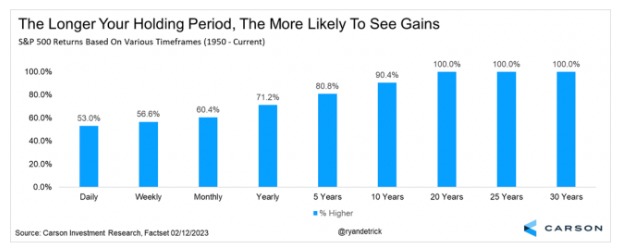
And even if you invest in the Nasdaq-100, the Dow Jones, the MSCI emerging markets index, the Euro Stoxx 50… No matter which index you choose, the trend is bullish over the long term.
On the markets, the adage that patience is the mother of safety is more true than ever.
Or, as Peter Lynch says: "If you can't imagine owning a stock for 10 years, don't even think about owning it for 10 minutes".
5. Prioritize the fundamentals without neglecting the price.
If you know how to choose your investments and are guaranteed to see them climb in the long term, there's no need to worry about the price when you don't buy them, right?
Wrong!!!.
Good timing can save you years of returns by avoiding buying at the top. Especially since the highs always bring decreases that could have saved you a lot for the same investment.
There is no need to put pressure on yourself for perfect timing (there is no such thing) or to become the king of cheapskates, waiting for it to get lower and lower.
Simply keep in mind that the goal is not just to make money on the markets but to optimize so that you are free as soon as possible.
These are the 5 principles that you should get tattooed if you want to invest in equity.
Incorporate them into your strategy and combine them with successful ETFs and you are sure to succeed in the long term.
Because even armies of investors succeeded by following them when they had to choose their shares themselves.
You, who only have to choose between a few clues, should tear everything apart.
Good luck with your investments!
Thanks for reading