


Please use a PC Browser to access Register-Tadawul
Get It
What's Next for Grab? Legal Chapter Closed, Southeast Asia Position Strengthened, Growth Focus Ahead
Grab Holdings Ltd. (Singapore) Class A GRAB | 4.88 | -3.94% |
Southeast Asia’s digital economy is expanding, and Grab Holdings (NASDAQ:GRAB) is right at the center of it. The Singapore-based super app offering everything from ride-hailing and food delivery to digital payments and lending has been making impressive moves in late 2025. In November 2025, Grab announced a $60 million investment in remote driving technology company Vay, aiming to accelerate autonomous vehicle capabilities across the region. Just weeks earlier in October, the company partnered with May Mobility to bring autonomous vehicle services to Southeast Asia, integrating self-driving tech with Grab’s proprietary GrabMaps. Meanwhile, Grab’s fintech arm is flourishing. GrabPay’s transaction volume surged 38% year-on-year in Q2 2025, reaching $5.8 billion in total payment volume.
Yet amid this growth, Grab recently agreed to pay $80 million to settle a class action lawsuit filed by investors who claimed the company concealed critical financial information during its SPAC merger and early public trading period, such as heavy spending on driver and consumer incentives, which led to a shocking 44% revenue drop in Q4 2021 and a $1.1 billion quarterly loss.
Although many assume that such lawsuits negatively impact a company, let’s take a closer look at whether that’s really the case, including from a financial perspective.
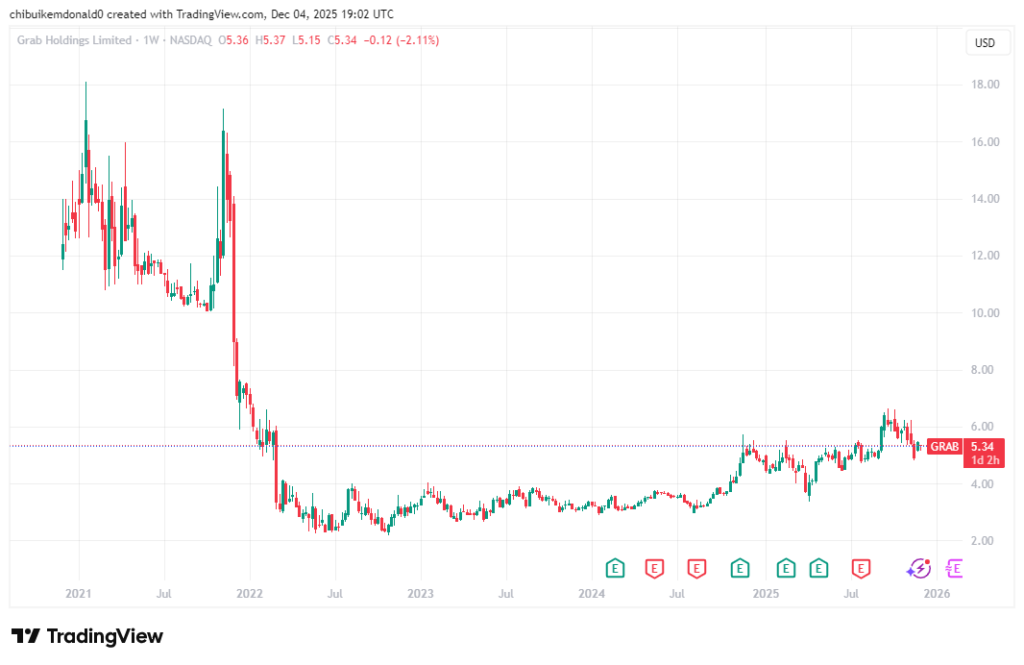
Grab shares are holding steady around $5.30, with a market cap of about $21.5 billion. Over the past year, the stock swung between a low of $3.36 in April 2025 and a high of $6.62 in September showing real ups and downs but bouncing back strong, up roughly 32% year-to-date. This recovery comes from better financial performance and new partnerships, like teaming up with May Mobility to bring self-driving cars to Southeast Asia.
When Grab released its Q3 2025 results on November 4, the earnings per share came in at $0.01, missing what analysts expected by a couple cents. But the revenue numbers told a better story. Grab brought in $873 million that quarter, beating expectations and growing 22% compared to the same time last year. The company made a profit of $17 million and saw its adjusted EBITDA jump 51% to $136 million, showing they’re getting more efficient at running the business. Operating profit hit $27 million, which was $65 million better than the year before.
Based on that strong quarter, Grab’s management raised their forecasts for the full year. They now expect 2025 revenue to land between $3.38 billion and $3.40 billion, and adjusted EBITDA between $490 million and $500 million both higher than their earlier predictions. Looking ahead, analysts think Grab will earn about $0.05 per share for the full year 2025, then jump to $0.10 in 2026 and $0.16 in 2027. Revenue is projected to grow from $3.4 billion this year to over $4 billion next year as Grab expands across Southeast Asia.
Grab has a massive safety net with about $7.4 billion in cash, meaning they can keep investing in growth without money worries. The company is also profitable now, with a return on equity of 1.91% and a net margin of 3.81%. The stock isn’t cheap trading at a P/E ratio around 136 and a price-to-sales ratio of 8.61 but investors are paying that premium because they expect big growth ahead.
Despite some lingering caution around the recent earnings miss, most analysts are optimistic about Grab’s future, especially with its bold push into new technology. A big reason for this excitement is Grab’s strategic investment in WeRide, a global leader in self-driving cars. Announced in August 2025, this partnership aims to put robotaxis on the road across Southeast Asia by 2026.
According to MarketBeat, Wall Street sentiment is largely positive. Of the 9 analysts covering the stock, 5 rate it a “Buy” and 4 say “Hold,” with no “Sell” ratings. This shows that while some experts are waiting to see how things play out, the majority believe Grab’s dominant position makes it a solid bet for growth.
With an average price target of $6.37 (about 21% higher than today’s price), analysts see plenty of room for the stock to climb. However, they warn that hitting this target depends on Grab successfully navigating the regulations of self-driving cars while keeping its main business profitable.
Grab agreed to pay $80 million to settle a class action lawsuit from investors who claimed the company misled them about its financial health during its 2021 SPAC merger and early public trading. The core accusation was simple: Grab hid the true cost of its aggressive spending on driver and consumer incentives, which were eating into profits far more than disclosed. When the company finally revealed in March 2022 that it had posted a staggering 44% quarterly revenue decline and a $1.1 billion loss, contradicting earlier statements, the stock tanked 37.3%. Investors felt deceived, claiming Grab knew about these massive losses but didn’t warn them upfront.
By settling, Grab avoided a potentially messy trial that could have dragged on for years and cost far more in legal fees and damages. The $80 million payout uses just 1.08% of its $7.4 billion cash reserves. This is a small price to pay for a company now projecting $3.38 to $3.40 billion in revenue for 2025, with improving profit margins. Adjusted EBITDA is expected to hit $490-500 million this year. Investors who bought shares between December 2, 2021, and March 2, 2022, can now file claims, with payouts expected to be distributed in the coming months.
In conclusion, an $80 million settlement might sound huge, but for Grab, it's more like a clean-up cost than a crisis. It closes the book on a messy chapter without dragging the company through years of court battles, and it barely dents a cash pile of about $7.4 billion or 2025 revenue expected above $3.3 billion. At the same time, Grab is upgrading how it runs the business: it's bringing in seasoned oversight with Laura Franco joining the board, winning backing from serious investors like Norges Bank, and leaning hard into future growth with robotaxi partnerships through WeRide and May Mobility. In the end, this lawsuit is less of a long-term problem and more of a cleanup, helping Grab get back to what it does best, leading the region's digital economy.
Benzinga Disclaimer: This article is from an unpaid external contributor. It does not represent Benzinga’s reporting and has not been edited for content or accuracy.