

99% AI? Musk Says AI Could Overtake SpaceX’s Rockets Next Month — SPCX Is Back Below $135
SpaceX SPCX | 0.00 | |
NVIDIA Corporation NVDA | 0.00 | |
Microsoft Corporation MSFT | 0.00 | |
Leverage Shares 2X Long SPCX Daily ETF SPCH | 0.00 | |
Leverage Shares 2X Short SPCX Daily ETF SSPC | 0.00 |
SpaceX(SPCX.US) is asking investors to rethink what kind of company they own.
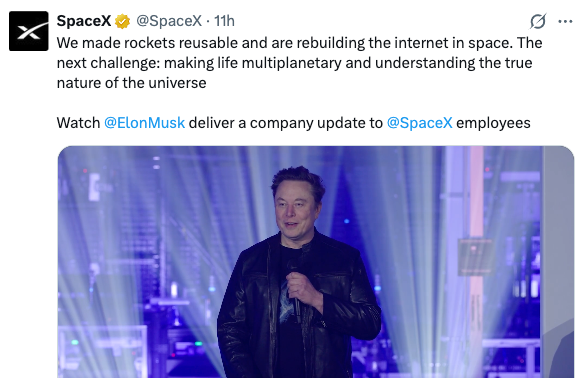
In a newly released all-hands address, Elon Musk said he expects AI revenue to surpass all of SpaceX's other businesses combined as early as September, pull significantly further ahead in the fourth quarter, and eventually account for roughly 99% of the company's value within five years.
SpaceX shares fell 3.9% to $133.29 on August 11, slipping back below their $135 IPO price after gaining nearly 30% over the previous three sessions. Yet, it is up by ~1% at around $134.7 during today's premarket session.
That tension is now the core investment question:
Can SpaceX(SPCX.US) turn enormous AI spending into revenue fast enough for investors to start valuing SPCX as an AI company rather than primarily as a rocket and satellite operator?
This Is No Longer Just a Space Story
Musk's comments sound dramatic, but the strategic shift has already been visible in SpaceX's financials.
The company spent about $15.8 billion on AI-related capital expenditure in Q2, more than double Q1's $7.7 billion. Its AI compute capacity expanded to roughly 1.4 gigawatts, versus about 0.4 GW a year earlier.
The next step is much bigger.
Musk has outlined a path toward approximately 10 GW of AI compute by the end of 2027. In his latest employee address, he argued that if SpaceX reaches that scale, it could potentially support $300 billion to $500 billion of annual revenue.
That figure should be treated as a management scenario, not a forecast. But it illustrates why AI is becoming so important to the SpaceX(SPCX.US) valuation debate.
SpaceX's pre-IPO materials already described an AI strategy built around two forms of monetization: selling compute capacity and selling intelligence through consumer and enterprise AI products. The company also identified Cursor as part of its enterprise strategy.
Grok Bot, launched on August 11, adds another layer.
Why Grok Bot Matters — Even If It Is Small Today
For investors, the important part of Grok Bot is not how much revenue the early beta generates this month.
It is what the product says about SpaceX(SPCX.US)'s AI strategy.
SpaceXAI describes Grok Bot as a group of persistent AI agents that operate from their own cloud computer. They can log into applications and websites, work across inboxes and other tools, and continue completing tasks even when the user's own computer is closed. They can also operate on services without a clean API or MCP connection.
Multiple Bots can work simultaneously, share context and delegate tasks to each other. Internally, SpaceXAI says teams have already used them for sales outreach, CRM updates, expense and invoice processing, employee operations and software bug fixing.
That makes Grok Bot useful evidence of a broader vertical strategy:
AI chips → compute infrastructure → Grok models → enterprise software → autonomous agents.
The company's $60 billion acquisition of Cursor, announced in June 2026, is expected to strengthen the final software layer. SpaceX's IPO materials had already disclosed an option to acquire Cursor at an implied $60 billion equity value, and the company exercised that option on June 16, signing a merger agreement that is expected to close in the third quarter of 2026, pending regulatory approvals.
In other words, SpaceX is not simply trying to rent GPUs.
It is trying to capture economics across much more of the AI stack.
The Bull Case Has Changed — but So Has the Risk
For SpaceX(SPCX.US), the bullish argument is increasingly straightforward.
If AI revenue really overtakes rockets, Starlink and other businesses over the coming quarters, investors may begin to assign much more weight to SpaceX's compute and software businesses.
There is already commercial evidence behind the infrastructure strategy. SpaceX disclosed compute-service agreements in its IPO materials, while its Q2 results showed rapid expansion in physical AI capacity.
But the same strategy creates the biggest risk.
10 GW of compute requires extraordinary amounts of capital.
SemiAnalysis estimates that building to that scale could require roughly $300 billion to $500 billion of capital expenditure, while Wells Fargo analyst Ken Gawrelski now projects SpaceX's 2027 AI capex at about $263 billion, with total 2027 capex reaching roughly $296 billion after Q2 results.
That creates an important distinction for investors:
More AI spending is not automatically bullish.
The spending becomes supportive only if utilization, customer commitments and revenue scale quickly enough to justify the capital being deployed.
The market has already shown sensitivity to this issue. SpaceX(SPCX.US) shares fell after Q2 despite stronger-than-expected revenue, as investors focused on AI capital spending of $15.8 billion versus roughly $13.1 billion expected by Wall Street.
Wall Street Is Already Split on How Much the AI Story Is Worth
The size of the valuation disagreement shows just how uncertain the new SpaceX(SPCX.US) narrative remains.
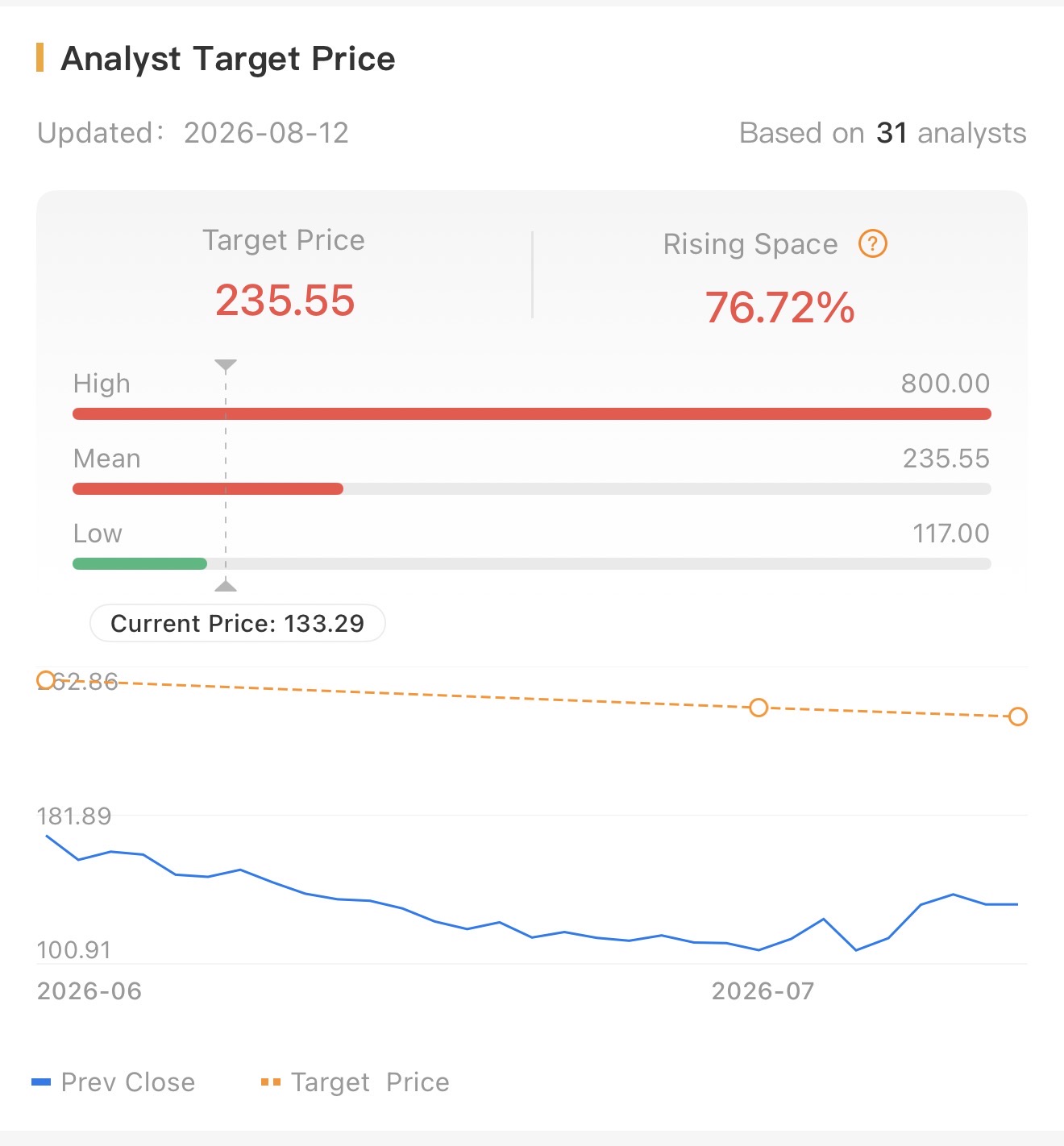
Wells Fargo maintained a Buy rating after earnings but reduced its price target to $215 from $230, while raising its spending estimates substantially.
Morningstar takes a very different view. It maintains a $73.97 fair value estimate, arguing that the stock already embeds aggressive assumptions around reusable Starship economics and the eventual competitiveness of space-based AI infrastructure.
This is therefore not simply a debate about whether AI will grow.
The real disagreement is over how much capital SpaceX(SPCX.US) must spend to capture that growth, how quickly it can monetize the resulting capacity, and how much of that success is already reflected in SPCX's valuation.
Nvidia May Be the Cleaner Near-Term Read-Through
The SpaceX AI buildout also matters beyond SPCX.
NVIDIA Corporation(NVDA.US) has become one of the most direct listed beneficiaries.
During SpaceX's first earnings call, Musk said the company had decided to build its AI infrastructure exclusively on Nvidia, highlighting the upcoming Vera Rubin architecture. Nvidia shares subsequently gained following the endorsement.
That creates different exposures to the same theme.
For SpaceX(SPCX.US), investors need the massive AI investment to produce attractive returns.
For NVIDIA Corporation(NVDA.US), SpaceX's willingness to spend aggressively can itself translate into demand for accelerators and AI systems.
The distinction matters: the customer carries much of the execution and financing risk, while the supplier can benefit from the infrastructure buildout before SpaceX's long-term AI economics are fully proven.
What to Watch Next: Four Tests Matter More Than the Headlines
1. Does AI revenue really become SpaceX's largest business?
Musk has effectively put a near-term date on the thesis: September. Since investors may not receive detailed monthly segment data, the next quarterly results and any interim revenue or annualized run-rate disclosures could provide the first real confirmation.
2. Can compute scale without destroying capital efficiency?
SpaceX(SPCX.US) finished Q2 around 1.4 GW and has discussed moving above 2 GW before ultimately targeting roughly 10 GW in 2027. Investors should watch whether capacity additions are accompanied by contracted customers, utilization and rising AI revenue rather than simply larger capex bills.
3. Does Grok Bot move from interesting technology to commercial adoption?
The product is still in early beta, initially available to eligible SuperGrok Heavy and Cursor subscribers, with enterprise customers directed to a waitlist.
Expansion into paying enterprise deployments would strengthen the idea that SpaceX can monetize AI above the infrastructure layer rather than relying mainly on compute rental.
4. Can the stock absorb near-term supply?
Another lockup-related expiration is expected on August 20, potentially making roughly 320 million additional shares available for trading. That is primarily a market-structure issue rather than a change in SpaceX's fundamentals, but it could temporarily complicate the stock's reaction to positive AI headlines.
Stocks & ETFs to Watch
| Ticker | Why It Matters | What to Watch |
|---|---|---|
| The central vehicle for SpaceX's shift from space and connectivity toward AI infrastructure and software | AI revenue mix, compute utilization, capex, Grok/Cursor monetization and Aug. 20 share supply | |
| SpaceX has selected Nvidia as its exclusive AI-compute architecture, making the 10 GW plan a potential source of major hardware demand | Vera Rubin shipments, SpaceX orders and the pace of AI infrastructure deployment | |
Microsoft Corporation(MSFT.US) Direxion Shares ETF Trust Direxion Daily MSFT Bull 1.5X Shares(MSFU.US) Direxion Shares ETF Trust Direxion Daily MSFT Bear 1X Shares(MSFD.US) | SemiAnalysis sees Microsoft as one potential major buyer of large-scale SpaceX compute capacity as AI demand remains constrained | Any confirmed SpaceX compute agreement and Microsoft's own AI capacity requirements |
The Bottom Line
Grok Bot is an important launch, but it is not the main story for investors.
The larger development is that Musk is effectively telling the market that today's SpaceX(SPCX.US) business mix may look almost irrelevant within several years.
That is an unusually large claim for a company whose shares are still trading around their IPO price.
The next phase for SpaceX(SPCX.US) therefore depends less on another ambitious AI announcement and more on confirmation: AI revenue overtaking the legacy businesses, compute capacity generating attractive economics, Grok and Cursor creating enterprise monetization, and the company demonstrating that hundreds of billions of potential future investment can generate adequate returns.
If those signals arrive, the market may increasingly treat SpaceX(SPCX.US) as an AI platform with rockets attached.
If revenue fails to keep pace with the spending, the same AI strategy could remain the biggest reason investors hesitate to award SPCX that valuation.
Disclaimer: This article is for informational purposes only and does not constitute investment advice or a recommendation to buy or sell any securities.