

AES (AES) Stock May Be Below Fair Value As Cash Flow Recovers
AES Corporation AES | 0.00 |
AES stock has delivered a loss of 25.5% over the past five years, yet the current valuation work suggests the shares may now be trading below their intrinsic value. This view is based on a Discounted Cash Flow (DCF) estimate and earnings multiples that both point to an undervalued picture.
- The 25.5% decline over five years means long-term holders have seen capital erode, which can set expectations low even if the current price reflects more caution than the fundamentals suggest.
- Future cash flow growth and AES' ability to convert those cash flows into debt reduction can support the valuation, while any pressure on cash generation or refinancing costs may limit how much value the market is willing to ascribe.
- AES screens as undervalued on broader checks, with 5 of 6 valuation tests pointing to a discount relative to the fundamentals.
The issue now is whether AES' current share price already reflects the long-term risks or if the discount implied by the intrinsic value work leaves room for a better outcome than the past five years suggest.
Does AES Look Undervalued on Cash Flow?
The Discounted Cash Flow model for AES uses projected free cash flows to estimate what the stock could be worth today. AES currently reports latest twelve month free cash flow of a loss of about $2.3b, yet the projections used in the model assume that cash generation recovers to positive levels over the coming years.
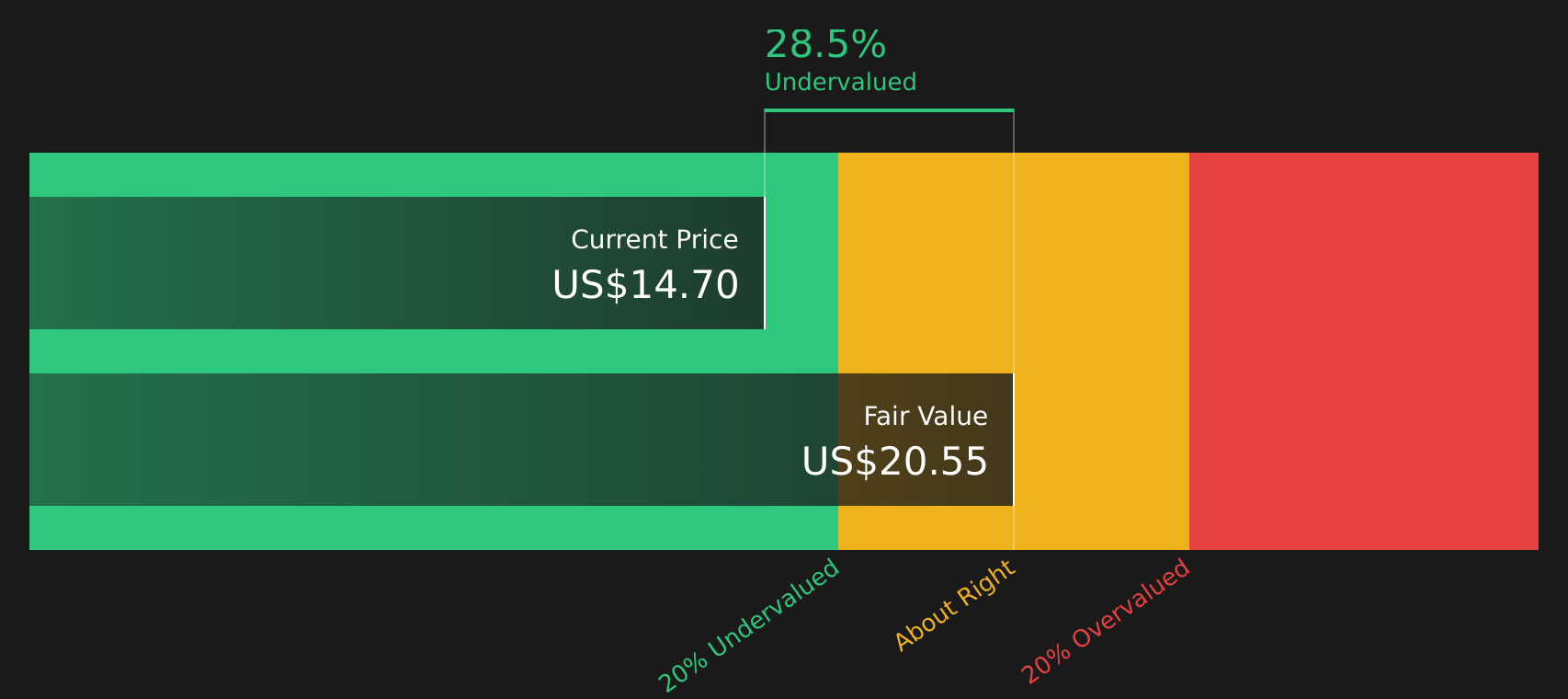
On those assumptions, the DCF model arrives at an estimated intrinsic value of about $20.40 per share. Compared with the current share price, this indicates AES is trading at a discount of roughly 27.7%. In other words, the model suggests the market price is below what the projected cash flows support, even after factoring in the company’s debt and required return to equity holders.
Overall, the Discounted Cash Flow work indicates AES stock currently screens as undervalued relative to its projected cash generation.
Our Discounted Cash Flow (DCF) analysis suggests AES is undervalued by 27.7%. Track this in your watchlist or portfolio, or discover 50 more high quality undervalued stocks.
Is AES Still Cheap on Earnings?
The P/E ratio is a useful yardstick for AES because it is currently profitable and covered by earnings estimates. AES trades on a P/E of about 5.5x, which is far below the Renewable Energy sector average of 16.9x and also below the peer group average of 34.3x. That already puts AES at a sizeable discount compared with many other listed utilities and renewables stocks.
A fair P/E for AES, based on its sector, size and risk profile, is estimated at around 18.9x. The gap between this fair ratio and the current 5.5x suggests the market is pricing AES well below what this framework implies for the stock. Investors are effectively paying less per dollar of AES earnings than both the wider industry and this tailored fair value model would indicate.
On the P/E multiple alone, AES stock appears undervalued relative to both its industry and its modelled fair value.

The AES Narrative: What Would Justify Today's Price?
Simply Wall St Narratives aim to connect AES' current valuation puzzle to clear scenarios for the company’s future. They spell out which paths for growth, margins and earnings would need to play out for AES' stock to be worth materially more or less than today’s price, and each links its number to a concrete view of how growth, profitability and risks might evolve that you can revisit as new information comes through.
One of the top community narratives on AES: roughly fairly valued
"AES's leading, long-term pipeline of renewables and energy storage projects backed by multi year PPAs positions the company to capitalize on rising electricity demand from AI and data centers..."
Do you think there's more to the story for AES? Head over to our Community to see what others are saying!
The Bottom Line
AES screens as undervalued on both the Discounted Cash Flow (DCF) intrinsic value estimate and on earnings multiples, which is a rare alignment between two different approaches. The key question is whether AES can deliver the cash flow recovery and balance sheet progress that the intrinsic value work assumes, and whether the market is willing to close the current discount to peers. What matters most from here is whether AES can convert its project pipeline and existing contracts into steadier free cash flow. That will decide if today’s valuation discount is an opportunity or an accurate reflection of ongoing risk.
This article by Simply Wall St is general in nature. We provide commentary based on historical data and analyst forecasts only using an unbiased methodology and our articles are not intended to be financial advice. It does not constitute a recommendation to buy or sell any stock, and does not take account of your objectives, or your financial situation. We aim to bring you long-term focused analysis driven by fundamental data. Note that our analysis may not factor in the latest price-sensitive company announcements or qualitative material. Simply Wall St has no position in any stocks mentioned.