

AES (AES) Stock May Trade At A Discount On Cash Flow And Earnings
AES Corporation AES | 0.00 |
AES stock is back in focus as a potential takeover and a long term share price decline of 26.1% over five years meet a set of valuation checks that currently lean cheap, including an intrinsic value estimate from a Discounted Cash Flow (DCF) that points to meaningful upside versus the market price.
- Over the past five years, AES shares have declined 26.1%, which keeps the stock trading well below where longer term holders bought in and puts more weight on whether today’s price offers a margin of safety.
- The planned US$33b take private deal led by BlackRock may support the current valuation, while regulatory pushback and scrutiny around control of AES Indiana introduce a clear risk that the terms or timing of any transaction could change.
- On Simply Wall St’s broader checks, AES screens as undervalued in 5 of 6 areas, and that high score suggests the current share price sits at a discount to its assessed fundamentals.
The issue now is whether AES is priced more by the prospective buyout terms or by its underlying intrinsic value, and what that means for investors considering the stock at today’s level.
Does AES Look Undervalued on Cash Flow?
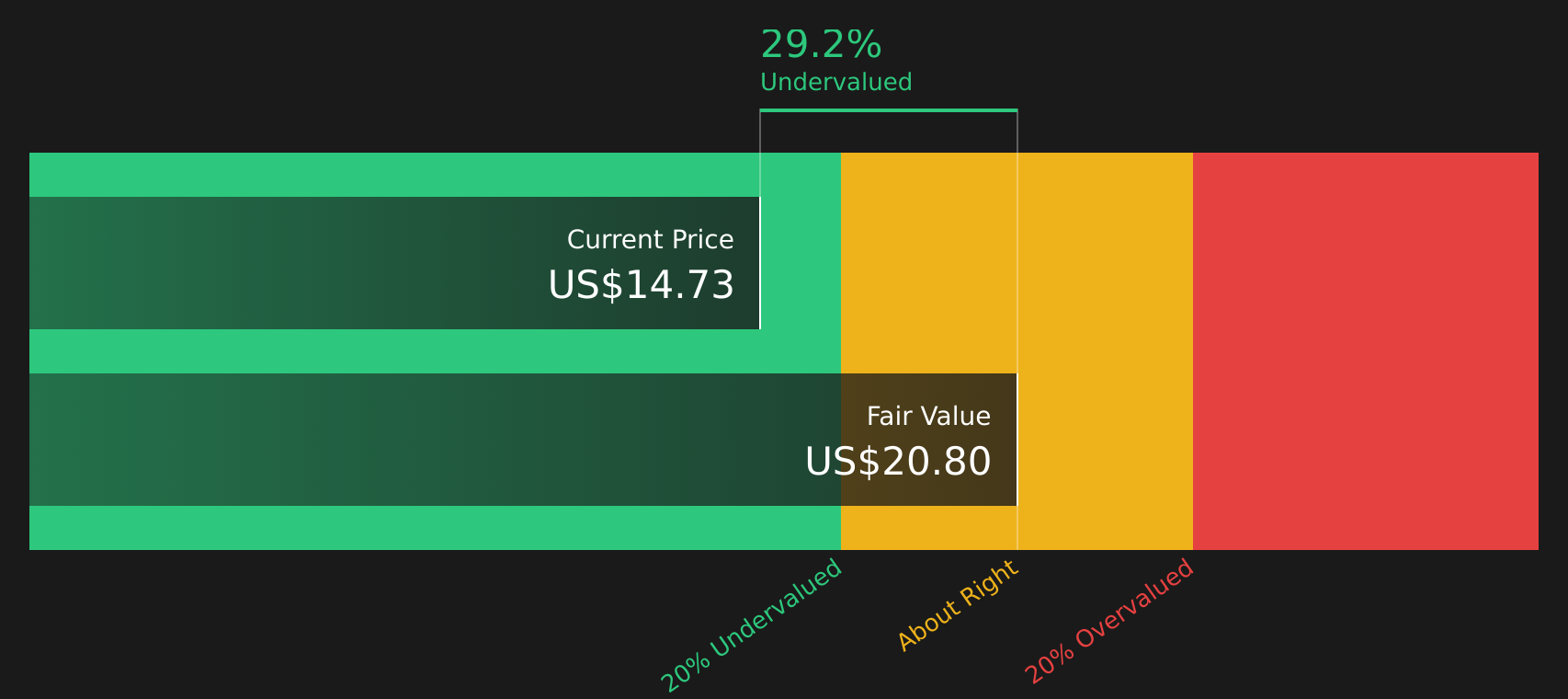
The Discounted Cash Flow (DCF) model values AES by projecting future free cash flows and discounting them back to today. For AES, the latest twelve month free cash flow shows a use of cash of about US$2.2b, and the model assumes those cash flows recover over time to positive levels. On that basis, the 2 Stage Free Cash Flow to Equity approach arrives at an estimated intrinsic value of about $20.31 per share.
Compared with the current share price, that DCF estimate implies AES trades at roughly a 27.6% discount. This points to the stock screening as undervalued on this method. The complaint to US regulators over the proposed US$33b BlackRock led takeover helps explain why the market price may still sit below the DCF estimate despite the deal terms.
Overall, AES stock currently appears undervalued relative to what its projected cash flows suggest under this DCF approach.
Our Discounted Cash Flow (DCF) analysis suggests AES is undervalued by 27.6%. Track this in your watchlist or portfolio, or discover 53 more high quality undervalued stocks.
Is AES Still Cheap on Earnings?
The P/E ratio is a useful check for AES because earnings remain a key reference point for a mature utility and power producer. AES currently trades on a P/E of about 7.6x, which is well below the Renewable Energy industry average of roughly 16.5x and also below a broader peer group nearer 31.0x.
On Simply Wall St’s blended fair P/E estimate of about 20.7x, the current P/E implies a large gap between what investors are paying for each dollar of AES earnings and what that framework suggests as a more typical level given its profile. Even with the ongoing take private proposal in the background, the market is valuing AES at a sizeable discount to both the industry benchmark and this fair ratio yardstick.
On the P/E multiple alone, AES stock appears undervalued compared with both its sector and the modelled fair earnings multiple.

The AES Narrative: What Would Justify Today's Price?
Simply Wall St Narratives pick up where AES' valuation puzzle leaves off and spell out the future growth, margin and earnings paths that would need to play out for the stock to be worth materially more or less than today's price on the Community page. Rather than focusing on a single multiple or model output, each Narrative lays out the assumptions behind its view of fair value so you can later compare them with AES' reported results as they come through.
One of the top community narratives on AES: roughly fairly valued
"AES's strategic transition out of coal and into higher-quality renewable and storage assets is driving a material uplift in average project net margins, reducing regulatory and environmental risks…"
Do you think there's more to the story for AES? Head over to our Community to see what others are saying!
The Bottom Line
AES screens as undervalued on both the Discounted Cash Flow (DCF) intrinsic value estimate and its current earnings multiple, so the key question is why that discount persists. The ongoing take private proposal and regulatory scrutiny sit at the center of that gap between modelled value and market price. For you as an investor, the crux is whether AES eventually re-rates closer to its intrinsic value or whether deal uncertainty and regulatory risk keep a discount in place. The answer to that will likely decide whether today’s pricing proves to be an opportunity or a value trap.
This article by Simply Wall St is general in nature. We provide commentary based on historical data and analyst forecasts only using an unbiased methodology and our articles are not intended to be financial advice. It does not constitute a recommendation to buy or sell any stock, and does not take account of your objectives, or your financial situation. We aim to bring you long-term focused analysis driven by fundamental data. Note that our analysis may not factor in the latest price-sensitive company announcements or qualitative material. Simply Wall St has no position in any stocks mentioned.