
AI Is "Going to the Sky"! Musk and OpenAI Compete for Space Data Centers—Which Space Stocks Are Worth Watching?
Alphabet Inc. Class C GOOG | 294.46 | -0.15% |
Alphabet Inc. Class A GOOGL | 295.77 | -0.54% |
Amazon.com, Inc. AMZN | 209.77 | -0.38% |
Rocket Lab RKLB | 67.73 | +3.37% |
Virgin Galactic SPCE | 2.46 | +2.50% |
As the demand for AI computing power continues to grow exponentially, terrestrial data centers face significant challenges related to energy and cooling. Recently, Silicon Valley tech giants have turned their attention to space, making it the next battleground in the AI race.
On November 4, Google (Alphabet Inc. Class C(GOOG.US) / Alphabet Inc. Class A(GOOGL.US) ) announced the launch of the "Project Sun Catcher," aiming to send two prototype satellites equipped with its proprietary TPU AI chips into orbit by early 2027. Google is collaborating with satellite company Planet Labs to develop the necessary hardware. CEO Sundar Pichai stated that preliminary research indicates their chips can withstand the radiation environment of low Earth orbit.
Meanwhile, Amazon.com, Inc.(AMZN.US) founder Jeff Bezos predicts that gigawatt-level data centers will emerge in space within the next decade. Startup Starcloud has already successfully launched a test satellite equipped with NVIDIA GPUs, indicating an increasing number of participants in this space race.
Elon Musk has publicly declared that his company, SpaceX, "will do this." He noted that by expanding the V3 version of "Starlink" satellites, a space-based data center can be constructed. Musk also hinted at launching a new initiative called "Heart of Galaxy," aiming to integrate the core capabilities of SpaceX, Tesla, and xAI to deploy solar-powered AI satellites into deep space.
Yesterday, media reports revealed that OpenAI explored the possibility of acquiring or partnering with a rocket company this past summer. CEO Sam Altman has long been interested in the potential for space-based data centers, believing that the insatiable demand for computing resources by AI systems will eventually consume vast amounts of power, making space a more viable option.
This raises the question: why space? Which companies are worth watching? This article will explore these topics in detail.
Why Space? The Answer Lies in Energy
The seemingly sci-fi concept of sending data centers into space is driven by one core factor: energy.
As the demand for AI model training and inference grows exponentially, the scale, power consumption, and cooling costs of terrestrial data centers are rising sharply, placing immense pressure on Earth's resources, including land, water, and electricity. Space, therefore, offers a theoretical ultimate solution.
Elon Musk has pointed out that as computing clusters expand, the combined demand for power supply and cooling systems will soon exceed the limits of terrestrial infrastructure. He explained that achieving a sustained computing capacity of 200 to 300 gigawatts annually would require building massive and extraordinarily expensive power plants—especially considering that a typical nuclear power plant generates only about 1 gigawatt of continuous output.
Currently, the total continuous power generation capacity in the United States is approximately 490 gigawatts. (It’s worth noting that while Musk used the term "annually," he was referring to sustained output over a specific period.) Dedicating a significant portion of this power to artificial intelligence is simply not feasible. Musk believes that achieving near-terawatt levels of power demand for AI on Earth’s grid is practically impossible.
“You can’t build power plants of that scale. Sustained output of 1 terawatt? That’s just not feasible. It has to be done in space. In space, you can harness continuous solar energy without needing batteries because sunlight is always available. Solar panels will also be cheaper—they don’t need glass or frames—and cooling can be achieved through simple radiation,” Musk explained.
Which Space-Related Stocks Are Worth Watching?
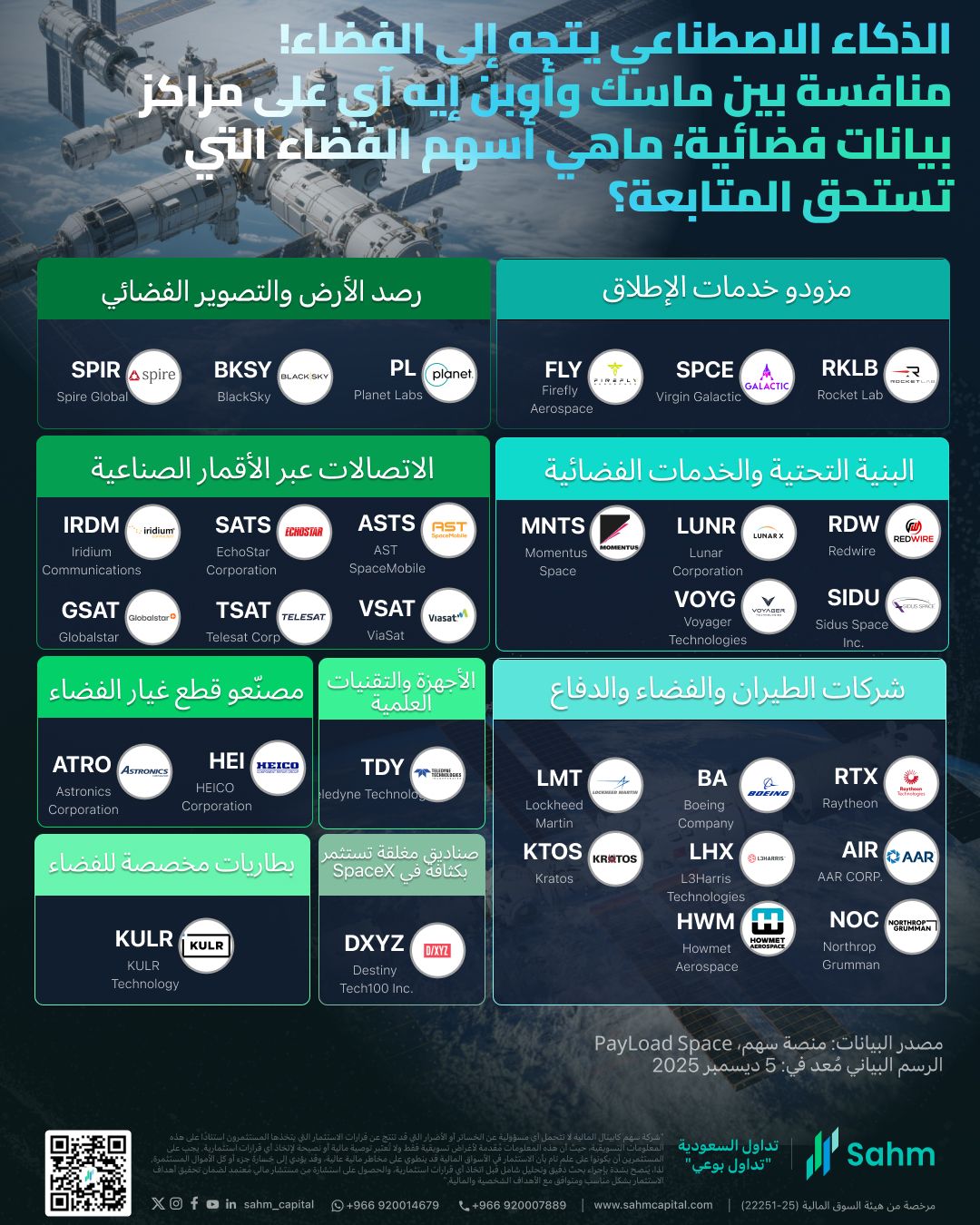
Specifically:
1. Launch Service Providers
Rocket Lab(RKLB.US): A leading commercial space company focused on small to medium rocket launch services, second only to SpaceX globally.
Virgin Galactic(SPCE.US): Known as the first publicly traded space tourism company, offering suborbital flight services. They've completed two test flights to the edge of space and have reservations from 603 people across 60 countries, totaling nearly $80 million in deposits.
2. Space Infrastructure and Services
Lunar Corporation(LUNR.US): A new player in lunar exploration, planning to launch its IM-2 mission to the moon by late 2024 or early 2025. They've secured additional contracts with NASA's Near Space Network (NSN), potentially tapping into its $4.82 billion value.
Redwire Corporation Common Stock(RDW.US): Positioned as a pragmatic leader in space infrastructure, focusing on essential components like space manufacturing and advanced robotics crucial for future space missions.
Other notable companies include MOMENTUS INC(MNTS.US), Sidus Space Inc.(SIDU.US), and Voyager Technologies(VOYG.US), the latter collaborating with NASA on the "Starlab" commercial space station, set to replace the retiring ISS by 2030.
3. Satellite Communications
AST SPACEMOBILE INC(ASTS.US): Aims to build a global low-earth orbit satellite internet using existing 4G/5G frequencies, enabling direct satellite connectivity for mobile devices.
In North America, major GEO broadband providers include EchoStar Corporation Class A(SATS.US) and ViaSat, Inc.(VSAT.US).
Iridium Communications Inc.(IRDM.US): Offers global voice and data services via 66 satellites, poised for growth through user expansion and government contracts.
Globalstar, Inc.(GSAT.US): One of the earliest successful entrants in satellite communications, though facing challenges in user growth and profitability.
4. Earth Observation and Imaging
Planet Labs PBC(PL.US): With over 13 years in earth imaging, they operate the largest remote sensing satellite constellation, providing high-frequency data and AI analysis for global clients.
BlackSky Technology Inc. Class A Common Stock(BKSY.US): Offers real-time geospatial intelligence services, partnering with Palantir(PLTR.US) to integrate imagery and data into their platform.
Spire Global, Inc. Class A Common Stock(SPIR.US): Collaborating with NVIDIA to develop AI-driven weather forecasting capabilities, offering rapid global updates beyond traditional models.
5. Technology Instruments
- Teledyne Technologies Incorporated(TDY.US): Specializes in aerospace systems, including avionics, defense systems, and satellite technology, serving diverse markets like automation and environmental tracking.
6. Space Batteries
- KULR Technology Group Inc(KULR.US): Provides cutting-edge energy storage solutions for space, aerospace, and defense, with NASA among its clients.
7. Aerospace and Defense Companies
- Key players include RAYTHEON TECHNOLOGIES CORPORATION(RTX.US), Lockheed Martin Corporation(LMT.US), L3 HARRIS TECHNOLOGIES INC(LHX.US), Northrop Grumman Corporation(NOC.US), Boeing Company(BA.US), AAR CORP.(AIR.US), Kratos Defense & Security Solutions, Inc.(KTOS.US), and HOWMET AEROSPACE INC(HWM.US). Lockheed Martin supports NASA with technologies like supersonic aircraft development and space exploration projects.
8. Space Component Manufacturers
- Companies such as HEICO Corporation(HEI.US) and Astronics Corporation(ATRO.US).
Additionally, consider the closed fund Destiny Tech100 Inc.(DXYZ.US), heavily invested in SpaceX, for potential opportunities.
Summary
The competition for space-based computing power transcends a mere technological race. It represents a strategic intersection of artificial intelligence, semiconductors, and aerospace—impacting future industrial ecosystems and the geopolitical tech landscape. This comprehensive system competition is unfolding rapidly.
However, this vision faces significant challenges. While proponents highlight space's ability to avoid natural disasters, the inherent risks of space itself—such as high radiation levels, debris collisions, and solar flares disrupting communication—pose unique threats not present on Earth. Moreover, the potential for catastrophic outcomes looms if large numbers of artificial objects are sent into orbit without reliable cleanup or maintenance plans. A major collision could trigger a chain reaction, potentially crippling many technologies that modern society relies on.
What are your thoughts on AI in space?