

AMC (AMC) Stock Sits Below Fair Value Following Governance Overhaul
AMC Entertainment Holdings, Inc. Class A AMC | 0.00 |
AMC Entertainment Holdings stock has delivered a very large 5 year share price decline, yet current valuation checks suggest the stock now screens as cheap on several measures. Recent momentum and corporate changes have pulled the company back into focus for investors trying to work out whether that long slide has already priced in much of the bad news.
- The share price has fallen about 99.0% over the past 5 years, which shows how severe the long term reset has been for AMC Entertainment Holdings shareholders.
- Recent record box office takings and a proposed governance overhaul that may increase board accountability can support sentiment, while ongoing execution risks around attendance, capital spending and balance sheet decisions remain important for any valuation case.
- The broader checks lean cheap, with AMC Entertainment Holdings scoring 5 out of 6 on value and both the Discounted Cash Flow (DCF) intrinsic value estimate and market multiples pointing to undervaluation, including an intrinsic estimate that sits about 25% above the recent share price.
The stock's next move may depend on whether investors agree that the current price already reflects the past 5 year drawdown or still overstates the risks to AMC Entertainment Holdings future cash flows.
Scan beyond AMC Entertainment Holdings and compare its recent reset with other deep value ideas using the curated list of 49 high quality undervalued stocks.
Is AMC Entertainment Holdings a Bargain on Cash Flow?
The Discounted Cash Flow (DCF) model values AMC Entertainment Holdings based on projected future cash that could be available to shareholders. The latest twelve month free cash flow is a loss of about $37.4 million, and the model assumes a recovering profile over time rather than ongoing contraction.
Using those cash flow projections and a 2 Stage Free Cash Flow to Equity approach, the DCF results in an estimated intrinsic value of about $3.53 per share. That is roughly 25% above the recent share price, which implies AMC Entertainment Holdings appears undervalued on this method. With the current momentum tied to strong box office numbers and a proposed governance overhaul, the share price reaction so far still leaves a gap to the DCF estimate.
Overall, the DCF analysis indicates that AMC Entertainment Holdings stock currently appears undervalued relative to its projected cash flows.
Our Discounted Cash Flow (DCF) analysis suggests AMC Entertainment Holdings is undervalued by 25.0%. Track this in your watchlist or portfolio, or discover 49 more high quality undervalued stocks.

Is AMC Entertainment Holdings Still Cheap on Sales?
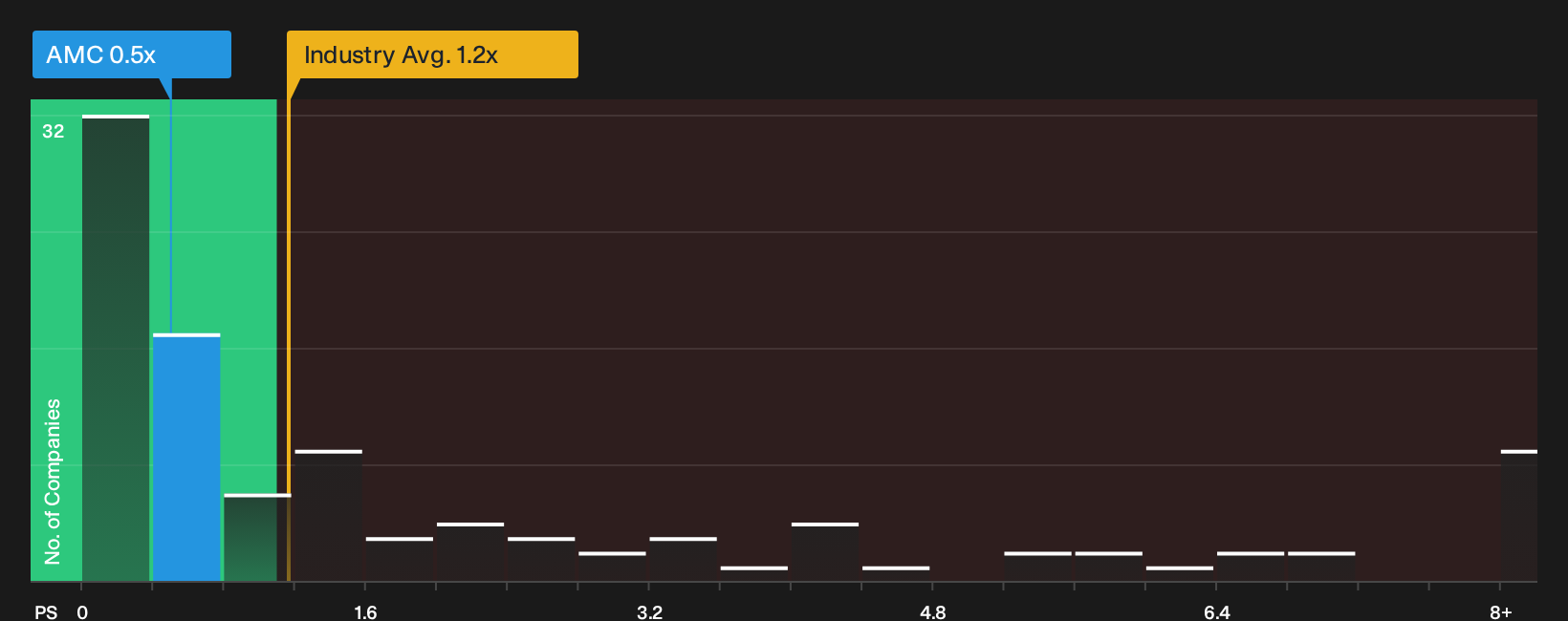
P/S is a useful lens for AMC Entertainment Holdings because revenue is a cleaner reference point than profits for a business that has reported recent cash flow losses. On this metric, AMC trades on a P/S of about 0.5x, compared with an Entertainment industry average of roughly 1.3x and a broader peer group around 4.1x.
The fair P/S ratio for AMC Entertainment Holdings, based on factors like its sector, margins, scale and risk profile, is estimated at about 0.8x. That sits above the current 0.5x, which indicates investors are pricing the stock at a discount to what this model suggests could be reasonable for its revenue base. This is consistent with the earlier DCF work, which also indicated that AMC Entertainment Holdings appeared cheap on that basis.
On the P/S multiple, AMC Entertainment Holdings stock appears undervalued relative to both its industry and the modelled fair ratio.
The AMC Entertainment Holdings Narrative: What Would Justify Today's Price?
Simply Wall St Narratives for AMC Entertainment Holdings pick up where the valuation work leaves off. They spell out which assumptions about AMC Entertainment Holdings' future growth, margins and earnings would need to be true for the stock to be worth materially more or less than the current price, and each one links its number to a clear view on how growth, profitability and risk might evolve that you can revisit as fresh information emerges. These sit on Simply Wall St's Community page and offer a structured way to think about what the market is currently pricing in.
Community narratives around AMC Entertainment Holdings are split, with some investors focused on earnings power from premium formats and others concentrating on leverage and structural industry risks.
Bull case: roughly fairly valued
"Ongoing success in diversifying content such as direct distribution of concerts (Taylor Swift, Beyoncé, Eminem), niche film events, and alternative content reduces dependence on studio box office releases and capitalizes on demand for event-based cinema, driving incremental revenues and revenue stability..."
Bear case: 47% overvalued
"High debt levels and costly infrastructure demands limit innovation and expose AMC to financial and operational risks..."
Do you think there's more to the story for AMC Entertainment Holdings? Head over to our Community to see what others are saying!
The Bottom Line
For AMC Entertainment Holdings, both the Discounted Cash Flow (DCF) intrinsic value estimate and the market multiples point to the stock screening as undervalued rather than expensive. The agreement between these methods suggests the current discount is more than just a quirk of one model and instead reflects concern about execution, balance sheet decisions and industry risks. The key question from here is whether AMC can translate recent operational improvements and governance changes into steadier cash flows, or whether the current discount is the market correctly pricing the chance that these pressures persist.
This article by Simply Wall St is general in nature. We provide commentary based on historical data and analyst forecasts only using an unbiased methodology and our articles are not intended to be financial advice. It does not constitute a recommendation to buy or sell any stock, and does not take account of your objectives, or your financial situation. We aim to bring you long-term focused analysis driven by fundamental data. Note that our analysis may not factor in the latest price-sensitive company announcements or qualitative material. Simply Wall St has no position in any stocks mentioned.