
Ampco-Pittsburgh Corporation (NYSE:AP) Held Back By Insufficient Growth Even After Shares Climb 25%
Ampco-Pittsburgh Corporation AP | 7.17 | -0.42% |
Ampco-Pittsburgh Corporation (NYSE:AP) shares have continued their recent momentum with a 25% gain in the last month alone. The annual gain comes to 163% following the latest surge, making investors sit up and take notice.
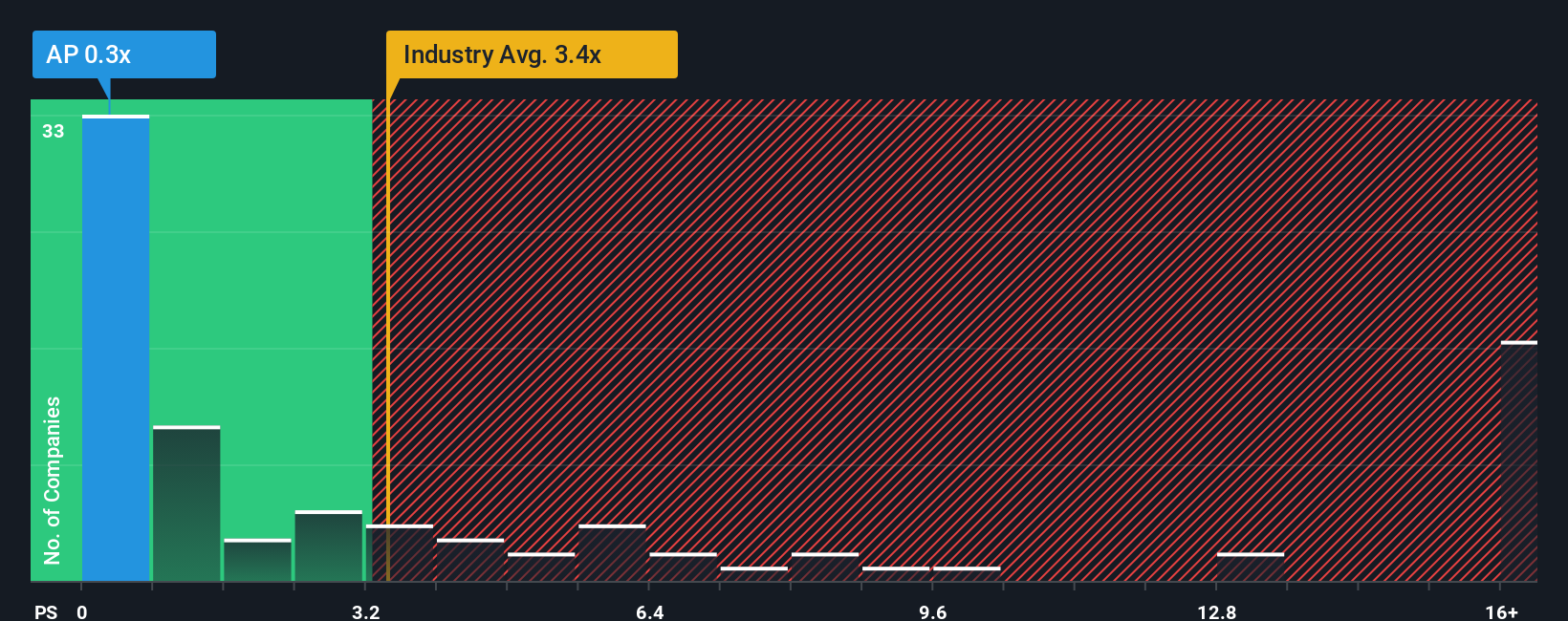
Although its price has surged higher, Ampco-Pittsburgh's price-to-sales (or "P/S") ratio of 0.3x might still make it look like a strong buy right now compared to the wider Metals and Mining industry in the United States, where around half of the companies have P/S ratios above 3.4x and even P/S above 12x are quite common. However, the P/S might be quite low for a reason and it requires further investigation to determine if it's justified.
What Does Ampco-Pittsburgh's Recent Performance Look Like?
We'd have to say that with no tangible growth over the last year, Ampco-Pittsburgh's revenue has been unimpressive. One possibility is that the P/S is low because investors think this benign revenue growth rate will likely underperform the broader industry in the near future. If you like the company, you'd be hoping this isn't the case so that you could potentially pick up some stock while it's out of favour.
Although there are no analyst estimates available for Ampco-Pittsburgh, take a look at this free data-rich visualisation to see how the company stacks up on earnings, revenue and cash flow.How Is Ampco-Pittsburgh's Revenue Growth Trending?
The only time you'd be truly comfortable seeing a P/S as depressed as Ampco-Pittsburgh's is when the company's growth is on track to lag the industry decidedly.
If we review the last year of revenue, the company posted a result that saw barely any deviation from a year ago. Fortunately, a few good years before that means that it was still able to grow revenue by 12% in total over the last three years. Accordingly, shareholders probably wouldn't have been overly satisfied with the unstable medium-term growth rates.
Comparing that to the industry, which is predicted to deliver 29% growth in the next 12 months, the company's momentum is weaker, based on recent medium-term annualised revenue results.
In light of this, it's understandable that Ampco-Pittsburgh's P/S sits below the majority of other companies. Apparently many shareholders weren't comfortable holding on to something they believe will continue to trail the wider industry.
The Final Word
Ampco-Pittsburgh's recent share price jump still sees fails to bring its P/S alongside the industry median. We'd say the price-to-sales ratio's power isn't primarily as a valuation instrument but rather to gauge current investor sentiment and future expectations.
As we suspected, our examination of Ampco-Pittsburgh revealed its three-year revenue trends are contributing to its low P/S, given they look worse than current industry expectations. At this stage investors feel the potential for an improvement in revenue isn't great enough to justify a higher P/S ratio. If recent medium-term revenue trends continue, it's hard to see the share price experience a reversal of fortunes anytime soon.
It's always necessary to consider the ever-present spectre of investment risk. We've identified 3 warning signs with Ampco-Pittsburgh (at least 2 which are concerning), and understanding them should be part of your investment process.
Of course, profitable companies with a history of great earnings growth are generally safer bets. So you may wish to see this free collection of other companies that have reasonable P/E ratios and have grown earnings strongly.
This article by Simply Wall St is general in nature. We provide commentary based on historical data and analyst forecasts only using an unbiased methodology and our articles are not intended to be financial advice. It does not constitute a recommendation to buy or sell any stock, and does not take account of your objectives, or your financial situation. We aim to bring you long-term focused analysis driven by fundamental data. Note that our analysis may not factor in the latest price-sensitive company announcements or qualitative material. Simply Wall St has no position in any stocks mentioned.