

Assessing Arbor Realty Trust (ABR) Valuation After CLO Redemption And Improved Repurchase Financing Terms
Arbor Realty Trust Inc ABR | 0.00 |
Arbor Realty Trust (ABR) recently redeemed $787.0 million of legacy CLO 17 notes and moved about $1.21 billion of assets into repurchase facilities with JPMorgan, securing better terms and creating roughly $132.3 million of liquidity.
Despite the refinancing progress, the stock has had a weak run, with a 30-day share price return down 29.9% and a 1-year total shareholder return down 35.1%. This indicates that momentum has been soft even as funding terms improve.
If this refinancing story has you thinking about where else capital is moving, it could be a good moment to scan 21 top founder-led companies for fresh stock ideas.
With Arbor’s shares down sharply over the past year even as it reshapes its balance sheet and trades below some analyst and intrinsic value estimates, you have to ask: is this a reset buying opportunity, or is the market already pricing in future growth?
Price-to-Earnings of 14x: Is it justified?
On a P/E of 14x, Arbor Realty Trust trades at a higher earnings multiple than the wider US Mortgage REITs group and also above its own estimated fair P/E level.
The P/E ratio compares the current share price to earnings per share and is a quick way to see how much investors are paying for each dollar of profit. For a mortgage REIT such as Arbor, this matters because earnings can be sensitive to funding costs, credit performance and one off items like the recent $49.6 million loss that affected the latest 12 month results.
Here, the stock’s 14x P/E is above the US Mortgage REITs industry average of 11.8x and above the modelled fair P/E of 12.2x. This suggests the current price carries a richer earnings tag than both sector peers and the level implied by the SWS fair ratio model. If that fair ratio is a guide to where valuations could settle, there is a gap that may need to close over time either through earnings or price.
Result: Price-to-Earnings of 14x (OVERVALUED).
However, the share price has fallen 29.9% over 30 days and 35.1% over 1 year, and annual revenue declined 49.3%. This could pressure sentiment further.
Another View: Cash Flow Points to Undervaluation
While Arbor looks expensive on a 14x P/E, the SWS DCF model suggests the stock at $5.64 is trading below an estimated future cash flow value of $7.79, implying a discount of about 27.6%. For you, that sets up a clear question: which signal deserves more weight?
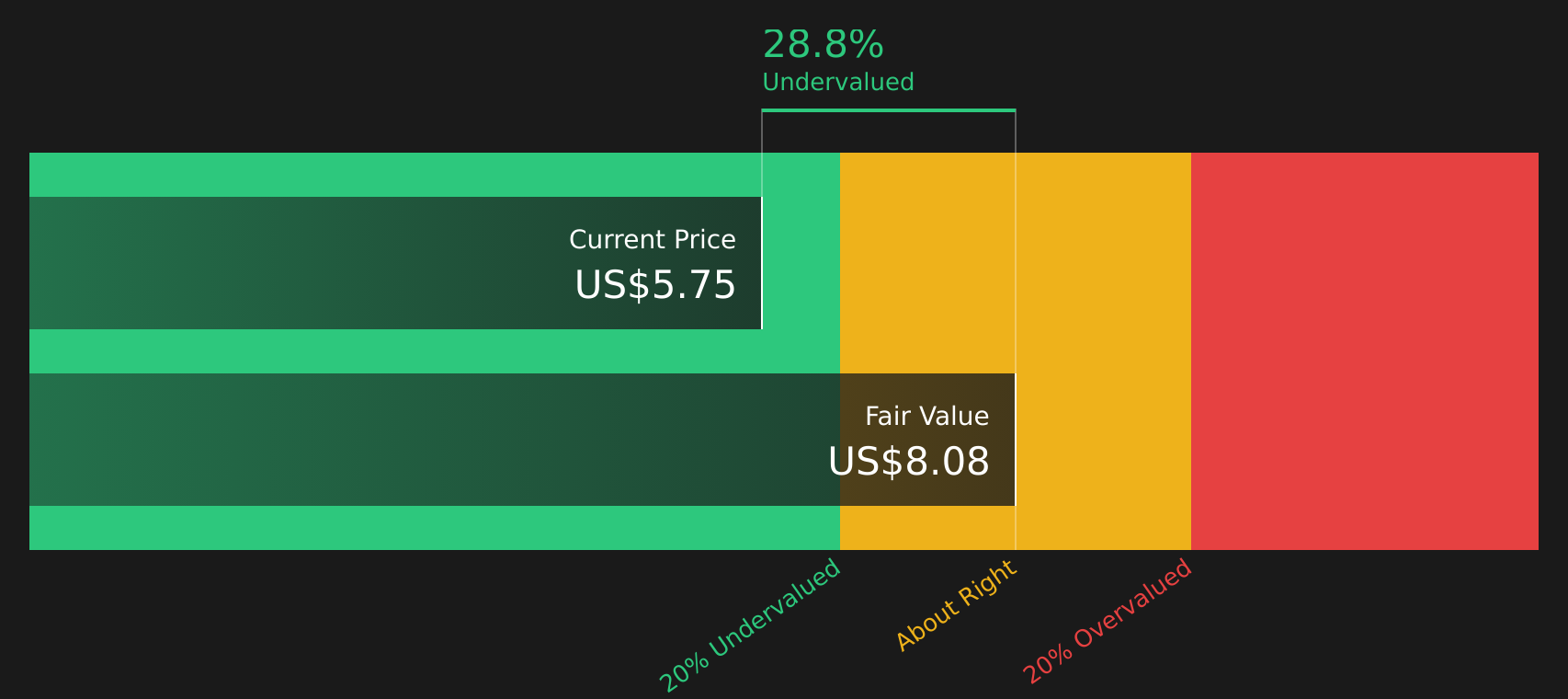
Simply Wall St performs a discounted cash flow (DCF) on every stock in the world every day (check out Arbor Realty Trust for example). We show the entire calculation in full. You can track the result in your watchlist or portfolio and be alerted when this changes, or use our stock screener to discover 46 high quality undervalued stocks. If you save a screener we even alert you when new companies match - so you never miss a potential opportunity.
Next Steps
If this mix of risks and potential rewards feels finely balanced, do not wait for consensus. Check the data, stress test your thesis, and then review the 3 key rewards and 4 important warning signs.
Looking for more investment ideas?
If Arbor has sharpened your focus on risk, income and value, do not stop here. Broaden your watchlist now so you are not chasing the next move late.
- Spot potential value opportunities early by scanning 46 high quality undervalued stocks that combine solid fundamentals with pricing that may not fully reflect their underlying businesses.
- Strengthen your portfolio’s income profile by reviewing 10 dividend fortresses that offer higher yields with a focus on resilience.
- Dial down portfolio risk by zeroing in on 64 resilient stocks with low risk scores and see which companies score better on financial stability.
This article by Simply Wall St is general in nature. We provide commentary based on historical data and analyst forecasts only using an unbiased methodology and our articles are not intended to be financial advice. It does not constitute a recommendation to buy or sell any stock, and does not take account of your objectives, or your financial situation. We aim to bring you long-term focused analysis driven by fundamental data. Note that our analysis may not factor in the latest price-sensitive company announcements or qualitative material. Simply Wall St has no position in any stocks mentioned.