

Assessing BancFirst (BANF) Valuation As Options Activity Climbs And Earnings Beat Lifts Sentiment
Bancfirst BANF | 0.00 |
Unusual options activity in BancFirst (BANF) has put the stock on many investors’ screens, with elevated implied volatility coinciding with a recent earnings beat and generally more positive analyst sentiment.
Recent trading reflects this renewed attention, with the share price at $108.24 and a 1-year total shareholder return that declined 15.04%, while the 3-year and 5-year total shareholder returns of 31.34% and 77.84% point to a stronger longer term record.
If the options activity around BancFirst has you curious about what else is moving, it could be a good moment to broaden your search with 19 top founder-led companies
With the stock recently weaker over 1 year but stronger over 3 and 5 years, renewed options activity and a discount to analyst targets raise the key question: is BancFirst undervalued today, or is the market already pricing in future growth?
Price-to-Earnings of 14.7x: Is it justified?
BancFirst currently trades on a P/E of 14.7x, which sits above both its banking peers and the level suggested by Simply Wall St's fair value models.
The P/E ratio compares the current share price to earnings per share, so a higher P/E usually reflects higher expectations for future profits or a perceived quality premium.
For BancFirst, the picture is mixed. On one side, the company scores as "good value" against the Simply Wall St DCF based fair value estimate and has a record of earnings growth and high quality earnings. On the other side, the current P/E of 14.7x is described as expensive relative to the peer average of 12.4x and also rich compared to the estimated fair P/E of 10.6x, a level the market could move toward if sentiment cools.
That premium is even clearer against the wider US Banks industry average P/E of 11.2x, which suggests investors are currently paying more for each dollar of BancFirst earnings than for many sector peers and more than the fair ratio indicates might be reasonable.
Result: Price-to-Earnings of 14.7x (OVERVALUED)
However, the recent 1-year return decline and P/E premium over peers could reverse quickly if earnings soften or investor sentiment toward regional banks cools.
Another view: cash flows tell a different story
While the 14.7x P/E makes BancFirst look expensive versus peers, the SWS DCF model points in the opposite direction. At $108.24, the stock is described as trading around 41% below an estimated fair value of $184.34. This frames the current P/E premium as a possible opportunity rather than just a risk. So which signal deserves more weight in your process?
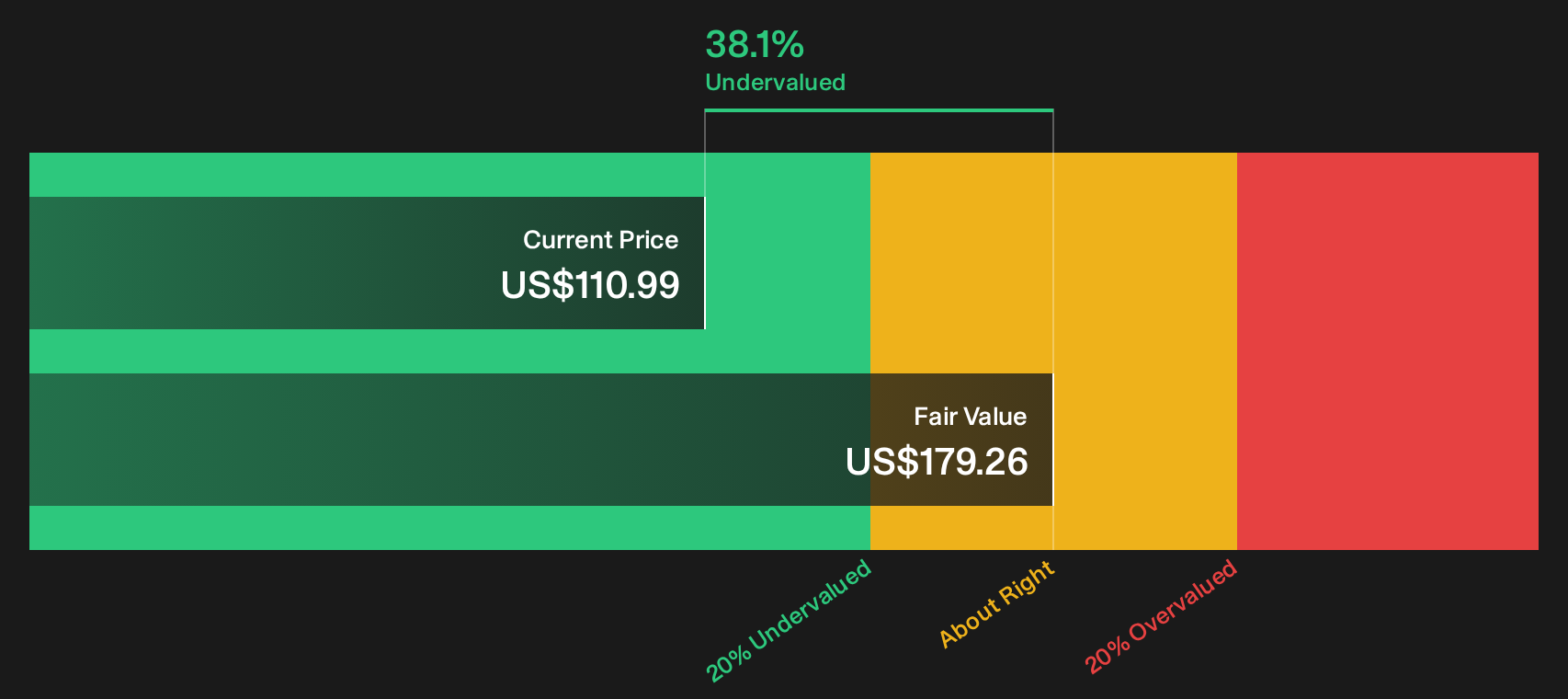
Simply Wall St performs a discounted cash flow (DCF) on every stock in the world every day (check out BancFirst for example). We show the entire calculation in full. You can track the result in your watchlist or portfolio and be alerted when this changes, or use our stock screener to discover 54 high quality undervalued stocks. If you save a screener we even alert you when new companies match - so you never miss a potential opportunity.
Next Steps
If mixed signals around valuation and sentiment leave you unsure, this is the moment to look through the data yourself and decide where you stand. To weigh both the concerns and the potential upside in one place, start with 3 key rewards and 1 important warning sign
Looking for more investment ideas?
If BancFirst has sparked your interest, do not stop here. Broaden your watchlist with fresh ideas that match the kind of portfolio you want to build.
- Target stronger upside potential by scanning for quality companies trading below what their fundamentals suggest using the 54 high quality undervalued stocks.
- Build a steadier income stream by focusing on companies with higher yields and resilient payouts through the 12 dividend fortresses.
- Prioritise capital preservation by concentrating on stocks with sturdier financial profiles and lower overall risk using the 66 resilient stocks with low risk scores.
This article by Simply Wall St is general in nature. We provide commentary based on historical data and analyst forecasts only using an unbiased methodology and our articles are not intended to be financial advice. It does not constitute a recommendation to buy or sell any stock, and does not take account of your objectives, or your financial situation. We aim to bring you long-term focused analysis driven by fundamental data. Note that our analysis may not factor in the latest price-sensitive company announcements or qualitative material. Simply Wall St has no position in any stocks mentioned.