

Assessing Nuvalent (NUVL) Valuation As Mixed Momentum Meets High P/B And DCF Upside
Nuvalent, Inc. Class A NUVL | 103.01 | -1.66% |
Nuvalent (NUVL) is drawing attention after recent trading left the stock at a last close of US$100.50, with returns over the past month and the past 3 months both in negative territory.
Short term momentum has softened, with a 1-day share price return of 3.42% and a 30-day share price return of 5.58% bringing Nuvalent to US$100.50. Its 1-year total shareholder return of 26.43% and 3-year total shareholder return of about 3.3x paint a stronger longer term picture.
If this kind of mixed momentum has you reviewing your watchlist, it could be a good time to scan our screener of 27 healthcare AI stocks as potential next ideas.
So with short term returns under pressure but a much stronger multi year track record and clinical programs still in development, is Nuvalent quietly offering value today, or is the market already pricing in everything that comes next?
Price-to-Book of 9.2x: Is it justified?
On Simply Wall St’s checks, Nuvalent’s shares trade on a P/B of 9.2x, which screens as good value against its selected peer group but expensive against the broader US Biotechs industry.
The P/B ratio compares the company’s market value to its net assets on the balance sheet. It is often used for early stage or unprofitable biopharma names where earnings are not yet a reliable anchor. For Nuvalent, this framing reflects how much investors are paying today for its clinical pipeline and cash position relative to accounting equity, rather than current profits.
Against a peer average P/B of 49.1x, Nuvalent’s 9.2x looks far lower. This suggests the market is not assigning the same premium some comparables carry for their development portfolios. However, against the broader US Biotechs industry average of 2.6x, the same 9.2x stands out as materially higher, indicating investors are willing to pay a multiple of book value that sits well above the wider group.
Result: Preferred multiple of Price-to-Book of 9.2x (ABOUT RIGHT)
However, you still need to weigh clinical trial risk and the company’s US$381.435 million net loss, as either could quickly change how that P/B looks.
Another View: Our DCF Model Points to a Bigger Gap
If you step away from book value and look at our DCF model instead, the picture shifts. Simply Wall St’s estimate of future cash flow value sits at about $535.45 per share, compared with today’s $100.50 price, which screens as a very large discount.
That kind of gap can reflect opportunity, but it can also signal how much has to go right in clinical and commercial execution. The real question for you is whether that disconnect is caution or mispricing.
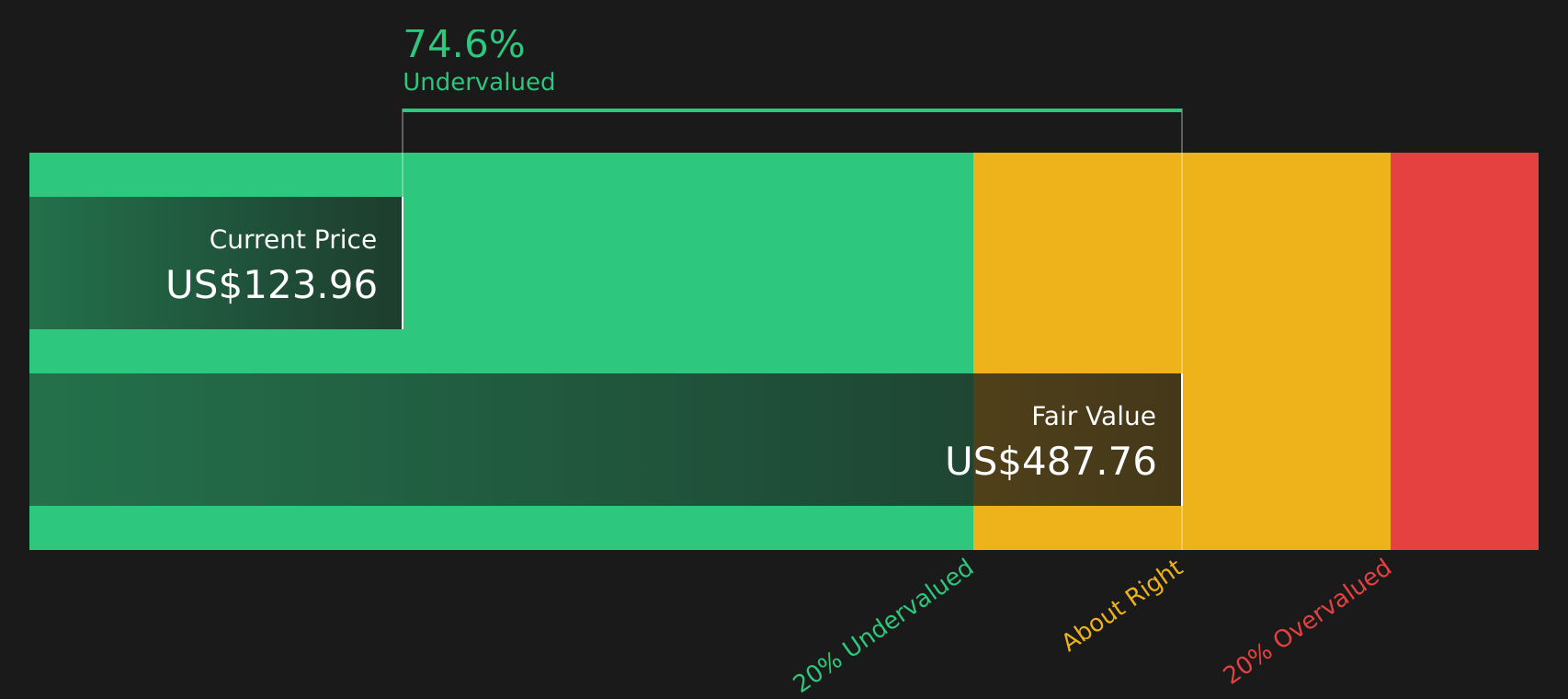
Simply Wall St performs a discounted cash flow (DCF) on every stock in the world every day (check out Nuvalent for example). We show the entire calculation in full. You can track the result in your watchlist or portfolio and be alerted when this changes, or use our stock screener to discover 54 high quality undervalued stocks. If you save a screener we even alert you when new companies match - so you never miss a potential opportunity.
Next Steps
All of this leaves a mixed but interesting picture, so if you think the window to act could be short, spend a few minutes with the full data and weigh up the 3 key rewards and 3 important warning signs before you decide where you stand.
Ready to hunt for more ideas?
If you are on the fence about Nuvalent, do not sit still, use the Simply Wall St screener to line up your next few watchlist candidates today.
- Target stability first and stress less by scanning our 87 resilient stocks with low risk scores that score well on resilience and risk metrics.
- Spot potential mispricings early by running through 54 high quality undervalued stocks where solid fundamentals meet prices that look out of sync with underlying strength.
- Lock in potential income ideas by reviewing 15 dividend fortresses that focus on higher yielding payouts backed by stronger balance sheets.
This article by Simply Wall St is general in nature. We provide commentary based on historical data and analyst forecasts only using an unbiased methodology and our articles are not intended to be financial advice. It does not constitute a recommendation to buy or sell any stock, and does not take account of your objectives, or your financial situation. We aim to bring you long-term focused analysis driven by fundamental data. Note that our analysis may not factor in the latest price-sensitive company announcements or qualitative material. Simply Wall St has no position in any stocks mentioned.