
AST SpaceMobile: A $30B Bet Requiring Flawless Execution
AST SPACEMOBILE INC ASTS | 92.62 | +10.28% |
AST SpaceMobile Inc. (NASDAQ:ASTS) is one of the most controversial stocks in telecom. The company is developing the first space-based cellular broadband network that people will be able to use with their existing smartphones. Its market value was north of $30 billion in January 2026. Its paltry run-rate revenue of $18.5 million over the last year has been called into question, as have its cumulative operating losses of some $274 million (SEC filings). This disparity between financial fundamentals and market cap means the investment is 100% about execution, not fundamentals.
BlueBird 6 was inserted into orbit from the Indian Satish Dhawan Space Centre on December 23, 2025 (AST SpaceMobile press release). This satellite is almost 2,400 square feet in area, three times larger than any previous one and with nearly 10 times the capacity of any of the company’s earlier satellites. It was “a breakthrough moment” that “validates years of U.S. innovation and American manufacturing,” said Abel Avellan, the chief executive officer. It is designed to deliver speeds of up to 120 Mbps on off-the-shelf mobile devices. But does that justify a market capitalization of $30 billion? The answer depends entirely on execution
The Business Plan: Space-Based Cell Towers
The way AST SpaceMobile is attacking the existing market is completely different from its competitors. The constellation is a space-based cellular long range communication system that sends signals to unmodified communications devices over existing wireless bands. Even those who have weak service in the countryside or live out of cell range can receive phone service without having to buy another piece of hardware. The company already has agreements with more than 35 mobile operators around the world, from AT&T and Verizon to Vodafone and Rakuten (investor presentation). As a B2B wholesale model, AST does not directly sell to end consumers. Instead, it sells infrastructure to the third parties that do.
The addressable market is substantial. Nearly 3.5 billion people, or 42% of the world’s population, have little or no access to mobile communications (GSMA). Given that, the market opportunity could be more than $1.1 trillion a year, according to the company. A tiny bit of that could make a fortune. But there is execution risk in the journey from technological demonstration to commercial scale.
Financial Reality: Pre-Revenue Valuation Challenges
From the financials, it is clear that this is an early stage commercialization story. For the trailing twelve months ended Q3 2025, AST reported revenue of $18.5 million against an operating loss of $274.2 million (Q3 2025 earnings report). The company had a net loss attributable to common stockholders of $303.8 million, or $1.29 a diluted share.
| Metric | TTM Value | YoY Change |
| Revenue | $18.5M | +641% |
| Operating Loss | ($274.2M) | Widened |
| Net Loss | ($303.8M) | Expanded |
| Cash from Operations | ($164.9M) | Improved |
| R&D Expenses | $151.7M | +24% |
The truth is more nuanced, though. In its latest presentation, AST SpaceMobile presented $1.204 billion of cash and short-term investments on hand for roughly 7-8 quarters of financial runway under current burn rates (investor presentation). Total assets were $2.55 billion with total liabilities of $924.9 million, thus the company had net equity of $1.626 billion. The book value per share is $4.56, so the stock sells at approximately 22 times book at around $100 a share.
Valuation multiples are extreme by almost any historical measure. The P/S ratio is 1,424x, over 114,000% above the sector median of 1.25x. EV/Sales stands at 549x even considering forward sales, which remain speculative. These multiples are valid only if investors believe the company will generate significant revenue over the next 24 to 36 months. Management forecasts second-half 2026 revenue of $50 to $75 million and more than $1 billion of commercial revenue commitments from partners (company guidance).
Execution Milestones and the Road to Commercialization
The company has greatly accelerated its operational execution. BlueBird 6 is the first next-generation satellite in AST’s fleet, and the company plans to launch 45 to 60 new satellites by the end of 2026. The company expects an average of 45 days between launches throughout the year. Production capability has scaled to around 500,000 square feet of facilities in Texas and Florida with the ability to produce six satellites per month. More than 3,800 patents and pending patent applications cover AST’s technology.
AT&T announced it has reached several infrastructure milestones since BlueBird 6 was deployed, including the activation of a fourth ground relay station (AT&T press release). The company intends to provide a beta satellite service for select AT&T customers and FirstNet public safety users in the first half of 2026 ahead of the commercial launch. If the revenue inflection materializes within the next 12 months, sentiment will improve. If delayed, investor confidence will be greatly affected.
| Milestone | Timeline |
| BlueBird 6 Launch | Completed Dec 2025 |
| Objective: 5 Orbital Launches | By End of Q1 2026 |
| AT&T Beta Service | H1 2026 |
| 45-60 Satellites in Orbit | By End of 2026 |
| Commercial Service Launch | H2 2026 |
Competitive Landscape: The Starlink Challenge
Competition in space-based connectivity is heating up. Starlink, SpaceX’s satellite internet service, already has more than 9,000 satellites orbiting the Earth and serves over nine million customers around the world (Starlink). While Starlink’s current strategy involves proprietary ground terminals, the company is developing direct-to-device capability through its collaboration with T-Mobile and its spectrum acquisition from EchoStar. This development diminishes AST’s differentiation.
AST SpaceMobile still has a few cards to play. The macro-satellite design requires a lower number of satellites for complete coverage by area, since each BlueBird covers roughly 300,000 square miles. The direct-to-device approach removes the hardware costs to the end user, and the B2B partnership model circumvents competing directly with consumers. But Starlink’s velocity, its financial advantage and its existing base of customers pose major obstacles. SpaceX has a structural advantage that AST cannot match, as SpaceX can launch its own satellites at marginal cost.
Technical Analysis: Channel Formation and Critical Levels
The shares are still trading in a well-defined rising trading channel that dates back to the start of 2025. The stock is respecting both ends of the channel, and has since corrected lower into this range. The latest pullback is setting up as a textbook backtest of prior resistance.
After breaking out above the $100 level in late 2025, the stock has retraced back to test this prior resistance as potential support. This is a constructive technical development. The gap has since filled and the stock is currently testing this zone, which could lead to more upside if support can hold. The current price around $99.12 represents a key inflection point, with the stock testing the confluence of the gap fill zone and prior resistance turned support.
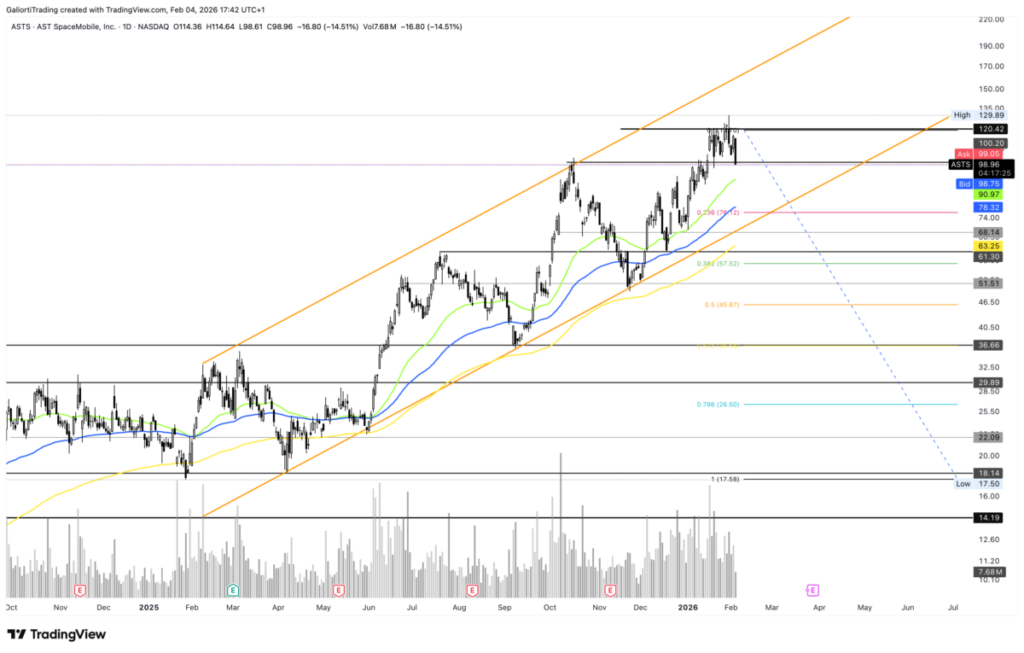
The stochastic indicator remains around 89-90 and has now turned down from overbought territory. For the stock to climb toward the upper part of the channel around $200, this indicator would ideally need to cool off to oversold levels near 40 again. A pullback to $76, a key horizontal support from summer 2025, would provide a stronger technical base for the next leg higher. Below that, the 0.382 Fibonacci retracement at $57.52 and the 0.5 Fibonacci at $45.87 represent deeper correction targets. The weekly moving averages sit much lower, with the 50 WMA at $40.87 and the 100 WMA at $36.66.
That said, if it finds support at $100, this pullback presents a better opportunity to consider buying ASTS than chasing the stock at higher levels. However, should the $100 level break as support, the next levels to watch would be the $76 horizontal support and later the 0.382 Fibonacci at $57.52. The lower channel floor is sliding in the $50-60 range, representing the bearish scenario.
| Level | Price | Significance |
| Upper Channel | ~$200 | Bullish target |
| Recent High | $120.93 | Resistance zone |
| Current Price | $99.12 | Testing gap fill support |
| Horizontal Support | $76 | Secondary support |
| 0.382 Fibonacci | $57.52 | Correction target |
| 0.5 Fibonacci | $45.87 | Deep correction |
| 50/100 WMA Zone | $37-41 | Major support |

Risks to the Thesis
AST SpaceMobile is a moonshot with real risk that investors must consider. The biggest risk is execution. There are several different stages and points in the process of constructing and deploying infrastructure into orbit that could delay the project if one of these launches were to fail. The company set an ambitious goal of 45 to 60 spacecraft by the end of 2026, and has almost no room for errors.
There is also the matter of regulatory risk. The present service is offered under experimental licenses and direct-to-device services have not been fully authorized by the FCC. The business model would be damaged by regulatory resistance or delay. The allocation of frequencies is uncertain and there are still worries about possible interference with land-based mobile networks.
Dilution risk is also present. With 148.5 million shares in August 2024, the total share count has now expanded to about 272 million today, a massive dilution for early investors. The company has an at-the-market equity facility and may require further capital as it expands. Capital-intensive satellite launches could force the company back to market despite reporting more than a billion in cash.
The valuation is in itself a risk. With a trailing price-to-sales ratio over 500 and a forward P/S of approximately 110, any hiccup in execution would result in brutal multiple contraction. Space technology stocks have demonstrated extreme volatility in recent years, and position sizing needs to acknowledge that reality.
Investment Considerations
A bet on AST SpaceMobile is extremely asymmetric: you succeed big or lose hard. The technology appears to work, as voice and data tests were successful. The company has commercial contracts with leading telcos, and the addressable market is huge. Satellite connectivity is a rare service that people can use directly on their existing cellphones. First-mover advantages in this market could be long lasting.
But at the current valuation there is very little margin of safety. Investors are paying for execution that has yet to be delivered. Starlink’s threat is real and expanding. Regulatory approval is not assured. The company is years from being profitable, and potential dilution remains a concern.
For speculative investors, technical signals indicate it would be best to wait for a pullback toward support at $76 before taking a position. That area would offer a more favorable entry with better risk-reward. Delivering according to the Q1 2026 launch milestones is extremely important if the company’s ambitious timeline is to be met. Any delays would likely damage the stock significantly.
The company is scheduled to release its next earnings report on March 27, 2026. The shares remain incredibly speculative until execution milestones go live and commercial scaling of revenue materializes, so position sizing is key.
Benzinga Disclaimer: This article is from an unpaid external contributor. It does not represent Benzinga’s reporting and has not been edited for content or accuracy.