

Atkore Stock And Other U.S. Companies That Could Benefit From Canada Tariffs
Atkore Inc ATKR | 0.00 |
Tariffs on Canadian goods have suddenly reshaped a corner of the market, and U.S. manufacturers that already focus on domestic production are now in the spotlight. That shift could redirect demand, alter pricing power, and reward investors who understand which stocks are most exposed to this new trade reality. This article walks through 3 U.S. listed companies linked to the tariff story and explains how each might be affected.
The stocks in the article below are just a starting sample of U.S. listed domestic substitutes. The full screen surfaced 9 more companies with equally compelling tariff related narratives that are not covered here. To go deeper, identify and analyze your own highest conviction ideas straight inside the U.S.-Listed Domestic Substitutes for Tariffed Canadian Consumer & Industrial Goods screener.
Atkore (ATKR)
Atkore is a U.S. based manufacturer of electrical conduit, cable management, and safety and infrastructure products that can slot in as a domestic alternative when tariffs make Canadian industrial and building materials more expensive. Its Electrical segment generates about US$2.1b of revenue, while Safety & Infrastructure adds roughly US$836 million. With most of its sales tied to these domestic oriented product lines and a market cap of about US$3.2b, Atkore provides exposure to tariff driven reshoring themes within a focused industrial business.
Investors watching the tariff story may find Atkore interesting because it already leans heavily on domestically produced conduit and infrastructure components, which can look more attractive when Canadian imports face higher duties and USMCA terms remain unsettled. At the same time, management has flagged pricing pressure in PVC conduit, commodity cost swings, and short order visibility as real risks. In addition, a CEO transition and a US$50 million antitrust settlement add extra moving parts. Prysmian’s agreed all cash acquisition at US$95 per share means this is a stock where tariff support, U.S. electrification demand and corporate change all intersect, leaving more to consider around earnings quality, cash generation, and what the deal ultimately means for existing shareholders.
Atkore’s reshoring story is gaining attention, but the real question is how pricing pressure, the antitrust settlement, and the agreed takeout fit together. Get the full context in the analysis report for Atkore

Lifeway Foods (LWAY)
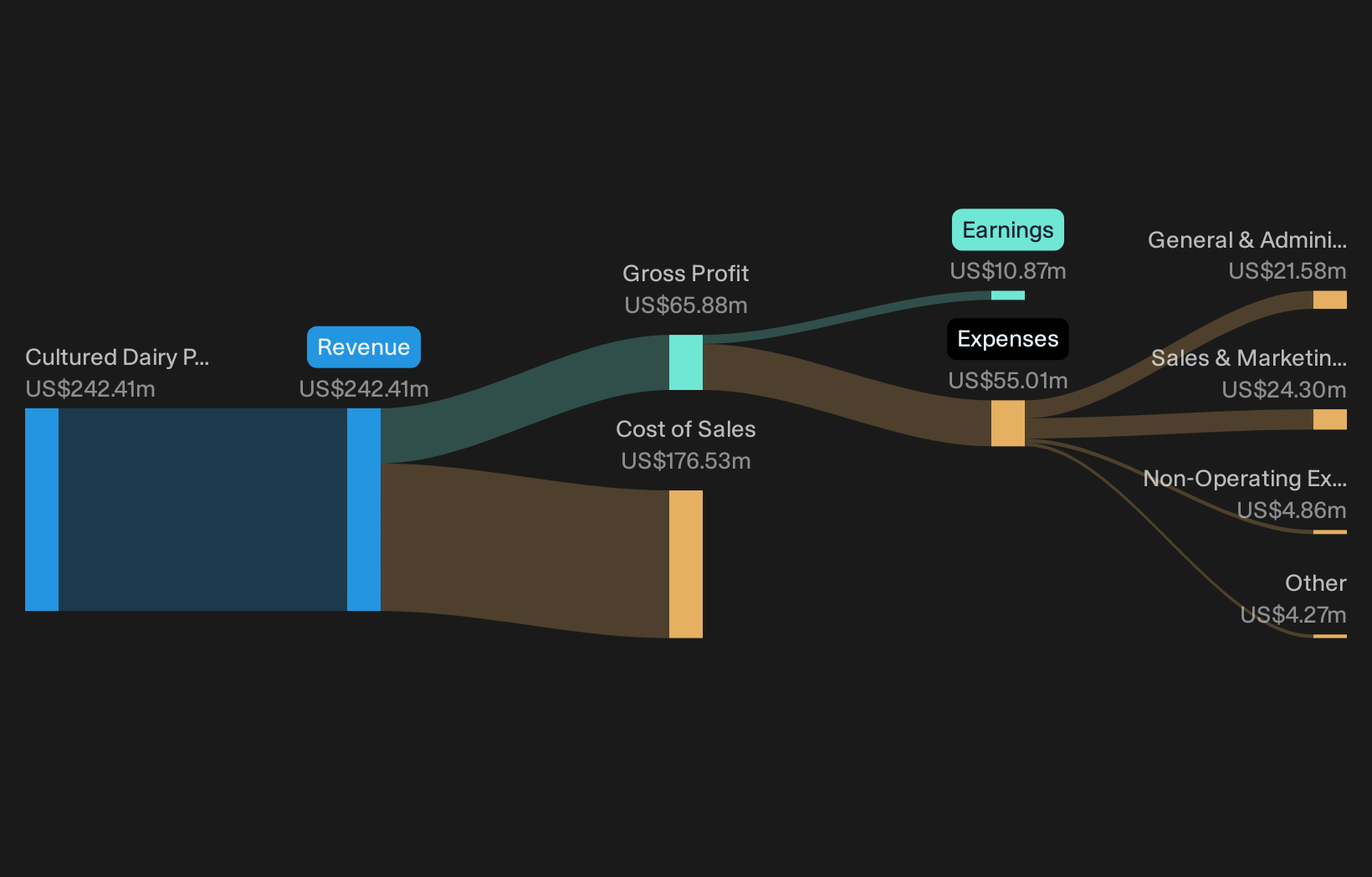
Lifeway Foods is a U.S. based producer of probiotic dairy drinks and cultured products that can act as a domestic substitute for tariffed Canadian dairy imports. The company generates about US$242 million in revenue from cultured dairy products such as kefir, farmer cheese and drinkable yogurt, with all reported sales in the United States. With a market cap of roughly US$400 million, Lifeway is a small but focused player in refrigerated functional dairy.
Lifeway Foods provides exposure to two notable forces at the same time: consumer interest in gut health that is supporting its kefir and cultured dairy range, and the potential for new tariffs on Canadian dairy imports to shift more demand toward U.S. produced products. The story is not risk free. Profit margins have recently come under pressure, insider selling has raised questions, and the business is still heavily dependent on dairy inputs and a relatively narrow product set. For investors, the central question is whether the growth, potential tariff tailwind and brand strength are enough to offset earnings quality concerns and governance questions over the next few years.
Lifeway Foods sits at the crossroads of gut health demand and tariff driven dairy shifts. Yet the real story may be how its earnings quality and governance questions stack up against that potential in the analysis report for Lifeway Foods
Utz Brands (UTZ)
Utz Brands is a U.S. based snack company that manufactures potato chips, tortilla chips, pretzels, pork skins, popcorn and related salty snacks that can act as domestic substitutes when Canadian food imports face higher tariffs. The business generates about US$1.5b in revenue from manufacturing, distributing, marketing and selling snack food products, with all reported sales in the United States, and has a market cap of roughly US$2.0b.
For investors watching tariff driven substitution, Utz Brands offers a pure play on U.S. made salty snacks as retailers weigh domestic options over higher cost Canadian imports. The company is focusing on geographic expansion, premium brands such as Boulder Canyon, and supply chain efficiency. At the same time, it is currently loss making and has recently reported profit pressure and leadership changes, which add execution risk. With an agreed going private deal on the table and questions around organic growth, the key consideration is whether the mix of better for you products, margin potential and domestic production can outweigh those concerns at today’s price.
Utz Brands could have an underappreciated salty snacks story, with domestic production and better for you brands potentially masking a deeper earnings and balance sheet twist in the analysis report for Utz Brands

Seeking Fresh Alternatives Beyond Tariff Plays
Tariff stories move quickly and fresh ideas can start breaking out before most investors even notice. Do not get caught chasing momentum after it is flying. Consider acting early instead of waiting to respond.
- Identify resilient cash generators before they hit everyone’s radar by scanning the list of solid balance sheet and fundamentals (50 results) that focuses on robust finances while it still really matters.
- Explore structural trends in automation and efficiency by reviewing the curated 38 robotics and automation stocks where leaders could develop momentum before the broader market reacts.
- Evaluate potential infrastructure-related opportunities by checking the hand picked 38 power grid technology and infrastructure stocks while these ideas are still mostly under the radar.
This article by Simply Wall St is general in nature. We provide commentary based on historical data and analyst forecasts only using an unbiased methodology and our articles are not intended to be financial advice. It does not constitute a recommendation to buy or sell any stock, and does not take account of your objectives, or your financial situation. We aim to bring you long-term focused analysis driven by fundamental data. Note that our analysis may not factor in the latest price-sensitive company announcements or qualitative material. Simply Wall St has no position in any stocks mentioned.