

Atlassian (TEAM) Is Up 7.9% After Index Shift Highlights Its AI-Driven Cloud Momentum
Atlassian TEAM | 0.00 |
- In late June 2026, Atlassian Corporation was moved out of the Russell Top 200 and Russell Top 200 Growth indices and added to the Russell Midcap and Russell Midcap Growth benchmarks, reflecting a shift in how the company is classified within US equity indices.
- This reshuffle comes as Atlassian reports reaccelerating revenue and cloud growth, supported by expanding AI-driven annual recurring revenue and stronger enterprise adoption of its platform.
- With Atlassian’s AI-enhanced cloud momentum now clearer, we’ll examine how this index reclassification shapes the company’s broader investment narrative.
This technology could replace computers: discover 27 stocks that are working to make quantum computing a reality.
Atlassian Investment Narrative Recap
To own Atlassian, you need to believe its cloud and AI platform can translate strong usage into durable, high‑quality recurring revenue, even as the company remains unprofitable today. The recent shift from Russell Top 200 into Russell Midcap indices does not materially change the core near term catalyst, which is the pace and profitability of cloud and AI adoption, but it does sit against the key risk that complex enterprise cloud migrations and aggressive AI investment may not convert efficiently into earnings.
The most relevant recent announcement here is Atlassian’s Q3 FY2026 result, which showed revenue of US$1,786.97 million, up from US$1,356.72 million a year earlier, and highlighted faster growth from customers using its Rovo AI platform. That operational backdrop helps frame the index reclassification as more about where Atlassian sits in the market hierarchy than about a change in its business trajectory, while keeping the focus squarely on whether cloud and AI initiatives ultimately support margin improvement.
Yet despite this renewed AI driven cloud momentum, investors should be aware that...
Atlassian's narrative projects $9.5 billion revenue and $569.4 million earnings by 2029. This requires 15.3% yearly revenue growth and about a $786.2 million earnings increase from -$216.8 million today.
Uncover how Atlassian's forecasts yield a $140.37 fair value, a 64% upside to its current price.
Exploring Other Perspectives
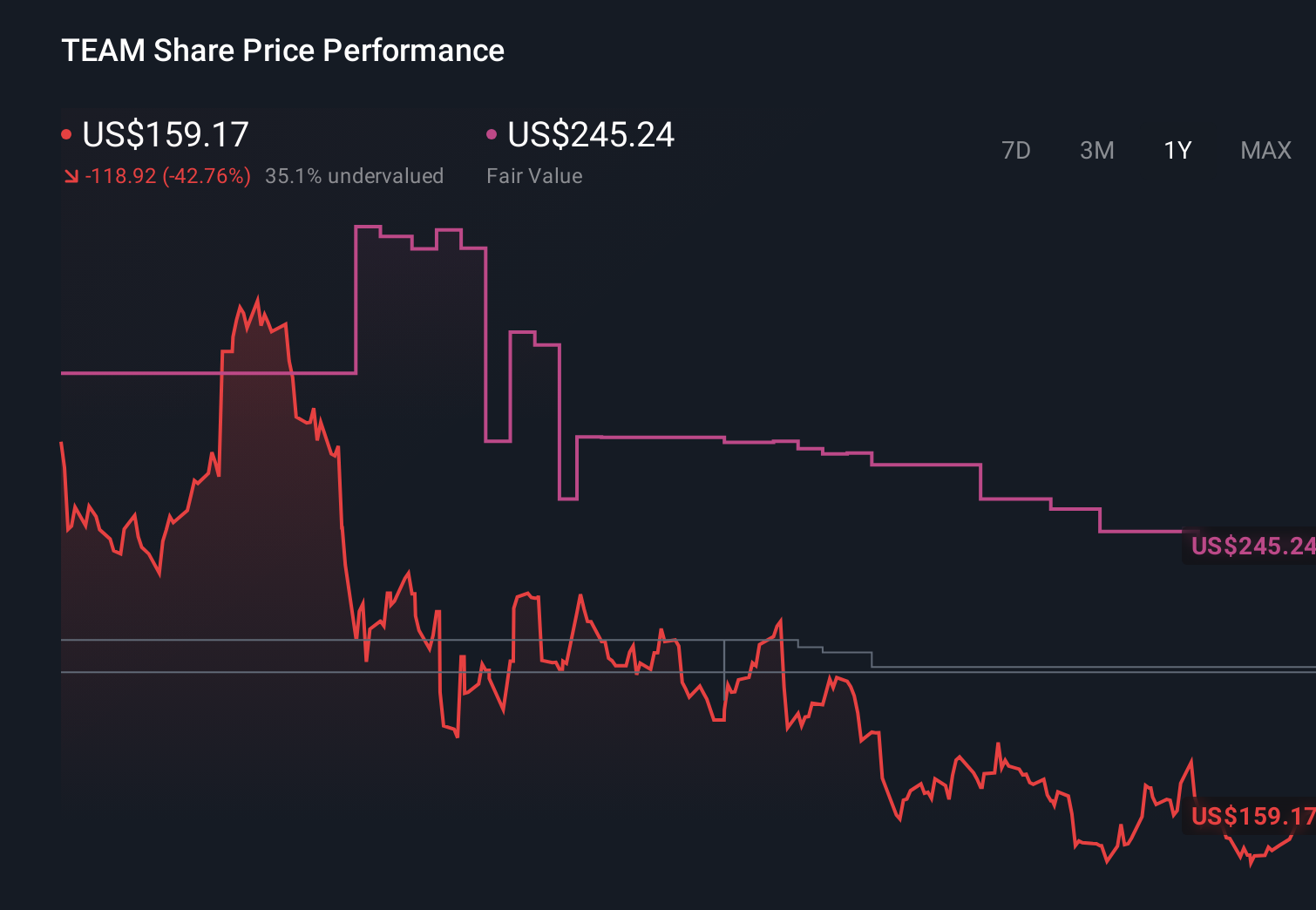
Some of the lowest ranked analysts paint a far more cautious picture, assuming about 13 percent annual revenue growth and no profit by 2029, which may look very different once this index shift and AI driven reacceleration are fully reflected in updated views.
Explore 11 other fair value estimates on Atlassian - why the stock might be worth just $83.41!
Decide For Yourself
Disagree with existing narratives? Extraordinary investment returns rarely come from following the herd, so go with your instincts.
- A great starting point for your Atlassian research is our analysis highlighting 3 key rewards and 2 important warning signs that could impact your investment decision.
- Our free Atlassian research report provides a comprehensive fundamental analysis summarized in a single visual - the Snowflake - making it easy to evaluate Atlassian's overall financial health at a glance.
Want Some Alternatives?
Early movers are already taking notice. See the stocks they're targeting before they've flown the coop:
- Invest in the nuclear renaissance through our list of 89 elite nuclear energy infrastructure plays powering the global AI revolution.
- The best AI stocks today may lie beyond giants like Nvidia and Microsoft. Find the next big opportunity with these 15 smaller AI-focused companies with strong growth potential through early-stage innovation in machine learning, automation, and data intelligence that could fund your retirement.
- Uncover the next big thing with 20 elite penny stocks that balance risk and reward.
This article by Simply Wall St is general in nature. We provide commentary based on historical data and analyst forecasts only using an unbiased methodology and our articles are not intended to be financial advice. It does not constitute a recommendation to buy or sell any stock, and does not take account of your objectives, or your financial situation. We aim to bring you long-term focused analysis driven by fundamental data. Note that our analysis may not factor in the latest price-sensitive company announcements or qualitative material. Simply Wall St has no position in any stocks mentioned.