

Baidu (BIDU) Stock Looks Cheap On Sales But Mixed On Broader Checks
Baidu, Inc. Sponsored ADR Class A BIDU | 0.00 |
Baidu stock has delivered a decline of 36.8% over the past five years, yet current valuation checks do not clearly mark it out as a bargain. Recent news around a planned dual primary listing in Hong Kong and an artificial intelligence partnership in China has put Baidu back in focus for investors trying to square the long term share price record with today’s valuation signals.
- The share price is down 36.8% over five years, which raises questions about how much long term pessimism is already reflected in Baidu’s valuation.
- The planned shift to a dual primary Hong Kong listing and the reported Apple related AI partnership can support interest in the stock. However, any disappointment on execution or regulatory approvals may weigh on how investors price Baidu’s future cash flows.
- Baidu currently passes only 2 of 6 valuation checks, which points to a company that screens as undervalued on some simple multiples but does not look like a clear across the board bargain.
For investors, the debate is whether Baidu’s mixed valuation picture after a weak five year share price record leaves enough upside potential to justify the risks now in the price.
Does Baidu Look Undervalued on Sales?
The P/S multiple is often a useful way to look at Baidu because it focuses on what investors are paying for each unit of revenue rather than volatile earnings.
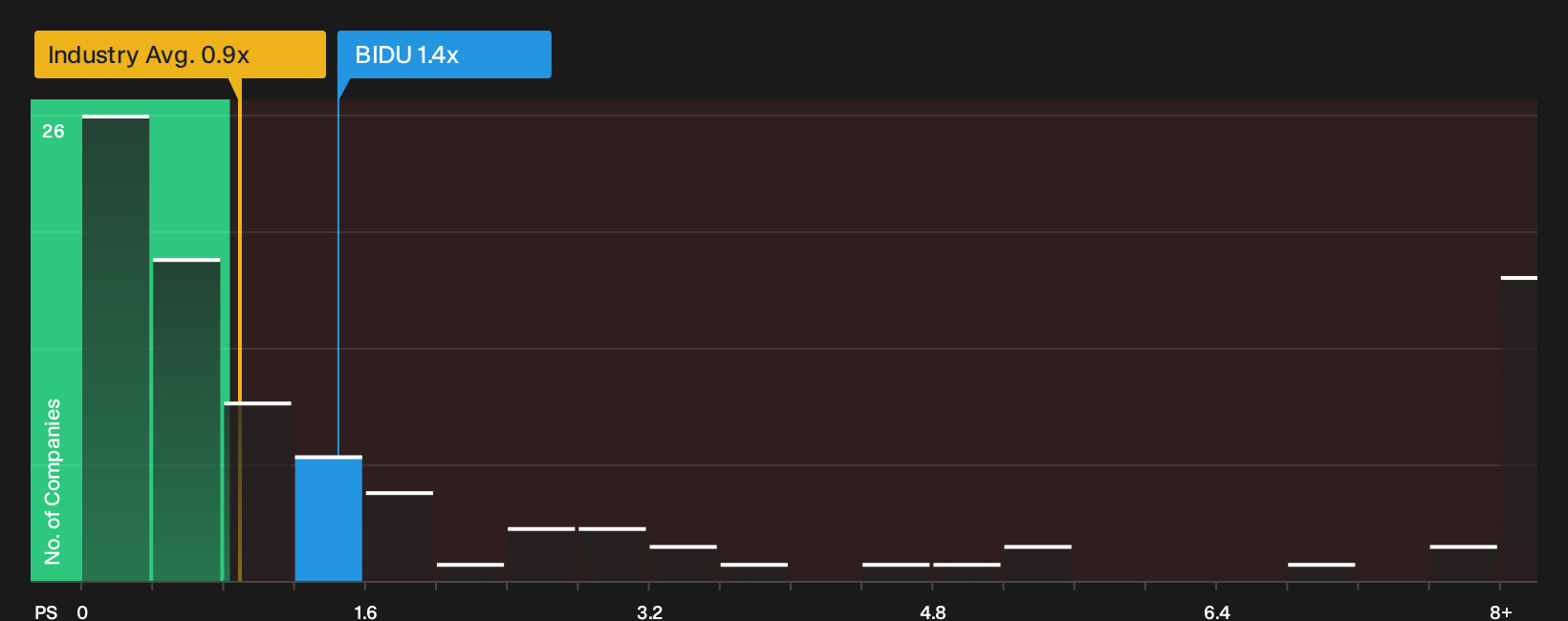
Baidu trades on a P/S ratio of 1.9x. This is higher than the Interactive Media and Services industry average of about 0.9x, but lower than the peer group average of 5.2x. On Simply Wall St’s blended “fair” P/S ratio of 2.2x, which adjusts for factors such as growth profile, margins, size and risk, Baidu’s current multiple sits at a discount to the level indicated by this framework.
Despite the recent interest around Baidu’s reported Apple related AI partnership in China, the market is still pricing the stock below this modelled fair P/S level. For investors, that suggests some caution in the current price, but also potential for sentiment to narrow part of that gap if the revenue story holds together.
On the P/S multiple, Baidu stock currently appears undervalued relative to the level suggested by this fair value framework.
The Baidu Narrative: What Would Justify Today's Price?
Simply Wall St Narratives pick up where Baidu's valuation puzzle leaves off. They spell out which combinations of future growth, margins and earnings would need to play out for Baidu to be worth materially more or less than the current share price, and they sit on Simply Wall St's Community page. Each one presents fair value as a thesis about Baidu's business that you can revisit over time, rather than as a single static number.
One of the top community narratives on Baidu: 40% undervalued
"Baidu's leadership in foundation models (ERNIE) and proprietary AI architectures provides a competitive edge, especially as integration with products like search, digital human live-streaming, and cloud applications generates new commercial opportunities..."
Do you think there's more to the story for Baidu? Head over to our Community to see what others are saying!
The Bottom Line
Baidu screens as undervalued on its sales multiple, yet broader valuation checks look weak, so the stock does not show up as a straightforward bargain. The key question is whether the current discount reflects excessive caution or fairly prices the execution and regulatory risks around its AI and Hong Kong listing plans. For you as an investor, the crux is whether Baidu can sustain a revenue profile that eventually supports a higher multiple rather than the market being right that the discount belongs there.
This article by Simply Wall St is general in nature. We provide commentary based on historical data and analyst forecasts only using an unbiased methodology and our articles are not intended to be financial advice. It does not constitute a recommendation to buy or sell any stock, and does not take account of your objectives, or your financial situation. We aim to bring you long-term focused analysis driven by fundamental data. Note that our analysis may not factor in the latest price-sensitive company announcements or qualitative material. Simply Wall St has no position in any stocks mentioned.