

Bank First (BFC) Reports Strong Q2 Results, Is The Valuation Now Too Rich?
Bank First Corp BFC | 0.00 |
Bank First (BFC) is in focus after releasing second quarter results, reporting net interest income of US$55.03 million and net income of US$24.69 million, alongside an active share repurchase program.
At a share price of US$147.39, Bank First has delivered a 22.18% year to date share price return, while its 5 year total shareholder return of 135.11% points to sustained investor interest despite short term swings around recent earnings and buyback news.
If Bank First’s results have you thinking about what else might be moving, this could be a good moment to check out 17 top founder-led companies
After Bank First’s strong year to date run and solid recent earnings, the real tension now is whether most of the share price gains are already behind it or if current fundamentals still leave meaningful upside ahead.
Price-to-Earnings of 20.2x: Is it justified?
Bank First is trading on a P/E of 20.2x, which sits above both its peers and the wider US banks sector, while the last close was $147.39.
The P/E ratio compares the share price with earnings per share, so a higher multiple usually reflects investors paying more today for each dollar of current earnings.
For Bank First, the data points in two directions. On one side, the stock looks expensive versus peers and the broader US banks industry, which sit at 14.3x and 12.1x respectively. On the other side, the estimated fair P/E of 21x suggests the current multiple is not far from a level the market could gravitate towards if the company continues to deliver against expectations.
In other words, while Bank First trades at a premium to sector averages, its current P/E is close to that estimated fair ratio level. This frames the premium less as an outlier and more as a valuation the market could reasonably converge on if the growth story plays out.
Result: Price-to-Earnings of 20.2x (ABOUT RIGHT)
However, Bank First’s premium P/E and strong 1 year and 5 year total returns also mean expectations are elevated. As a result, any earnings disappointment or credit quality issues could quickly challenge the recent share price strength.
Another View: What Our DCF Says About Bank First
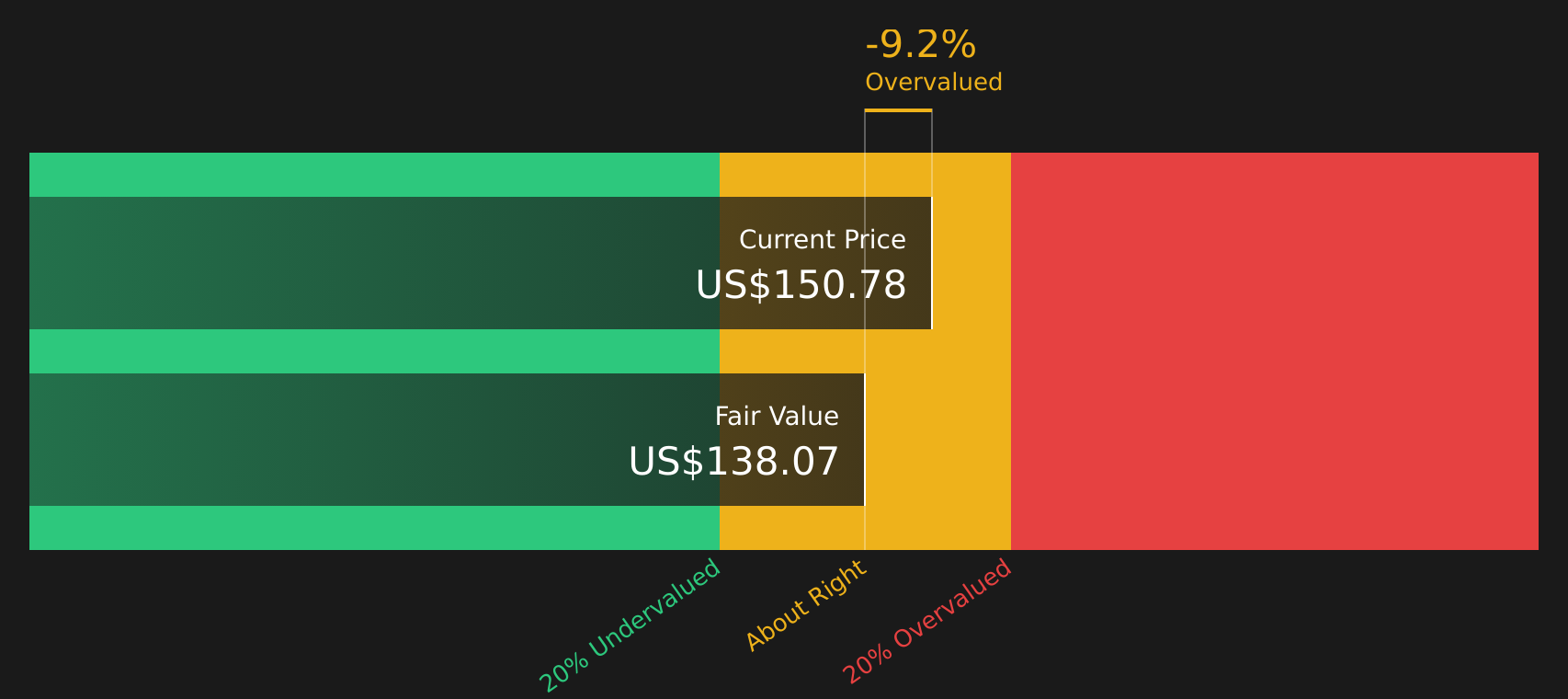
The P/E story suggests Bank First is roughly in line with its fair ratio, but the SWS DCF model offers a different angle. On that basis, the stock at $147.39 sits above an estimated value of $138.07, which points to a degree of overvaluation. For you, the question is whether the earnings outlook supports paying that extra premium.
Simply Wall St performs a discounted cash flow (DCF) on every stock in the world every day (check out Bank First for example). We show the entire calculation in full. You can track the result in your watchlist or portfolio and be alerted when this changes, or use our stock screener to discover 38 high quality undervalued stocks. If you save a screener we even alert you when new companies match - so you never miss a potential opportunity.
Next Steps
The mixed signals on Bank First’s valuation and recent strength suggest that sentiment is clearly divided. Act while the data is fresh and shape your own view by reviewing the 3 key rewards.
Looking for more investment ideas beyond Bank First?
If Bank First has sharpened your focus, do not stop there. Use the Simply Wall St Screener to surface other stocks that might suit your goals and risk comfort.
- Spot potential bargains early by checking companies highlighted in the 38 high quality undervalued stocks before the crowd pays closer attention.
- Prioritise resilience by reviewing opportunities in the 79 resilient stocks with low risk scores where financial risk scores are comparatively restrained.
- Hunt for less crowded opportunities by scanning the screener containing 20 high quality undiscovered gems that pair solid fundamentals with lower market attention.
This article by Simply Wall St is general in nature. We provide commentary based on historical data and analyst forecasts only using an unbiased methodology and our articles are not intended to be financial advice. It does not constitute a recommendation to buy or sell any stock, and does not take account of your objectives, or your financial situation. We aim to bring you long-term focused analysis driven by fundamental data. Note that our analysis may not factor in the latest price-sensitive company announcements or qualitative material. Simply Wall St has no position in any stocks mentioned.