

Bank of America (BAC) Stock Still Looks Undervalued As Earnings And Fair Value Align
Bank of America Corp BAC | 0.00 |
Bank of America stock has delivered a strong 3 year run, but current valuation checks still suggest investors are not paying full price for its earnings power. Both an Excess Returns intrinsic value estimate and earnings multiples point to the stock trading at a discount to what the underlying business may justify.
- Bank of America has returned 131.0% over the past 3 years. This puts the recent pullback over the last week in the context of a much stronger multi year move.
- Debate over the Federal Reserve's proposed changes to GSIB capital surcharges can influence how much capital Bank of America holds against risk. Regulatory and legal headlines such as the SEC's action against a former banker also highlight ongoing conduct and compliance risk that could affect investor confidence.
- On Simply Wall St’s broader checks, Bank of America carries a mixed valuation profile overall, with a value score of 3 that sits between a clear bargain and a clear premium.
The issue now is whether Bank of America's current discount to intrinsic value can persist after a strong multi year share price gain.
Scan 51 high quality undervalued stocks that, like Bank of America, combine strong multi year returns with valuation signals that still point to a discount on current fundamentals.
Is Bank of America Still Cheap on Excess Returns?
The Excess Returns model evaluates how much profit Bank of America generates over and above the required return on its equity base. For Bank of America, the inputs describe a bank with solid profitability relative to its book value rather than one relying on aggressive growth assumptions.
The model uses a Book Value of $39.34 per share and a Stable EPS of $5.50 per share, with that earnings figure grounded in future Return on Equity estimates from 13 analysts. Against a Cost of Equity of $3.48 per share, this implies an Excess Return of $2.02 per share and an Average Return on Equity of 12.70%. Stable Book Value is set at $43.31 per share, again sourced from analyst estimates. These cash-flow-like excess returns translate into an intrinsic value estimate of $89.89 per share, which compares to a current price that implies the stock is 30.8% undervalued. The ongoing debate over higher GSIB capital surcharges helps explain why the market might still price Bank of America below what this model suggests.
On these Excess Returns assumptions, Bank of America stock appears undervalued relative to the earnings power implied by its equity base.
Our Excess Returns analysis suggests Bank of America is undervalued by 30.8%. Track this in your watchlist or portfolio, or discover 51 more high quality undervalued stocks.

Does Bank of America Look Undervalued on Earnings?
P/E is the most common way investors look at mature banks like Bank of America, because earnings tend to be the main driver of long term value for these businesses.
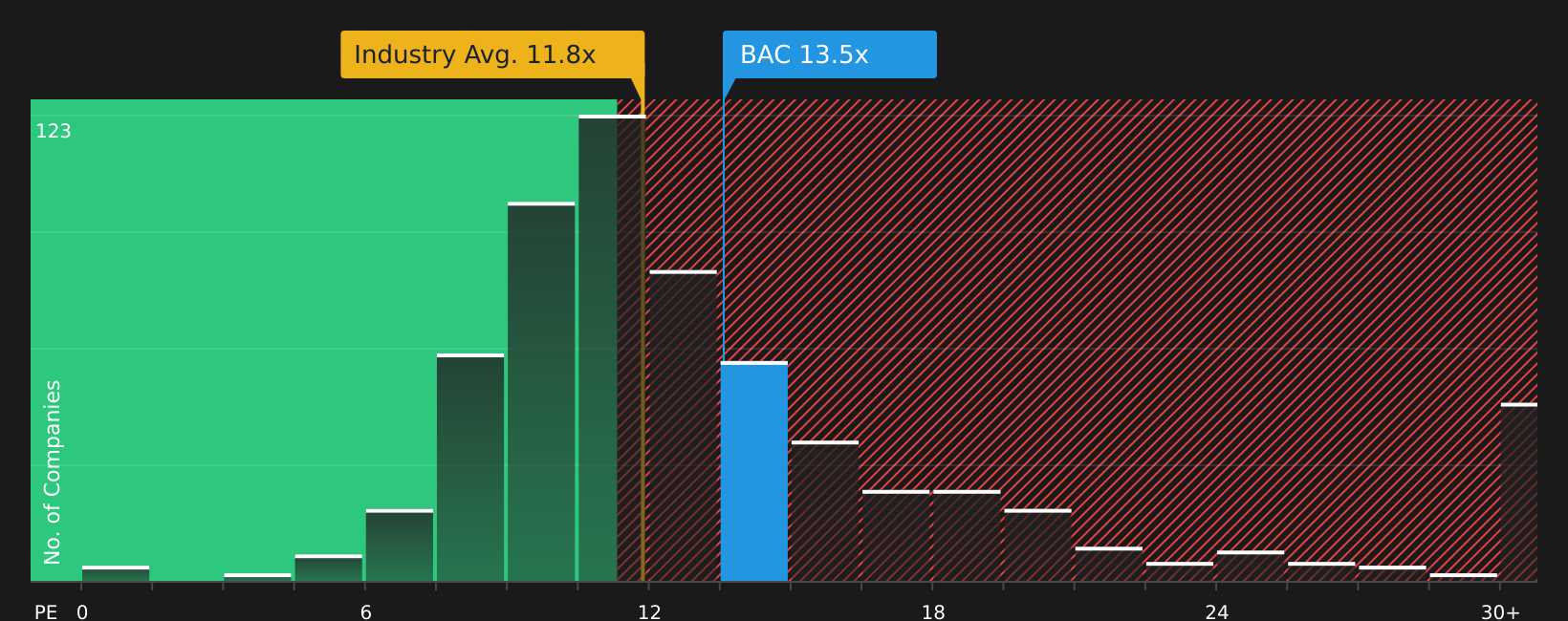
Bank of America currently trades on a P/E of 13.5x. That is close to the peer average of 13.5x and above the broader banks industry average of 11.8x. On Simply Wall St’s model, which looks at factors such as profitability, risk and size to infer a tailored “fair” P/E, Bank of America is assigned a fair ratio of 15.8x. The gap between this and the current 13.5x suggests the stock trades below what this framework implies for its earnings profile.
This points to a market price that does not fully reflect the earnings power implied by the Excess Returns model, even after a strong multi year share move.
On the P/E multiple, Bank of America stock appears undervalued relative to the earnings level this framework suggests could justify a higher ratio.
The Bank of America Narrative: What Would Justify Today's Price?
Simply Wall St Narratives pick up where this Bank of America valuation puzzle leaves off by spelling out which growth, margin and earnings paths would need to hold for the stock to be worth materially more or less than today's price, and they sit within the Community page. Rather than relying on a single multiple or model output, each narrative lays out the assumptions behind its view of fair value so you can compare them with future results as they are reported.
Share a Narrative on Bank of America in the Simply Wall St community to lay out a clear, number driven view on whether today’s price reflects the impact of regulatory debates on GSIB capital surcharges and recent conduct headlines. Add your voice now so you can track how your thesis holds up as new results and regulatory decisions come through.
Do you think there's more to the story for Bank of America? Head over to our Community to see what others are saying!
The Bottom Line
For Bank of America, both the Excess Returns intrinsic value estimate and the P/E based view currently lean toward the same conclusion that the stock screens as undervalued on the supplied assumptions. Broader checks are mixed rather than emphatic, so the gap between intrinsic value and market price is not a one way signal.
What really decides things from here is whether that discount reflects temporary caution around capital rules and conduct risk or a more durable ceiling on the multiple investors are willing to pay. The core question is whether the current valuation gap proves to be a value trap or a lasting opportunity in Bank of America.
This article by Simply Wall St is general in nature. We provide commentary based on historical data and analyst forecasts only using an unbiased methodology and our articles are not intended to be financial advice. It does not constitute a recommendation to buy or sell any stock, and does not take account of your objectives, or your financial situation. We aim to bring you long-term focused analysis driven by fundamental data. Note that our analysis may not factor in the latest price-sensitive company announcements or qualitative material. Simply Wall St has no position in any stocks mentioned.